President Donald Trump successfully rallied House Republicans back into line Tuesday night after personally meeting with GOP holdouts who had blocked major crypto legislation earlier in the day. The late-evening intervention secured commitments from 11 of the 12 Republicans needed to advance the stablecoin-focused GENIUS Act and companion crypto bills. Trump Steps Up After Unexpected Defeat The House voted 196-223 against a procedural rule Tuesday during “Crypto Week” that would have allowed the GENIUS Act, the CLARITY Act, and the Anti-CBDC Surveillance State Act to advance to floor debate. The unexpected defeat threatened to derail the administration’s push for comprehensive digital asset legislation. Trump wrote on Truth Social. Many Republicans who voted against the bills expressed concerns that the GENIUS Act could enable a central bank digital currency despite language explicitly prohibiting the Federal Reserve from creating one. The bill states it “shall not be construed as expanding the Fed’s authority to offer services directly to the public.” The turnaround came after months of bipartisan work on the GENIUS Act, which passed the Senate 68-30 in June with 18 Democrats joining most Republicans. The legislation requires stablecoin issuers to maintain full dollar backing and establishes clear federal oversight frameworks. Republican Revolt Nearly Derails Crypto Legislation Thirteen Republicans initially voted against the procedural rule, citing fears about potential CBDC authorization. The “no” votes included prominent conservatives such as Reps. Marjorie Taylor Greene (Ga.), Chip Roy (Texas), and Andy Biggs (Ariz.). “ I just voted NO on the Rule for the GENIUS Act because it does not include a ban on Central Bank Digital Currency and because Speaker Johnson did not allow us to submit amendments, ” Rep. Greene wrote on X. The revolt occurred despite House Republicans’ strategy to advance the Senate version without amendments, thereby expediting the bill’s arrival at Trump’s desk. This approach was designed to deliver the first major crypto legislation to clear both chambers of Congress. Speaker Mike Johnson participated in Tuesday’s Oval Office meeting via telephone and committed to scheduling the re-vote as early as possible Wednesday morning. 🚨NOTICE OF ACTION🚨 The Committee granted, by a recorded vote of 8-4, a rule providing for consideration of H.R. 4016, H.R. 3633, H.R. 1919, and S. 1582. Thanks to @HouseAppropsGOP , @FinancialCmte , and @HouseAgGOP for their testimony tonight. pic.twitter.com/oAqzRkXVRa — House Rules Committee (@RulesReps) July 15, 2025 The Committee on Rules had granted an 8-4 vote providing consideration for the crypto bills following testimony from key House committees. Rep. Warren Davidson, a Republican who generally supports crypto policy, opposed the GENIUS Act strategy , calling the decision to separate the bills “designed to ultimately fail.” However, Financial Services Chair French Hill defended the approach, stating the bills “will protect investors, consumers, and make America a leader in financial technology.” Even Congressman Tim Moore has voiced his support on X in a post he made a few hours ago. Congress has a real opportunity to ensure America leads on crypto. The House must pass the CLARITY Act, the GENIUS Act, and the Anti-CBDC Surveillance State Act to protect innovation, privacy, and the future of the U.S. dollar. pic.twitter.com/dZsRMh40fT — Congressman Tim Moore (@RepTimMooreNC) July 15, 2025 The GENIUS Act would establish federal licensing requirements for stablecoin issuers and mandate full backing with U.S. dollars or equivalent liquid assets. Consumer protections are included for bankruptcy scenarios, with stablecoin holders receiving priority payments. Treasury Chief Champions Stablecoins as Dollar Reinforcement Tool Treasury Secretary Scott Bessent has become one of the key advocates for the GENIUS Act, declaring that stablecoins can “reinforce dollar supremacy” rather than threaten U.S. monetary dominance. His comments directly address European concerns about American digital asset policies. Crypto is not a threat to the dollar. In fact, stablecoins can reinforce dollar supremacy. Digital assets are one of the most important phenomena in the world right now, yet they have been ignored by national governments for far too long. This administration is committed to… pic.twitter.com/vWsLgYyNW7 — Treasury Secretary Scott Bessent (@SecScottBessent) June 18, 2025 The Treasury chief characterized crypto as “one of the most important phenomena in the world right now “ while criticizing how digital assets have been “ignored by national governments for far too long.” His embrace contrasts sharply with growing European resistance to U.S. stablecoin expansion. Italian Economy Minister Giancarlo Giorgetti warned that U.S. stablecoin policies could pose a “more dangerous impact on the euro than trade tariffs.” European officials fear dollar-denominated stablecoins could undermine monetary sovereignty by offering Europeans alternative payment methods that bypass local financial institutions. The stablecoin market has grown from under $10 billion to $239 billion in five years, with 98% of stablecoins pegged to the dollar and 80% of transactions occurring outside the United States. This expansion has prompted the European Central Bank to accelerate its digital euro project , though implementation remains years away. In light of the near-conclusion of the political drama surrounding the GENIUS Act, Federal banking regulators issued guidance on Monday, clarifying that banks can provide cryptocurrency custody services in both fiduciary and non-fiduciary arrangements. The joint statement from the Federal Reserve, FDIC, and OCC emphasized existing risk-management protocols while removing previous restrictions on crypto business engagement.President Donald Trump successfully rallied House Republicans back into line Tuesday night after personally meeting with GOP holdouts who had blocked major crypto legislation earlier in the day. The late-evening intervention secured commitments from 11 of the 12 Republicans needed to advance the stablecoin-focused GENIUS Act and companion crypto bills. Trump Steps Up After Unexpected Defeat The House voted 196-223 against a procedural rule Tuesday during “Crypto Week” that would have allowed the GENIUS Act, the CLARITY Act, and the Anti-CBDC Surveillance State Act to advance to floor debate. The unexpected defeat threatened to derail the administration’s push for comprehensive digital asset legislation. Trump wrote on Truth Social. Many Republicans who voted against the bills expressed concerns that the GENIUS Act could enable a central bank digital currency despite language explicitly prohibiting the Federal Reserve from creating one. The bill states it “shall not be construed as expanding the Fed’s authority to offer services directly to the public.” The turnaround came after months of bipartisan work on the GENIUS Act, which passed the Senate 68-30 in June with 18 Democrats joining most Republicans. The legislation requires stablecoin issuers to maintain full dollar backing and establishes clear federal oversight frameworks. Republican Revolt Nearly Derails Crypto Legislation Thirteen Republicans initially voted against the procedural rule, citing fears about potential CBDC authorization. The “no” votes included prominent conservatives such as Reps. Marjorie Taylor Greene (Ga.), Chip Roy (Texas), and Andy Biggs (Ariz.). “ I just voted NO on the Rule for the GENIUS Act because it does not include a ban on Central Bank Digital Currency and because Speaker Johnson did not allow us to submit amendments, ” Rep. Greene wrote on X. The revolt occurred despite House Republicans’ strategy to advance the Senate version without amendments, thereby expediting the bill’s arrival at Trump’s desk. This approach was designed to deliver the first major crypto legislation to clear both chambers of Congress. Speaker Mike Johnson participated in Tuesday’s Oval Office meeting via telephone and committed to scheduling the re-vote as early as possible Wednesday morning. 🚨NOTICE OF ACTION🚨 The Committee granted, by a recorded vote of 8-4, a rule providing for consideration of H.R. 4016, H.R. 3633, H.R. 1919, and S. 1582. Thanks to @HouseAppropsGOP , @FinancialCmte , and @HouseAgGOP for their testimony tonight. pic.twitter.com/oAqzRkXVRa — House Rules Committee (@RulesReps) July 15, 2025 The Committee on Rules had granted an 8-4 vote providing consideration for the crypto bills following testimony from key House committees. Rep. Warren Davidson, a Republican who generally supports crypto policy, opposed the GENIUS Act strategy , calling the decision to separate the bills “designed to ultimately fail.” However, Financial Services Chair French Hill defended the approach, stating the bills “will protect investors, consumers, and make America a leader in financial technology.” Even Congressman Tim Moore has voiced his support on X in a post he made a few hours ago. Congress has a real opportunity to ensure America leads on crypto. The House must pass the CLARITY Act, the GENIUS Act, and the Anti-CBDC Surveillance State Act to protect innovation, privacy, and the future of the U.S. dollar. pic.twitter.com/dZsRMh40fT — Congressman Tim Moore (@RepTimMooreNC) July 15, 2025 The GENIUS Act would establish federal licensing requirements for stablecoin issuers and mandate full backing with U.S. dollars or equivalent liquid assets. Consumer protections are included for bankruptcy scenarios, with stablecoin holders receiving priority payments. Treasury Chief Champions Stablecoins as Dollar Reinforcement Tool Treasury Secretary Scott Bessent has become one of the key advocates for the GENIUS Act, declaring that stablecoins can “reinforce dollar supremacy” rather than threaten U.S. monetary dominance. His comments directly address European concerns about American digital asset policies. Crypto is not a threat to the dollar. In fact, stablecoins can reinforce dollar supremacy. Digital assets are one of the most important phenomena in the world right now, yet they have been ignored by national governments for far too long. This administration is committed to… pic.twitter.com/vWsLgYyNW7 — Treasury Secretary Scott Bessent (@SecScottBessent) June 18, 2025 The Treasury chief characterized crypto as “one of the most important phenomena in the world right now “ while criticizing how digital assets have been “ignored by national governments for far too long.” His embrace contrasts sharply with growing European resistance to U.S. stablecoin expansion. Italian Economy Minister Giancarlo Giorgetti warned that U.S. stablecoin policies could pose a “more dangerous impact on the euro than trade tariffs.” European officials fear dollar-denominated stablecoins could undermine monetary sovereignty by offering Europeans alternative payment methods that bypass local financial institutions. The stablecoin market has grown from under $10 billion to $239 billion in five years, with 98% of stablecoins pegged to the dollar and 80% of transactions occurring outside the United States. This expansion has prompted the European Central Bank to accelerate its digital euro project , though implementation remains years away. In light of the near-conclusion of the political drama surrounding the GENIUS Act, Federal banking regulators issued guidance on Monday, clarifying that banks can provide cryptocurrency custody services in both fiduciary and non-fiduciary arrangements. The joint statement from the Federal Reserve, FDIC, and OCC emphasized existing risk-management protocols while removing previous restrictions on crypto business engagement.

Trump Secures 11 GOP Votes for GENIUS Act Following Oval Office Meeting — Vote Expected Tomorrow

President Donald Trump successfully rallied House Republicans back into line Tuesday night after personally meeting with GOP holdouts who had blocked major crypto legislation earlier in the day.

The late-evening intervention secured commitments from 11 of the 12 Republicans needed to advance the stablecoin-focused GENIUS Act and companion crypto bills.

Trump Steps Up After Unexpected Defeat

The House voted 196-223 against a procedural rule Tuesday during “Crypto Week” that would have allowed the GENIUS Act, the CLARITY Act, and the Anti-CBDC Surveillance State Act to advance to floor debate.

The unexpected defeat threatened to derail the administration’s push for comprehensive digital asset legislation.
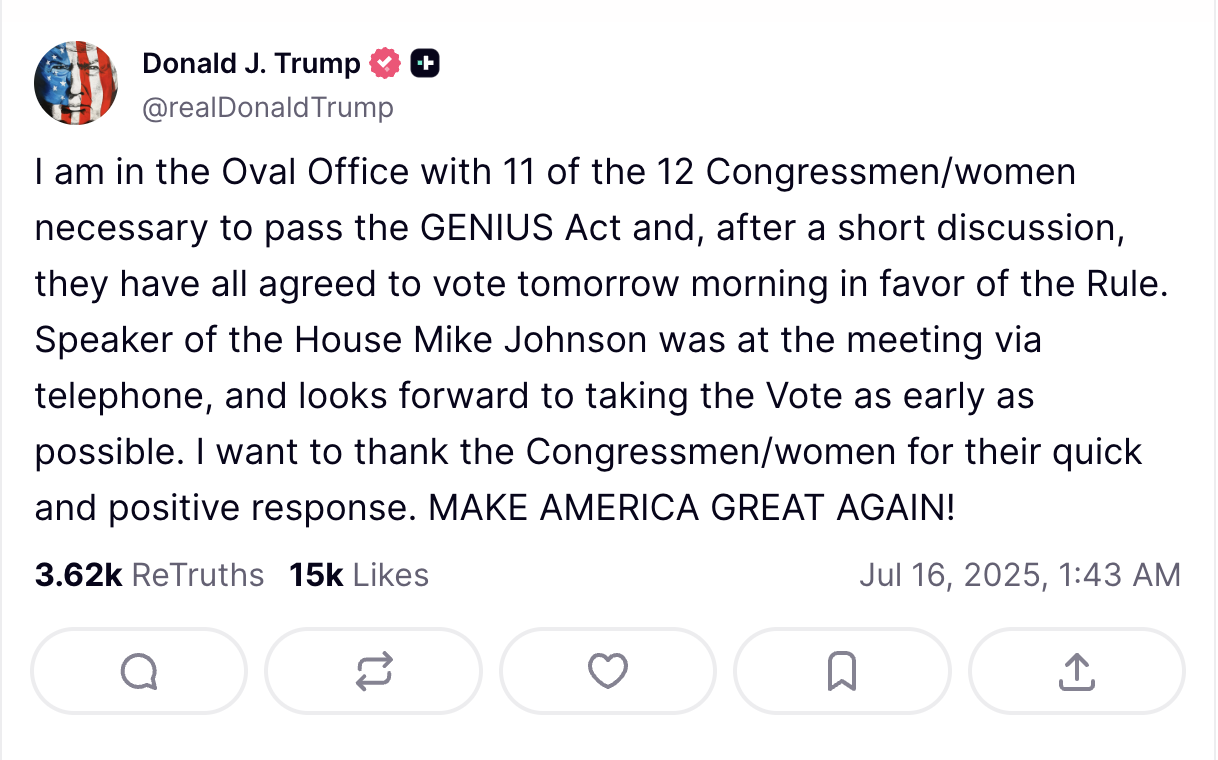
Trump Secures 11 GOP Votes for GENIUS Act Following Oval Office Meeting — Vote Expected TomorrowTrump wrote on Truth Social.

Many Republicans who voted against the bills expressed concerns that the GENIUS Act could enable a central bank digital currency despite language explicitly prohibiting the Federal Reserve from creating one.

The bill states it “shall not be construed as expanding the Fed’s authority to offer services directly to the public.”

The turnaround came after months of bipartisan work on the GENIUS Act, which passed the Senate 68-30 in June with 18 Democrats joining most Republicans.

The legislation requires stablecoin issuers to maintain full dollar backing and establishes clear federal oversight frameworks.

Republican Revolt Nearly Derails Crypto Legislation

Thirteen Republicans initially voted against the procedural rule, citing fears about potential CBDC authorization.

The “no” votes included prominent conservatives such as Reps. Marjorie Taylor Greene (Ga.), Chip Roy (Texas), and Andy Biggs (Ariz.).

I just voted NO on the Rule for the GENIUS Act because it does not include a ban on Central Bank Digital Currency and because Speaker Johnson did not allow us to submit amendments,” Rep. Greene wrote on X.

The revolt occurred despite House Republicans’ strategy to advance the Senate version without amendments, thereby expediting the bill’s arrival at Trump’s desk.

This approach was designed to deliver the first major crypto legislation to clear both chambers of Congress.

Speaker Mike Johnson participated in Tuesday’s Oval Office meeting via telephone and committed to scheduling the re-vote as early as possible Wednesday morning.

The Committee on Rules had granted an 8-4 vote providing consideration for the crypto bills following testimony from key House committees.

Rep. Warren Davidson, a Republican who generally supports crypto policy, opposed the GENIUS Act strategy, calling the decision to separate the bills “designed to ultimately fail.”

However, Financial Services Chair French Hill defended the approach, stating the bills “will protect investors, consumers, and make America a leader in financial technology.”

Even Congressman Tim Moore has voiced his support on X in a post he made a few hours ago.

The GENIUS Act would establish federal licensing requirements for stablecoin issuers and mandate full backing with U.S. dollars or equivalent liquid assets.

Consumer protections are included for bankruptcy scenarios, with stablecoin holders receiving priority payments.

Treasury Chief Champions Stablecoins as Dollar Reinforcement Tool

Treasury Secretary Scott Bessent has become one of the key advocates for the GENIUS Act, declaring that stablecoins can “reinforce dollar supremacy” rather than threaten U.S. monetary dominance.

His comments directly address European concerns about American digital asset policies.

The Treasury chief characterized crypto as “one of the most important phenomena in the world right now while criticizing how digital assets have been “ignored by national governments for far too long.”

His embrace contrasts sharply with growing European resistance to U.S. stablecoin expansion.

Italian Economy Minister Giancarlo Giorgetti warned that U.S. stablecoin policies could pose a “more dangerous impact on the euro than trade tariffs.”

European officials fear dollar-denominated stablecoins could undermine monetary sovereignty by offering Europeans alternative payment methods that bypass local financial institutions.

The stablecoin market has grown from under $10 billion to $239 billion in five years, with 98% of stablecoins pegged to the dollar and 80% of transactions occurring outside the United States.

This expansion has prompted the European Central Bank to accelerate its digital euro project, though implementation remains years away.

In light of the near-conclusion of the political drama surrounding the GENIUS Act, Federal banking regulators issued guidance on Monday, clarifying that banks can provide cryptocurrency custody services in both fiduciary and non-fiduciary arrangements.

The joint statement from the Federal Reserve, FDIC, and OCC emphasized existing risk-management protocols while removing previous restrictions on crypto business engagement.

Piyasa Fırsatı
NEAR Logosu
NEAR Fiyatı(NEAR)
$1.493
$1.493$1.493
-4.23%
USD
NEAR (NEAR) Canlı Fiyat Grafiği
Sorumluluk Reddi: Bu sitede yeniden yayınlanan makaleler, halka açık platformlardan alınmıştır ve yalnızca bilgilendirme amaçlıdır. MEXC'nin görüşlerini yansıtmayabilir. Tüm hakları telif sahiplerine aittir. Herhangi bir içeriğin üçüncü taraf haklarını ihlal ettiğini düşünüyorsanız, kaldırılması için lütfen [email protected] ile iletişime geçin. MEXC, içeriğin doğruluğu, eksiksizliği veya güncelliği konusunda hiçbir garanti vermez ve sağlanan bilgilere dayalı olarak alınan herhangi bir eylemden sorumlu değildir. İçerik, finansal, yasal veya diğer profesyonel tavsiye niteliğinde değildir ve MEXC tarafından bir tavsiye veya onay olarak değerlendirilmemelidir.

Ayrıca Şunları da Beğenebilirsiniz

Robert W. Baird & Co. Discloses Core AI Design Parameters and Launches Public Testing of Baird NEUROFORGE™ Equity AI

Robert W. Baird & Co. Discloses Core AI Design Parameters and Launches Public Testing of Baird NEUROFORGE™ Equity AI

New York, United States (PinionNewswire) — Robert W. Baird & Co. (“Baird”) today announced the public disclosure of selected core system design parameters of its
Paylaş
AI Journal2025/12/23 02:16
Best Crypto to Buy as Saylor & Crypto Execs Meet in US Treasury Council

Best Crypto to Buy as Saylor & Crypto Execs Meet in US Treasury Council

The post Best Crypto to Buy as Saylor & Crypto Execs Meet in US Treasury Council appeared on BitcoinEthereumNews.com. Michael Saylor and a group of crypto executives met in Washington, D.C. yesterday to push for the Strategic Bitcoin Reserve Bill (the BITCOIN Act), which would see the U.S. acquire up to 1M $BTC over five years. With Bitcoin being positioned yet again as a cornerstone of national monetary policy, many investors are turning their eyes to projects that lean into this narrative – altcoins, meme coins, and presales that could ride on the same wave. Read on for three of the best crypto projects that seem especially well‐suited to benefit from this macro shift:  Bitcoin Hyper, Best Wallet Token, and Remittix. These projects stand out for having a strong use case and high adoption potential, especially given the push for a U.S. Bitcoin reserve.   Why the Bitcoin Reserve Bill Matters for Crypto Markets The strategic Bitcoin Reserve Bill could mark a turning point for the U.S. approach to digital assets. The proposal would see America build a long-term Bitcoin reserve by acquiring up to one million $BTC over five years. To make this happen, lawmakers are exploring creative funding methods such as revaluing old gold certificates. The plan also leans on confiscated Bitcoin already held by the government, worth an estimated $15–20B. This isn’t just a headline for policy wonks. It signals that Bitcoin is moving from the margins into the core of financial strategy. Industry figures like Michael Saylor, Senator Cynthia Lummis, and Marathon Digital’s Fred Thiel are all backing the bill. They see Bitcoin not just as an investment, but as a hedge against systemic risks. For the wider crypto market, this opens the door for projects tied to Bitcoin and the infrastructure that supports it. 1. Bitcoin Hyper ($HYPER) – Turning Bitcoin Into More Than Just Digital Gold The U.S. may soon treat Bitcoin as…
Paylaş
BitcoinEthereumNews2025/09/18 00:27
BlackRock boosts AI and US equity exposure in $185 billion models

BlackRock boosts AI and US equity exposure in $185 billion models

The post BlackRock boosts AI and US equity exposure in $185 billion models appeared on BitcoinEthereumNews.com. BlackRock is steering $185 billion worth of model portfolios deeper into US stocks and artificial intelligence. The decision came this week as the asset manager adjusted its entire model suite, increasing its equity allocation and dumping exposure to international developed markets. The firm now sits 2% overweight on stocks, after money moved between several of its biggest exchange-traded funds. This wasn’t a slow shuffle. Billions flowed across multiple ETFs on Tuesday as BlackRock executed the realignment. The iShares S&P 100 ETF (OEF) alone brought in $3.4 billion, the largest single-day haul in its history. The iShares Core S&P 500 ETF (IVV) collected $2.3 billion, while the iShares US Equity Factor Rotation Active ETF (DYNF) added nearly $2 billion. The rebalancing triggered swift inflows and outflows that realigned investor exposure on the back of performance data and macroeconomic outlooks. BlackRock raises equities on strong US earnings The model updates come as BlackRock backs the rally in American stocks, fueled by strong earnings and optimism around rate cuts. In an investment letter obtained by Bloomberg, the firm said US companies have delivered 11% earnings growth since the third quarter of 2024. Meanwhile, earnings across other developed markets barely touched 2%. That gap helped push the decision to drop international holdings in favor of American ones. Michael Gates, lead portfolio manager for BlackRock’s Target Allocation ETF model portfolio suite, said the US market is the only one showing consistency in sales growth, profit delivery, and revisions in analyst forecasts. “The US equity market continues to stand alone in terms of earnings delivery, sales growth and sustainable trends in analyst estimates and revisions,” Michael wrote. He added that non-US developed markets lagged far behind, especially when it came to sales. This week’s changes reflect that position. The move was made ahead of the Federal…
Paylaş
BitcoinEthereumNews2025/09/18 01:44
