Linea, the Ethereum layer 2 network developed by ConsenSys, has officially released its LINEA tokenomics framework, revealing a unique Ethereum-aligned model. The update was shared in a July 29 blog post and arrives ahead of Linea’s anticipated Token Generation Event.…Linea, the Ethereum layer 2 network developed by ConsenSys, has officially released its LINEA tokenomics framework, revealing a unique Ethereum-aligned model. The update was shared in a July 29 blog post and arrives ahead of Linea’s anticipated Token Generation Event.…

Linea releases tokenomics: ETH used for gas, LINEA neither gas nor governance token

Linea, the Ethereum layer 2 network developed by ConsenSys, has officially released its LINEA tokenomics framework, revealing a unique Ethereum-aligned model.

Summary
  • Linea released tokenomics showing ETH as gas and no governance role for LINEA.
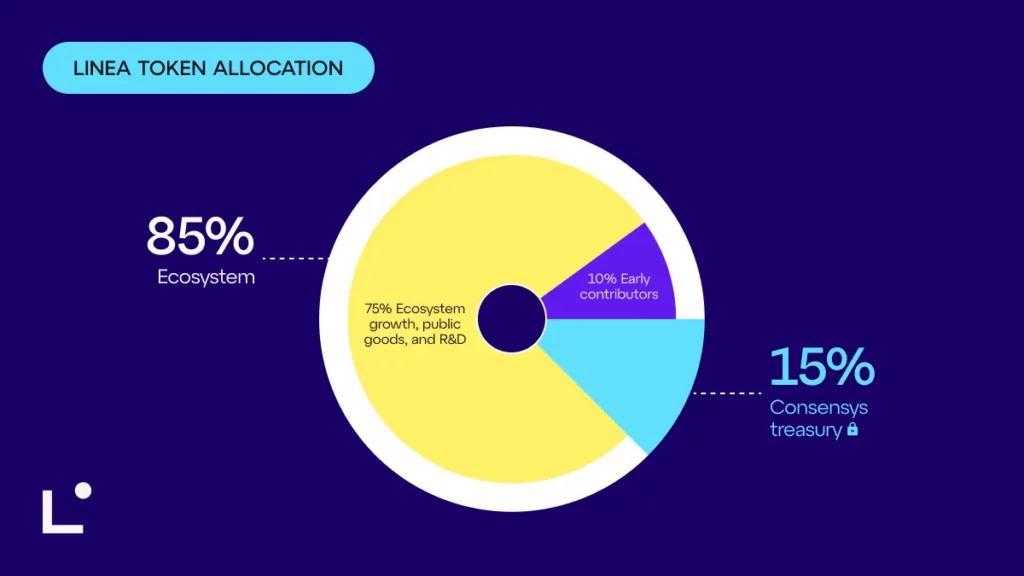
  • 85% of LINEA’s 72B supply goes to ecosystem incentives while 15% is reserved for ConsenSys.
  • Fee structure burns ETH and LINEA to link usage with long-term value.

The update was shared in a July 29 blog post and arrives ahead of Linea’s anticipated Token Generation Event. ETH will serve as the sole gas token, while the new LINEA token will function as an incentive and funding mechanism. 

LINEA not for gas or governance

Unlike typical L2 models, Linea separates utility and value capture by using ETH exclusively for gas while burning both ETH and LINEA from network fees. 20% of layer 2 ETH revenue is burned, with the remaining 80% used to buy and burn LINEA. This dual-burn mechanism is designed to reinforce ETH’s monetary premium while linking LINEA’s value to real usage.

LINEA will not serve as a governance token, and the protocol will not be governed by a DAO. Strategic decisions will instead be managed by the Linea Consortium, a council of Ethereum-native projects including ENS Labs, Eigen Labs, and SharpLink, under a U.S.-based nonprofit entity.

LINEA tokenomics

The total supply of LINEA is fixed at 72 billion tokens, with 85% allocated to ecosystem growth and 15% reserved for ConsenSys treasury. At launch, 22% of the total supply will be circulating, largely through early user airdrops and liquidity programs. No tokens have been sold to investors or employees.
Linea releases tokenomics: ETH used for gas, LINEA neither gas nor governance token - 1

The Ecosystem Fund, comprising 75% of the total supply, will be deployed over a 10-year period. In the first 12 to 18 months, about 25% will go toward community development, builder support, exchange readiness, and liquidity provisioning. The remaining 50% will go toward ecosystem infrastructure, public goods, and protocol research and development.

9% of the supply will be distributed to early users via airdrops and will be fully unlocked at TGE. Eligibility is based on Linea XP and onchain activity that reflects authentic usage and ecosystem engagement.

Another 1% will go to strategic builders, such as key decentralized applications and infrastructure partners, chosen through a curated selection process focused on long-term alignment.

Focused on Ethereum alignment

Instead of framing the LINEA token as a governance tool, Linea positions it as an “economic coordination tool.” Participation, not capital, will determine how it is allocated to users, builders, and ecosystem contributors. The model, which emphasizes decentralized growth and long-term public goods funding, echoes Ethereum’s (ETH) 2015 launch.

Currently, Linea has $155 million in total value locked, as per DefiLlama data, and hosts more than 350 applications. Two major updates that were recently rolled out include native USD Coin (USDC) integration and a fee subsidy partnership with Layerswap to reduce the cost of bridging into Linea.

Piyasa Fırsatı
TokenFi Logosu
TokenFi Fiyatı(TOKEN)
$0.002507
$0.002507$0.002507
+2.78%
USD
TokenFi (TOKEN) Canlı Fiyat Grafiği
Sorumluluk Reddi: Bu sitede yeniden yayınlanan makaleler, halka açık platformlardan alınmıştır ve yalnızca bilgilendirme amaçlıdır. MEXC'nin görüşlerini yansıtmayabilir. Tüm hakları telif sahiplerine aittir. Herhangi bir içeriğin üçüncü taraf haklarını ihlal ettiğini düşünüyorsanız, kaldırılması için lütfen [email protected] ile iletişime geçin. MEXC, içeriğin doğruluğu, eksiksizliği veya güncelliği konusunda hiçbir garanti vermez ve sağlanan bilgilere dayalı olarak alınan herhangi bir eylemden sorumlu değildir. İçerik, finansal, yasal veya diğer profesyonel tavsiye niteliğinde değildir ve MEXC tarafından bir tavsiye veya onay olarak değerlendirilmemelidir.

Ayrıca Şunları da Beğenebilirsiniz

Whales keep selling XRP despite ETF success — Data signals deeper weakness

Whales keep selling XRP despite ETF success — Data signals deeper weakness

The post Whales keep selling XRP despite ETF success — Data signals deeper weakness appeared on BitcoinEthereumNews.com. XRP ETFs have crossed $1 billion in assets
Paylaş
BitcoinEthereumNews2025/12/20 02:55
Foreigner’s Lou Gramm Revisits The Band’s Classic ‘4’ Album, Now Reissued
Foreigner’s Lou Gramm Revisits The Band’s Classic ‘4’ Album, Now Reissued

The post Foreigner’s Lou Gramm Revisits The Band’s Classic ‘4’ Album, Now Reissued appeared on BitcoinEthereumNews.com. American-based rock band Foreigner performs onstage at the Rosemont Horizon, Rosemont, Illinois, November 8, 1981. Pictured are, from left, Mick Jones, on guitar, and vocalist Lou Gramm. (Photo by Paul Natkin/Getty Images) Getty Images Singer Lou Gramm has a vivid memory of recording the ballad “Waiting for a Girl Like You” at New York City’s Electric Lady Studio for his band Foreigner more than 40 years ago. Gramm was adding his vocals for the track in the control room on the other side of the glass when he noticed a beautiful woman walking through the door. “She sits on the sofa in front of the board,” he says. “She looked at me while I was singing. And every now and then, she had a little smile on her face. I’m not sure what that was, but it was driving me crazy. “And at the end of the song, when I’m singing the ad-libs and stuff like that, she gets up,” he continues. “She gives me a little smile and walks out of the room. And when the song ended, I would look up every now and then to see where Mick [Jones] and Mutt [Lange] were, and they were pushing buttons and turning knobs. They were not aware that she was even in the room. So when the song ended, I said, ‘Guys, who was that woman who walked in? She was beautiful.’ And they looked at each other, and they went, ‘What are you talking about? We didn’t see anything.’ But you know what? I think they put her up to it. Doesn’t that sound more like them?” “Waiting for a Girl Like You” became a massive hit in 1981 for Foreigner off their album 4, which peaked at number one on the Billboard chart for 10 weeks and…
Paylaş
BitcoinEthereumNews2025/09/18 01:26
New York Regulators Push Banks to Adopt Blockchain Analytics

New York Regulators Push Banks to Adopt Blockchain Analytics

New York’s top financial regulator urged banks to adopt blockchain analytics, signaling tighter oversight of crypto-linked risks. The move reflects regulators’ concern that traditional institutions face rising exposure to digital assets. While crypto-native firms already rely on monitoring tools, the Department of Financial Services now expects banks to use them to detect illicit activity. NYDFS Outlines Compliance Expectations The notice, issued on Wednesday by Superintendent Adrienne Harris, applies to all state-chartered banks and foreign branches. In its industry letter, the New York State Department of Financial Services (NYDFS) emphasized that blockchain analytics should be integrated into compliance programs according to each bank’s size, operations, and risk appetite. The regulator cautioned that crypto markets evolve quickly, requiring institutions to update frameworks regularly. “Emerging technologies introduce evolving threats that require enhanced monitoring tools,” the notice stated. It stressed the need for banks to prevent money laundering, sanctions violations, and other illicit finance linked to virtual currency transactions. To that end, the Department listed specific areas where blockchain analytics can be applied: Screening customer wallets with crypto exposure to assess risks. Verifying the origin of funds from virtual asset service providers (VASPs). Monitoring the ecosystem holistically to detect money laundering or sanctions exposure. Identifying and assessing counterparties, such as third-party VASPs. Evaluating expected versus actual transaction activity, including dollar thresholds. Weighing risks tied to new digital asset products before rollout. These examples highlight how institutions can tailor monitoring tools to strengthen their risk management frameworks. The guidance expands on NYDFS’s Virtual Currency-Related Activities (VCRA) framework, which has governed crypto oversight in the state since 2022. Regulators Signal Broader Impact Market observers say the notice is less about new rules and more about clarifying expectations. By formalizing the role of blockchain analytics in traditional finance, New York is reinforcing the idea that banks cannot treat crypto exposure as a niche concern. Analysts also believe the approach could ripple beyond New York. Federal agencies and regulators in other states may view the guidance as a blueprint for aligning banking oversight with the realities of digital asset adoption. For institutions, failure to adopt blockchain intelligence tools may invite regulatory scrutiny and undermine their ability to safeguard customer trust. With crypto now firmly embedded in global finance, New York’s stance suggests that blockchain analytics are no longer optional for banks — they are essential to protecting the financial system’s integrity.
Paylaş
Coinstats2025/09/18 08:49