Bitcoin (BTC), Ethereum (ETH), and Ripple (XRP) are showing signs of stabilization around key support levels after a recent correction last week.Bitcoin (BTC), Ethereum (ETH), and Ripple (XRP) are showing signs of stabilization around key support levels after a recent correction last week.

Top 3 Price Prediction: Bitcoin, Ethereum, Ripple – BTC, ETH, and XRP stabilize near critical support levels

2025/06/16 11:33
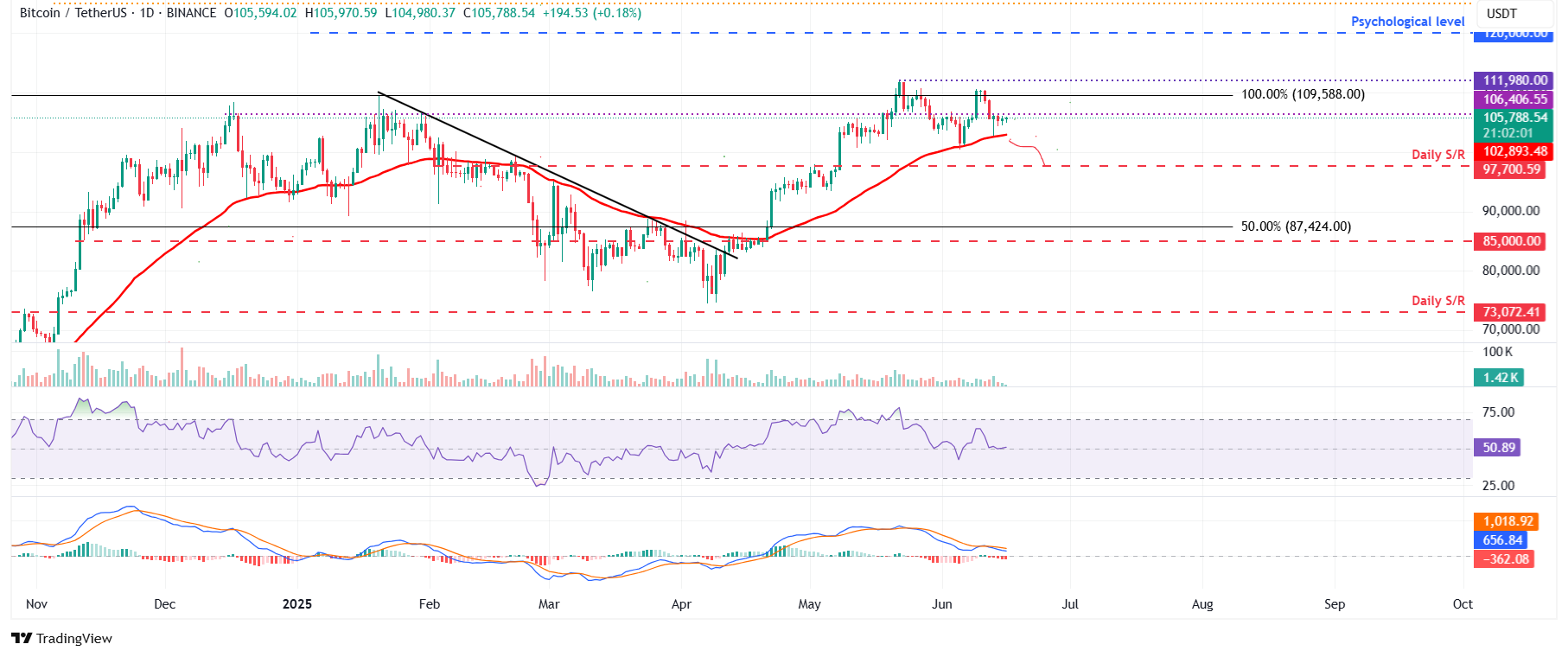
  • Bitcoin price stabilizes around $105,000 on Monday after closing below its key support level the previous week.
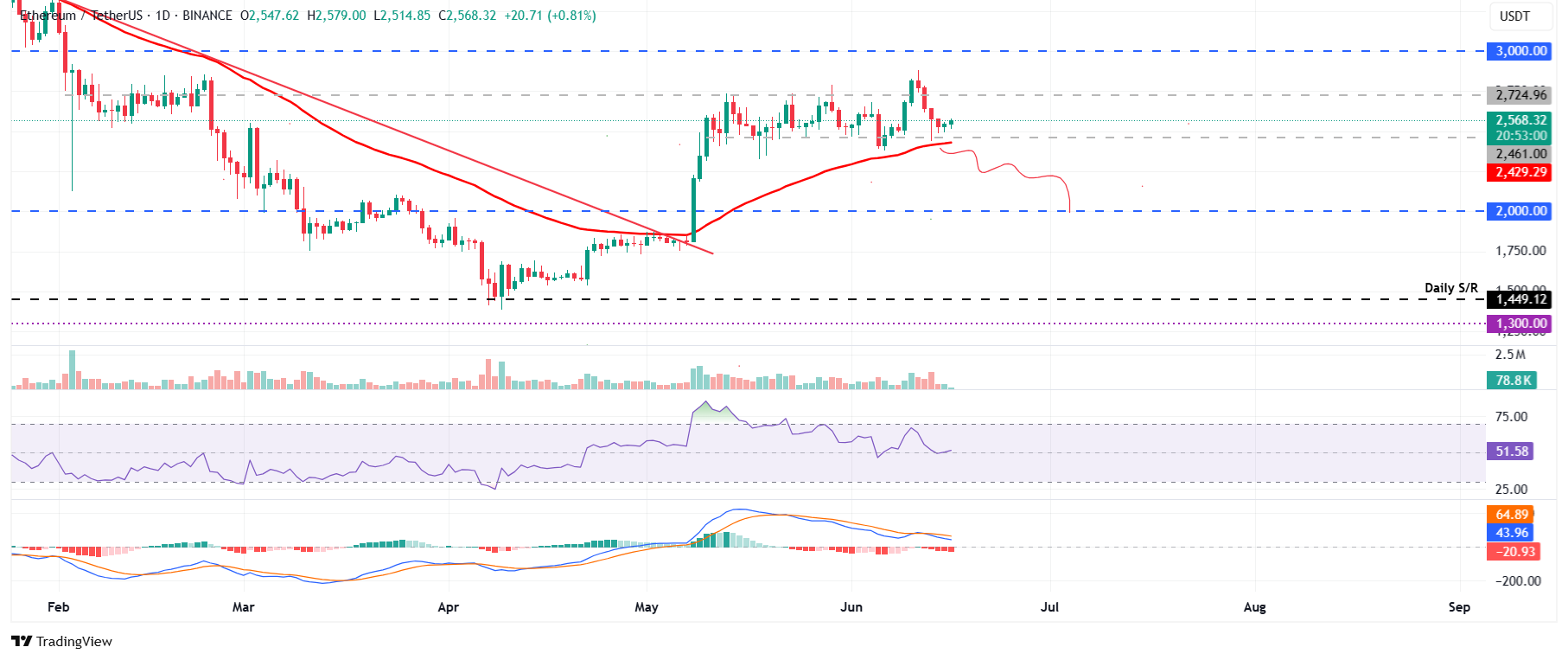
  • Ethereum hovers around its lower consolidation boundary of $2,461; a close below would indicate a correction ahead.
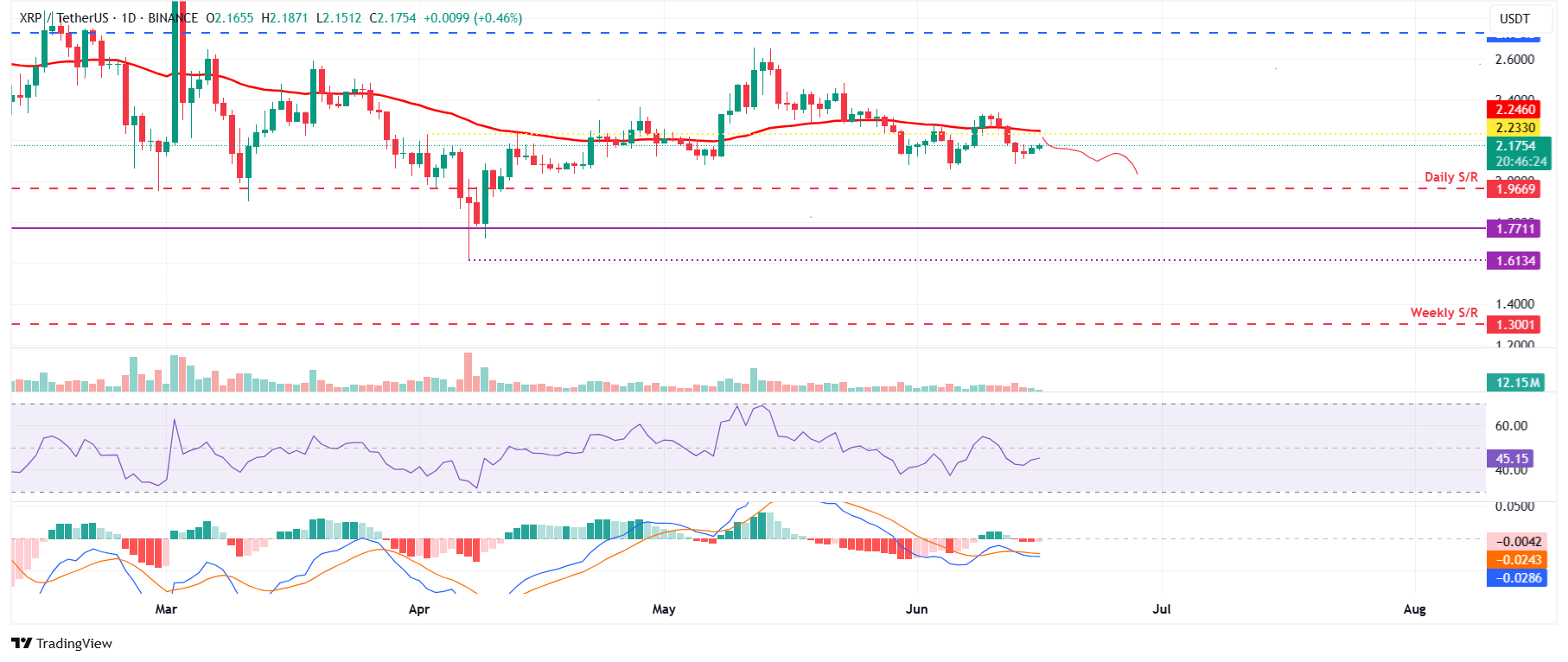
  • Ripple's XRP closes below its 50-day EMA support at $2.24, increasing the chances of a deeper correction.

Bitcoin (BTC), Ethereum (ETH), and Ripple (XRP) are showing signs of stabilization around key support levels after a recent correction last week. BTC attempts to regain strength after closing below its critical support level, while ETH and XRP hover near technical thresholds that could determine the direction of their next moves. 

Bitcoin could decline if it closes below its 50-day EMA 

Bitcoin price closed below its daily support level of $106,406 on Thursday and rebounded after retesting its 50-day Exponential Moving Average (EMA) at $102,893 the following day. BTC stabilized around the $105,000 level during the weekend. At the time of writing on Monday, it continues to consolidate, trading at around $105,788.

If BTC fails to close above the $106,406 resistance level and declines, it could extend the decline to retest its key, psychologically important level at $100,000.

The Relative Strength Index (RSI) on the daily chart is hovering around its neutral level of 50, indicating indecisiveness among traders. The Moving Average Convergence Divergence (MACD) indicator on the daily chart displayed a bearish crossover, signaling a sell and indicating a downward trend. 

BTC/USDT daily chart

BTC/USDT daily chart 

However, if BTC recovers, it could extend the recovery to retest its daily level of $106,406.

Ethereum could face a downleg if it closes below its 50-day EMA 

Ethereum price failed to find support around the upper consolidation level of $2,724 on Thursday and declined by 8.69% until Saturday. However, ETH hovered above its lower consolidation boundary of $2,461 the next day. At the time of writing on Monday, it continues to hover above this level.

If ETH faces a correction and closed below its 50-day EMA at $2,429, it could extend the decline to retest its next support level at $2,000.

The RSI on the daily chart is hovering around its neutral level of 50, indicating indecisiveness among traders. The MACD indicator on the daily chart displayed a bearish crossover, signaling a sell and indicating a downward trend. 

ETH/USDT daily chart

ETH/USDT daily chart

On the other hand, if ETH finds support around its lower consolidation boundary at $2,461, it could extend the recovery to retest its upper consolidation boundary at $2,724.

XRP is poised for a downleg below its 50-day EMA

XRP price closed below its 50-day EMA level at $2.24 on Thursday and declined nearly 6% until Saturday. However, it recovered slightly by 1.22% the next day. At the time of writing on Monday, it is nearing its 50-day EMA at $2.24.

If XRP faces a rejection from its 50-day EMA, it could extend the decline to retest its next daily support level at $1.96.

The RSI on the daily chart reads 45, below its neutral level and points downward, indicating strong bearish momentum. Moreover, the MACD indicator on the daily chart displayed a bearish crossover, signaling a sell and indicating a downward trend.
XRP/USDT daily chart

XRP/USDT daily chart

Conversely, if XRP recovers, it could extend to retest its 50-day EMA at $2.25.

Bitcoin, altcoins, stablecoins FAQs

Bitcoin is the largest cryptocurrency by market capitalization, a virtual currency designed to serve as money. This form of payment cannot be controlled by any one person, group, or entity, which eliminates the need for third-party participation during financial transactions.

Altcoins are any cryptocurrency apart from Bitcoin, but some also regard Ethereum as a non-altcoin because it is from these two cryptocurrencies that forking happens. If this is true, then Litecoin is the first altcoin, forked from the Bitcoin protocol and, therefore, an “improved” version of it.

Stablecoins are cryptocurrencies designed to have a stable price, with their value backed by a reserve of the asset it represents. To achieve this, the value of any one stablecoin is pegged to a commodity or financial instrument, such as the US Dollar (USD), with its supply regulated by an algorithm or demand. The main goal of stablecoins is to provide an on/off-ramp for investors willing to trade and invest in cryptocurrencies. Stablecoins also allow investors to store value since cryptocurrencies, in general, are subject to volatility.

Bitcoin dominance is the ratio of Bitcoin's market capitalization to the total market capitalization of all cryptocurrencies combined. It provides a clear picture of Bitcoin’s interest among investors. A high BTC dominance typically happens before and during a bull run, in which investors resort to investing in relatively stable and high market capitalization cryptocurrency like Bitcoin. A drop in BTC dominance usually means that investors are moving their capital and/or profits to altcoins in a quest for higher returns, which usually triggers an explosion of altcoin rallies.


Piyasa Fırsatı
NEAR Logosu
NEAR Fiyatı(NEAR)
$1.546
$1.546$1.546
+2.18%
USD
NEAR (NEAR) Canlı Fiyat Grafiği
Sorumluluk Reddi: Bu sitede yeniden yayınlanan makaleler, halka açık platformlardan alınmıştır ve yalnızca bilgilendirme amaçlıdır. MEXC'nin görüşlerini yansıtmayabilir. Tüm hakları telif sahiplerine aittir. Herhangi bir içeriğin üçüncü taraf haklarını ihlal ettiğini düşünüyorsanız, kaldırılması için lütfen [email protected] ile iletişime geçin. MEXC, içeriğin doğruluğu, eksiksizliği veya güncelliği konusunda hiçbir garanti vermez ve sağlanan bilgilere dayalı olarak alınan herhangi bir eylemden sorumlu değildir. İçerik, finansal, yasal veya diğer profesyonel tavsiye niteliğinde değildir ve MEXC tarafından bir tavsiye veya onay olarak değerlendirilmemelidir.

Ayrıca Şunları da Beğenebilirsiniz

Whales keep selling XRP despite ETF success — Data signals deeper weakness

Whales keep selling XRP despite ETF success — Data signals deeper weakness

The post Whales keep selling XRP despite ETF success — Data signals deeper weakness appeared on BitcoinEthereumNews.com. XRP ETFs have crossed $1 billion in assets
Paylaş
BitcoinEthereumNews2025/12/20 02:55
Foreigner’s Lou Gramm Revisits The Band’s Classic ‘4’ Album, Now Reissued

Foreigner’s Lou Gramm Revisits The Band’s Classic ‘4’ Album, Now Reissued

The post Foreigner’s Lou Gramm Revisits The Band’s Classic ‘4’ Album, Now Reissued appeared on BitcoinEthereumNews.com. American-based rock band Foreigner performs onstage at the Rosemont Horizon, Rosemont, Illinois, November 8, 1981. Pictured are, from left, Mick Jones, on guitar, and vocalist Lou Gramm. (Photo by Paul Natkin/Getty Images) Getty Images Singer Lou Gramm has a vivid memory of recording the ballad “Waiting for a Girl Like You” at New York City’s Electric Lady Studio for his band Foreigner more than 40 years ago. Gramm was adding his vocals for the track in the control room on the other side of the glass when he noticed a beautiful woman walking through the door. “She sits on the sofa in front of the board,” he says. “She looked at me while I was singing. And every now and then, she had a little smile on her face. I’m not sure what that was, but it was driving me crazy. “And at the end of the song, when I’m singing the ad-libs and stuff like that, she gets up,” he continues. “She gives me a little smile and walks out of the room. And when the song ended, I would look up every now and then to see where Mick [Jones] and Mutt [Lange] were, and they were pushing buttons and turning knobs. They were not aware that she was even in the room. So when the song ended, I said, ‘Guys, who was that woman who walked in? She was beautiful.’ And they looked at each other, and they went, ‘What are you talking about? We didn’t see anything.’ But you know what? I think they put her up to it. Doesn’t that sound more like them?” “Waiting for a Girl Like You” became a massive hit in 1981 for Foreigner off their album 4, which peaked at number one on the Billboard chart for 10 weeks and…
Paylaş
BitcoinEthereumNews2025/09/18 01:26
New York Regulators Push Banks to Adopt Blockchain Analytics

New York Regulators Push Banks to Adopt Blockchain Analytics

New York’s top financial regulator urged banks to adopt blockchain analytics, signaling tighter oversight of crypto-linked risks. The move reflects regulators’ concern that traditional institutions face rising exposure to digital assets. While crypto-native firms already rely on monitoring tools, the Department of Financial Services now expects banks to use them to detect illicit activity. NYDFS Outlines Compliance Expectations The notice, issued on Wednesday by Superintendent Adrienne Harris, applies to all state-chartered banks and foreign branches. In its industry letter, the New York State Department of Financial Services (NYDFS) emphasized that blockchain analytics should be integrated into compliance programs according to each bank’s size, operations, and risk appetite. The regulator cautioned that crypto markets evolve quickly, requiring institutions to update frameworks regularly. “Emerging technologies introduce evolving threats that require enhanced monitoring tools,” the notice stated. It stressed the need for banks to prevent money laundering, sanctions violations, and other illicit finance linked to virtual currency transactions. To that end, the Department listed specific areas where blockchain analytics can be applied: Screening customer wallets with crypto exposure to assess risks. Verifying the origin of funds from virtual asset service providers (VASPs). Monitoring the ecosystem holistically to detect money laundering or sanctions exposure. Identifying and assessing counterparties, such as third-party VASPs. Evaluating expected versus actual transaction activity, including dollar thresholds. Weighing risks tied to new digital asset products before rollout. These examples highlight how institutions can tailor monitoring tools to strengthen their risk management frameworks. The guidance expands on NYDFS’s Virtual Currency-Related Activities (VCRA) framework, which has governed crypto oversight in the state since 2022. Regulators Signal Broader Impact Market observers say the notice is less about new rules and more about clarifying expectations. By formalizing the role of blockchain analytics in traditional finance, New York is reinforcing the idea that banks cannot treat crypto exposure as a niche concern. Analysts also believe the approach could ripple beyond New York. Federal agencies and regulators in other states may view the guidance as a blueprint for aligning banking oversight with the realities of digital asset adoption. For institutions, failure to adopt blockchain intelligence tools may invite regulatory scrutiny and undermine their ability to safeguard customer trust. With crypto now firmly embedded in global finance, New York’s stance suggests that blockchain analytics are no longer optional for banks — they are essential to protecting the financial system’s integrity.
Paylaş
Coinstats2025/09/18 08:49