We’ve only had one genuinely failed presidency in the modern era: Richard Nixon’s. I believe we’re on the verge of the second, and for very similar reasons. If We’ve only had one genuinely failed presidency in the modern era: Richard Nixon’s. I believe we’re on the verge of the second, and for very similar reasons. If

Dramatic developments show Trump's presidency on the verge of collapse

2026/02/21 21:02
Okuma süresi: 6 dk

We’ve only had one genuinely failed presidency in the modern era: Richard Nixon’s. I believe we’re on the verge of the second, and for very similar reasons. If it plays out the way I expect, the consequences could be world-changing, and will certainly alter how our politics work for decades to come.

The tipping point began in a big way when Attorney General Pam Bondi went before Congress to defend Donald Trump. When asked how many of Epstein’s co-conspirators she’d indicted, she refused to answer and instead completely lost it, going off on a bizarre rant that included:

Nobody was buying it any more than when Trump said on Wednesday of this week, “I’ve been totally exonerated. I did nothing.”

Instead, both became punch lines for comedians and have Republicans hiding to avoid being interviewed.

And on Thursday we saw the bookend of this Watergate-like tipping point, when the former Prince Andrew was arrested by the British police. They didn’t even give the royal family an advance notice, didn’t invite him to come and be questioned, but instead just showed up and took him away, then tore apart his residences looking for evidence.

Consider the analogy.

The Watergate scandal that brought Nixon down began in June 1972, but Nixon didn’t resigned until August 1974. It crossed over his re-election in November 1972, and was barely a factor, just like Epstein was only a footnote to Trump’s election in 2024. For over two years, most Americans thought Watergate was overblown.

Early reporting in the mainstream media largely dismissed the initial furor of Democrats over their headquarters’ offices being broken into as partisan huffing and puffing, because almost nobody thought Nixon himself had anything to do with the crime.

Conservative media at the time ridiculed Democrats’ concerns as political opportunism, calling the event — as Nixon himself said — “A third-rate burglary.” The legal system was largely disinterested, beyond holding the burglars themselves to account for a crime where it wasn’t clear that anything was even taken from the offices.

And the Nixon administration — and his Department of Justice and its leader, Attorney General John Mitchell — ridiculed both politicians and media folks who expressed concern that Watergate represented an actual threat to our constitutional system of government.

What changed when the tapes were finally released (analogous to the release of 3 million documents by the DOJ and Bondi’s evasive testimony) was that Americans finally realized that the president was, in fact, “a crook” and that the institutions of the federal government — particularly the DOJ — had been covering up for him.

We’re damn close to that moment now.

The recent DOJ release included reference to a report that a 13-15-year old girl reported to the FBI that Trump beat her up when she bit his penis as he forced her to perform oral sex.

This week, reporter Roger Sollenberger found that she was interviewed at least four times by the FBI and those more in-depth interviews ­(case number 3501.045) had mysteriously gone entirely missing from the documents released by Patel and Bondi.

The story made a headline on the conservative news site Drudge Report, among others; this mirrors the period immediately before Nixon resigned when rightwing sites and elected Republicans stopped publicly defending him.

Nixon fell when institutional America and the GOP stopped speaking out in his defense. It wasn’t just the break-in or the hush money he paid the burglars that broke the dam; it was when the elite consensus turned on him.

Late in the evening on Aug. 7th, 1974, three Republican leaders — Barry Goldwater, Hugh Scott, and John Rhodes — walked over to the White House and told President Nixon that the evidence against him had accumulated beyond spin, loyalty, and even partisan defense. The center of gravity had shifted, and two days later he was gone.

I’m not suggesting Trump is losing his presidency this week or next; after all, Watergate took over two years and Nixon didn’t have Fox “News” or 1,500 rightwing radio stations or Vladimir Putin and Elon Musk churning social media on his behalf. Trump has a much more powerful firewall than Nixon ever dreamed of. It may sustain him for months or even another year.

And, as president, he has a lot of tools at his disposal to keep changing the subject, which is where these revelations about Trump could become “world changing” if he comes sufficiently desperate.

A war with Iran appears to be his latest gambit. During Watergate, Nixon’s aides developed what they called a “modified limited hangout,” a strategy not of disproving the scandal but of suffocating it in the media by overwhelming the public with competing announcements, threats, events, and crises.

Nonetheless, while Americans will tolerate misconduct, abuse of office to escape accountability is an entirely different animal. And allegations of child rape are a much bigger deal than breaking into the DNC; Nixon didn’t even participate, he just gave the orders and supervised the cover-up. Trump, on the other hand, appears to be right in the middle of Epstein’s operation, perhaps even including his teen modeling agency and Miss Teen USA pageant.

It’s a cliché that “the coverup is worse than the crime,” but they keep doing it.

And now it’s metastasizing beyond Epstein.

Bondi and Patel insist the Epstein investigation is closed. Kristi Noem and Kash Patel refuse to give Minnesota police evidence in the murders of Renee Good and Alex Pretti. ICE defies over 4,400 court orders and refuses members of Congress or the press entrance to its brutal concentration camps. Trump goes after the FBI agents who uncovered Putin’s efforts to make him president in 2016. He and his family make $4 billion off his presidency in less than a year. Trump sucks up to Putin.

Trump’s level of criminality and corruption exceeds Nixon’s by orders of magnitude.

The coverups were why Nixon’s Attorney General John Mitchell went to prison, as did his Chief of Staff H.R. Haldeman, his Assistant for Domestic Affairs John Ehrlichman, his Special Counsel Charles Colson, and his White House Counsel John Dean (who’s since been a frequent guest on my radio/TV program).

That has to be waking Pam Bondi and others around Trump up at night. And it should be giving pause to every elected Republican facing the November midterms.

Every Watergate moment looks impossible right up until the hour it becomes inevitable. And when that hour arrives, it never feels sudden to those who carefully read history; only to the people who insisted, until the very end, that it could never happen here.

  • Thom Hartmann is a New York Times best-selling author and SiriusXM talk show host. His Substack can be found here.
Piyasa Fırsatı
OFFICIAL TRUMP Logosu
OFFICIAL TRUMP Fiyatı(TRUMP)
$3,44
$3,44$3,44
-2,38%
USD
OFFICIAL TRUMP (TRUMP) Canlı Fiyat Grafiği
Sorumluluk Reddi: Bu sitede yeniden yayınlanan makaleler, halka açık platformlardan alınmıştır ve yalnızca bilgilendirme amaçlıdır. MEXC'nin görüşlerini yansıtmayabilir. Tüm hakları telif sahiplerine aittir. Herhangi bir içeriğin üçüncü taraf haklarını ihlal ettiğini düşünüyorsanız, kaldırılması için lütfen [email protected] ile iletişime geçin. MEXC, içeriğin doğruluğu, eksiksizliği veya güncelliği konusunda hiçbir garanti vermez ve sağlanan bilgilere dayalı olarak alınan herhangi bir eylemden sorumlu değildir. İçerik, finansal, yasal veya diğer profesyonel tavsiye niteliğinde değildir ve MEXC tarafından bir tavsiye veya onay olarak değerlendirilmemelidir.

Ayrıca Şunları da Beğenebilirsiniz

Why Smart Whales Abandon Cardano And Solana, Choosing Pepeto Presale For 100x Potential
Why Smart Whales Abandon Cardano And Solana, Choosing Pepeto Presale For 100x Potential

But a new player is emerging quickly: Pepeto (PEPETO), still in presale at just $0.000000153, already garnering over $6.7 million. […] The post Why Smart Whales Abandon Cardano And Solana, Choosing Pepeto Presale For 100x Potential appeared first on Coindoo.
Paylaş
Coindoo2025/09/20 01:35
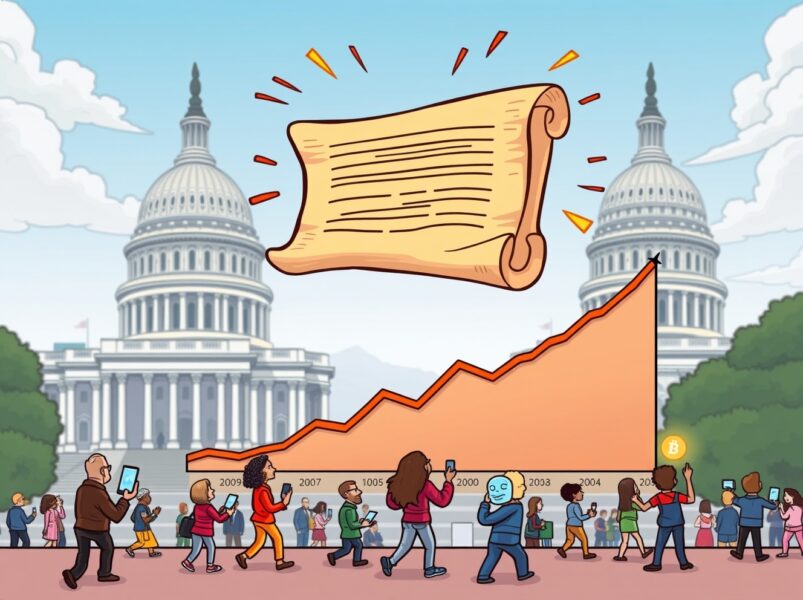
US Crypto Legislation: Unlocking a New Era for the Market Cycle

US Crypto Legislation: Unlocking a New Era for the Market Cycle

BitcoinWorld US Crypto Legislation: Unlocking a New Era for the Market Cycle Get ready for a potentially monumental shift in the crypto world! Galaxy Digital CEO Mike Novogratz has shared a fascinating prediction: significant US crypto legislation could fundamentally reshape the market’s traditional four-year cycle. This isn’t just speculation; it points to a future where crypto’s trajectory might look very different from what we’ve seen before. How is US Crypto Legislation Changing the Game? In a recent interview with Bloomberg, Novogratz highlighted two key pieces of legislation: the Genius Act and the CLARITY Act. These aren’t just bureaucratic terms; they represent a concerted effort to bring clarity and regulation to the cryptocurrency space. The Genius Act, enacted in July, focuses on stablecoin regulation. This is crucial because stablecoins, which are cryptocurrencies pegged to a stable asset like the US dollar, are becoming central to many digital transactions. The CLARITY Act aims to provide a clearer market structure. This means establishing defined rules for how cryptocurrencies are traded and regulated, making the market more transparent and accessible. Novogratz believes these legislative developments will act as a powerful magnet, drawing a massive influx of new investors into the market. Imagine millions of new participants feeling confident enough to engage with digital assets thanks to clear guidelines. Will We See a Different Crypto Market Cycle This Time? One of Novogratz’s most intriguing predictions challenges the historical pattern of crypto. He suggests that this current cycle might not conclude with the kind of large-scale sell-off that characterized previous Bitcoin (BTC) peaks. Historically, after major bull runs, investors often sold off their holdings, leading to significant market corrections. Consider the cycles of 2017 and 2021. Both saw incredible highs followed by substantial downturns as investors took profits. However, Novogratz argues that the investment environment has undergone a significant transformation. The presence of robust US crypto legislation is a key factor here, fostering a more mature market. The Power of Legitimized Stablecoins and Wider Adoption What exactly is different now? A major part of Novogratz’s argument centers on legalized stablecoins. These digital assets are poised to become seamlessly integrated into our daily lives. Think about using them directly within apps on your iPhone or across various social media platforms. This widespread usability has profound implications: Reduced Volatility Concerns: For everyday transactions, stablecoins offer the speed and efficiency of crypto without the wild price swings often associated with assets like Bitcoin or Ethereum. Easier Onboarding for New Users: When stablecoins are integrated into familiar platforms, the barrier to entry for new users dramatically decreases. People can engage with digital assets without needing to navigate complex exchanges immediately. Mainstream Acceptance: This level of integration pushes cryptocurrency further into the mainstream, moving it beyond niche trading circles and into everyday commerce. The clarity provided by US crypto legislation around these assets builds trust and encourages broader adoption. Navigating the Future: Opportunities and Potential Hurdles While the outlook is overwhelmingly positive, it’s also wise to consider the evolving landscape. The introduction of comprehensive US crypto legislation presents both immense opportunities and potential hurdles. Opportunities: A clearer regulatory framework can attract institutional investors, foster innovation within the blockchain space, and provide consumer protection, all contributing to a more robust and sustainable market. Potential Hurdles: Crafting effective legislation is complex. There might be ongoing debates, adjustments, and unforeseen impacts that could influence market dynamics. The industry will need to adapt to new compliance requirements. Ultimately, a regulated environment aims to create a more predictable and secure space for growth, benefiting both seasoned investors and newcomers alike. A New Dawn for Crypto Market Cycles Mike Novogratz’s vision paints an exciting picture for the future of cryptocurrency. The advent of clear US crypto legislation, particularly the Genius and CLARITY Acts, appears set to usher in a new era. This could mean a departure from the dramatic boom-and-bust cycles of the past, paving the way for more sustained growth and widespread adoption. As stablecoins become integral to our digital interactions, the crypto market is evolving into a more mature, integrated, and accessible financial ecosystem. The potential for a less volatile, more inclusive market is truly transformative. Frequently Asked Questions About Crypto Legislation Q1: What is the significance of the Genius Act and CLARITY Act? A1: The Genius Act focuses on regulating stablecoins, providing a clear framework for their issuance and use. The CLARITY Act aims to establish a clear market structure for cryptocurrencies, defining how they are traded and regulated. Together, they bring much-needed legal certainty to the crypto space. Q2: How could new US crypto legislation prevent large-scale sell-offs? A2: Novogratz suggests that with increased regulatory clarity and the widespread integration of stablecoins into daily apps, the market will attract a broader base of long-term investors. This could lead to more stable growth and reduce the likelihood of the rapid, panic-driven sell-offs seen after previous market peaks. Q3: How will legalized stablecoins change everyday use? A3: Legitimized stablecoins are expected to be integrated into common applications on devices like iPhones and social media platforms. This will make them easier to use for everyday transactions, payments, and remittances, much like traditional digital currency, but with the benefits of blockchain technology. Q4: What are the main benefits of clearer US crypto legislation for investors? A4: Clear legislation provides several benefits: it reduces regulatory uncertainty, which can attract more institutional and retail investors; it offers better consumer protection; and it fosters a more predictable and stable environment for innovation and growth within the crypto market. Q5: Are there any potential challenges with new crypto legislation? A5: While largely positive, challenges could include the complexity of implementing and enforcing new regulations, the need for continuous adaptation as technology evolves, and potential disagreements within the industry or among regulators on specific rules. However, these are part of any maturing market. If you found this article insightful, consider sharing it with your network! Help us spread the word about the exciting future of cryptocurrency and how US crypto legislation is shaping it. Your shares help inform and educate others about these pivotal market changes. To learn more about the latest crypto market trends, explore our article on key developments shaping Bitcoin and Ethereum institutional adoption. This post US Crypto Legislation: Unlocking a New Era for the Market Cycle first appeared on BitcoinWorld.
Paylaş
Coinstats2025/09/24 12:25
XRP Price Prediction February 2026: Senator Warren Warns Fed as Pepeto’s 100x Presale Steals the Spotlight From Ripple

XRP Price Prediction February 2026: Senator Warren Warns Fed as Pepeto’s 100x Presale Steals the Spotlight From Ripple

Senator Elizabeth Warren reportedly sent a letter to Fed Chair Jerome Powell and Treasury Secretary Scott Bessent demanding they not […] The post XRP Price Prediction
Paylaş
Coindoo2026/02/22 05:55