Phrases like “Bitcoin is the hurdle rate” and “Bitcoin is the new hurdle rate” frequently re-occur in the Bitcoin communities, often without a context. In short, this motto means that Bitcoin is the best benchmark for investment: avoid investing in…Phrases like “Bitcoin is the hurdle rate” and “Bitcoin is the new hurdle rate” frequently re-occur in the Bitcoin communities, often without a context. In short, this motto means that Bitcoin is the best benchmark for investment: avoid investing in…

‘Bitcoin is the hurdle rate’: What does it mean in the age of crypto?

Phrases like “Bitcoin is the hurdle rate” and “Bitcoin is the new hurdle rate” frequently re-occur in the Bitcoin communities, often without a context. In short, this motto means that Bitcoin is the best benchmark for investment: avoid investing in anything that yields lower returns than Bitcoin. Let’s delve deeper into the meaning of this phrase and explore what this credo challenges and why some find it controversial.

What is the hurdle rate?

The hurdle rate indicates the minimum return that makes an investment or a project viable. The hurdle rate is used while deciding whether to start a business project or make an investment. If it is too high, the project or an investment may be rejected. 

To determine a hurdle rate, one considers costs, inflation, interest rates, and potential risks. Some companies use their weighted average cost of capital (WACC) as a reference for the hurdle rate. However, some add the risk premium to WACC to get a safer hurdle rate. It’s understood that the return on investment rate should be above the hurdle rate so that the investment would be viable.

The current yield on 10-year U.S. Treasury bills is often used as a benchmark when calculating the hurdle rate, as it serves as the risk-free rate, since other investments are typically riskier. Some models use 3-month treasury bills instead. And that’s what Bitcoin maxis are challenging when they say Bitcoin is the hurdle rate.

How is Bitcoin the hurdle rate?

There are at least two messages attached to the “Bitcoin is the hurdle rate” motto. First off, bitcoiners point out the poor performance of the U.S. Treasury bills if compared to Bitcoin’s performance. 

The second meaning of Bitcoin as the hurdle rate is that sometimes you should just buy Bitcoin instead of trying to find a better-performing investment.

Explaining how Bitcoin is better than t-bills, Bitcoin enthusiasts usually emphasize Bitcoin’s predictability, citing the hard supply cap of nearly 21 million units, the pre-programmed issuance of new bitcoins, predetermined dates of halvings, etceters. Additionally, Bitcoin exhibits strong long-term price appreciation. In the past, there were no negative returns in any 5-year period. The constant long-term value accumulation is cited as one of the main reasons for the inclusion of Bitcoin in various state or corporate reserves.

None of these is the case for the U.S. Treasury bills, nor for gold, which is an asset most frequently compared with Bitcoin. While U.S. Treasury bills are usually chosen as the benchmark for the hurdle rate because they are considered a risk-free asset, many admit that risks are there. 
'Bitcoin is the hurdle rate': What does it mean in the age of crypto? - 1

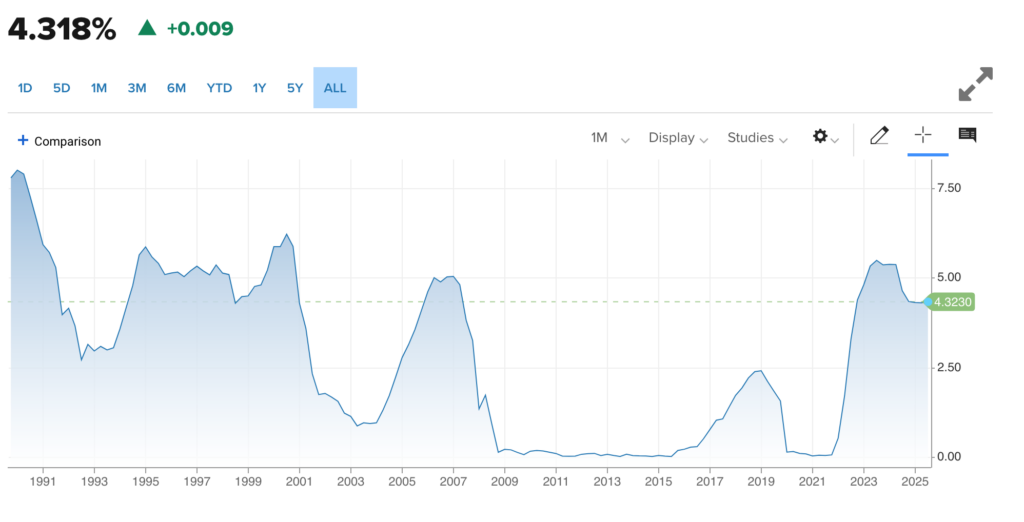
If you look at the chart, you may notice that the yield is subjected to serious volatility. In 2008, the yield rate fell below 1% and was this low until 2015. The COVID-19 pandemic managed to crash the yield rate again in 2020. At the same time, cryptocurrencies began to grow following the March 2020 market crash. In those days, many observers admitted that Bitcoin proved itself as a safe haven asset. 

The latest drop in the T-bill yield occurred in 2024. U.S. Treasury bill yield rates depend on various factors, including the actions of the Federal Reserve, in a centralized manner, not thinkable for Bitcoin. The incumbent POTUS, Donald Trump, is calling on the Fed to cut the rates, which it, as an independent agency, refuses to do, citing the inflation threat as the reason. Once the Fed complies and cuts the rates, the yield on Treasury bills will go down. Some expect that the increased inflation will propel Bitcoin’s price up.

Despite the fact that other traditional assets are considered even riskier, bitcoiners argue that the U.S. Treasury bills are not a suitable risk-free benchmark asset, and Bitcoin is a better fit. Bitcoin’s recognition by governments, financial institutions, corporations, and high-profile financial experts (including former Bitcoin skeptics) may solidify Bitcoin’s reputation as the benchmark. 

Bitcoin treasury companies, like Strategy, Metaplanet, or Nakamoto, emphasize that Bitcoin yield outperforms yield from other assets, so the accumulation of Bitcoin and releasing stocks that expose buyers to indirect “ownership” of Bitcoin is presented as a viable strategy. So far, MSTR (Strategy’s stock) has seen higher returns than the returns from Bitcoin itself. Until the Bitcoin treasuries bubble burst, Bitcoin may have been seen as the hurdle rate for treasury companies: if you can’t outperform Bitcoin, then you should own it.

However, hard-core Bitcoin enthusiasts warn that holding Bitcoin self-custody is safer than outsourcing BTC ownership to a centralized third party, whether it is a crypto exchange, treasury company, or anything else.

Why do some dispute this claim?

Some of the Bitcoin purists ridicule the idea that Bitcoin is the new hurdle rate—notably those critical towards Bitcoin treasury companies per se. 

The logic is clear: as the Bitcoin treasury companies’ frontmen weaponized the hurdle rate concept, it may be seen as a gimmick to promote these companies’ stocks as performing as well or even better than Bitcoin. They often discuss Bitcoin while selling traditional stocks to their clients.

So, generally, “Bitcoin is the hurdle rate” can serve as an economic observation, a slogan for treasury companies, or at least a Crypto Twitter meme.

Piyasa Fırsatı
Wink Logosu
Wink Fiyatı(LIKE)
$0.003442
$0.003442$0.003442
+2.89%
USD
Wink (LIKE) Canlı Fiyat Grafiği
Sorumluluk Reddi: Bu sitede yeniden yayınlanan makaleler, halka açık platformlardan alınmıştır ve yalnızca bilgilendirme amaçlıdır. MEXC'nin görüşlerini yansıtmayabilir. Tüm hakları telif sahiplerine aittir. Herhangi bir içeriğin üçüncü taraf haklarını ihlal ettiğini düşünüyorsanız, kaldırılması için lütfen [email protected] ile iletişime geçin. MEXC, içeriğin doğruluğu, eksiksizliği veya güncelliği konusunda hiçbir garanti vermez ve sağlanan bilgilere dayalı olarak alınan herhangi bir eylemden sorumlu değildir. İçerik, finansal, yasal veya diğer profesyonel tavsiye niteliğinde değildir ve MEXC tarafından bir tavsiye veya onay olarak değerlendirilmemelidir.

Ayrıca Şunları da Beğenebilirsiniz

SEC Staff Clarifies Custody Rules for Tokenized Stocks and Bonds

SEC Staff Clarifies Custody Rules for Tokenized Stocks and Bonds

The post SEC Staff Clarifies Custody Rules for Tokenized Stocks and Bonds appeared on BitcoinEthereumNews.com. The US Securities and Exchange Commission’s Trading
Paylaş
BitcoinEthereumNews2025/12/19 08:51
Breaking: CME Group Unveils Solana and XRP Options

Breaking: CME Group Unveils Solana and XRP Options

CME Group launches Solana and XRP options, expanding crypto offerings. SEC delays Solana and XRP ETF approvals, market awaits clarity. Strong institutional demand drives CME’s launch of crypto options contracts. In a bold move to broaden its cryptocurrency offerings, CME Group has officially launched options on Solana (SOL) and XRP futures. Available since October 13, 2025, these options will allow traders to hedge and manage exposure to two of the most widely traded digital assets in the market. The new contracts come in both full-size and micro-size formats, with expiration options available daily, monthly, and quarterly, providing flexibility for a diverse range of market participants. This expansion aligns with the rising demand for innovative products in the crypto space. Giovanni Vicioso, CME Group’s Global Head of Cryptocurrency Products, noted that the new options offer increased flexibility for traders, from institutions to active individual investors. The growing liquidity in Solana and XRP futures has made the introduction of these options a timely move to meet the needs of an expanding market. Also Read: Vitalik Buterin Reveals Ethereum’s Bold Plan to Stay Quantum-Secure and Simple! Rapid Growth in Solana and XRP Futures Trading CME Group’s decision to roll out options on Solana and XRP futures follows the substantial growth in these futures products. Since the launch of Solana futures in March 2025, more than 540,000 contracts, totaling $22.3 billion in notional value, have been traded. In August 2025, Solana futures set new records, with an average daily volume (ADV) of 9,000 contracts valued at $437.4 million. The average daily open interest (ADOI) hit 12,500 contracts, worth $895 million. Similarly, XRP futures, which launched in May 2025, have seen significant adoption, with over 370,000 contracts traded, totaling $16.2 billion. XRP futures also set records in August 2025, with an ADV of 6,600 contracts valued at $385 million and a record ADOI of 9,300 contracts, worth $942 million. Institutional Demand for Advanced Hedging Tools CME Group’s expansion into options is a direct response to growing institutional interest in sophisticated cryptocurrency products. Roman Makarov from Cumberland Options Trading at DRW highlighted the market demand for more varied crypto products, enabling more advanced risk management strategies. Joshua Lim from FalconX also noted that the new options products meet the increasing need for institutional hedging tools for assets like Solana and XRP, further cementing their role in the digital asset space. The launch of options on Solana and XRP futures marks another step toward the maturation of the cryptocurrency market, providing a broader range of tools for managing digital asset exposure. SEC’s Delay on Solana and XRP ETF Approvals While CME Group expands its offerings, the broader market is also watching the progress of Solana and XRP exchange-traded funds (ETFs). The U.S. Securities and Exchange Commission (SEC) has delayed its decisions on multiple crypto-related ETF filings, including those for Solana and XRP. Despite the delay, analysts anticipate approval may be on the horizon. This week, REX Shares and Osprey Funds are expected to launch an XRP ETF that will hold XRP directly and allocate at least 40% of its assets to other XRP-related ETFs. Despite the delays, some analysts believe that approval could come soon, fueling further interest in these assets. The delay by the SEC has left many crypto investors awaiting clarity, but approval of these ETFs could fuel further momentum in the Solana and XRP futures markets. Also Read: Tether CEO Breaks Silence on $117,000 Bitcoin Price – Market Reacts! The post Breaking: CME Group Unveils Solana and XRP Options appeared first on 36Crypto.
Paylaş
Coinstats2025/09/18 02:35
US Lawmakers May Limit De Minimis Tax Exemptions to Stablecoins, Excluding Bitcoin

US Lawmakers May Limit De Minimis Tax Exemptions to Stablecoins, Excluding Bitcoin

The post US Lawmakers May Limit De Minimis Tax Exemptions to Stablecoins, Excluding Bitcoin appeared on BitcoinEthereumNews.com. US lawmakers are considering de
Paylaş
BitcoinEthereumNews2025/12/19 09:28