In 2025, Bitcoin mining is no longer just a competition over hashpower and block rewards—it has evolved into a full-scale infrastructure war, where access to energy, geopolitical positioning, and integration with emerging technologies like AI define who survives and who fades out. According to the newly released Bitcoin Mining Market Review and Key Trends authored by Nico Smid, research analyst at GoMining Institutional, and Fakhul Miah, managing director at GoMining Institutional, the industry now finds itself locked in a struggle with one of the world’s fastest-growing tech verticals: artificial intelligence. AI hyperscalers are demanding huge amounts of electricity for model training and deployment, putting them on a direct collision course with Bitcoin miners, who also rely on affordable, high-volume power to remain profitable. This competition has triggered what the report calls a “power crunch,” forcing mining companies to rethink site selection, energy procurement, and geopolitical risk in real time. The competition for electricity is no longer limited to internal mining rivalries—it has gone external. Major players like Riot Platforms have paused a 600 MW expansion, while Iris Energy has shifted away from pure BTC mining to allocate capacity toward AI cloud services. On February 13, Riot Platforms also anno unced that it is actively pursuing potential partnerships within the AI and HPC sectors. 💡 Bitcoin miner @RiotPlatforms eyes AI and HPC as Bitcoin transactions slump. #Bitcoin #AI #Mining https://t.co/9lab9MJy32 — Cryptonews.com (@cryptonews) February 13, 2025 As nations attempt to balance power grids and prioritize forward-looking technologies, miners are being priced out, regulated against, or simply pushed aside, claims the report. Institutional Capital Pours in, but Miners Are Squeezed The report notes that this crunch comes at a time when institutional demand for Bitcoin has never been higher. Wall Street has poured billions into U.S. spot Bitcoin ETFs , and the U.S. government has officially recognized the asset by forming a Strategic Bitcoin Reserve. The result is a paradox: demand for Bitcoin is soaring, but the supply-side infrastructure—mining—is becoming more fragile. While capital floods into ETFs, miners face rising operating costs, compressed fees, and restricted energy access. Hash price has declined sharply post-halving, and transaction fee revenue has collapsed to less than 1% of miner income. Even as Bitcoin becomes more embedded in institutional portfolios and public balance sheets, the ability to mint new coins is under siege. This growing disconnect between Bitcoin’s financialization and the economic sustainability of mining is one of the report’s core warnings. Miners Turn to Financial Engineering to Survive To survive this high-cost, post-halving environment, miners are evolving into financial tacticians. No longer just hardware operators, leading firms are now using Bitcoin-backed loans, convertible notes, and creative equity structures to raise capital without liquidating their BTC reserves. The report identifies this trend as “the rise of the financially engineered miner,” where the ability to model capital stack scenarios is as important as mining efficiency. The shift marks a turning point in how mining companies operate. Access to energy is still paramount, but access to capital markets—and the sophistication to operate within them—is now equally essential. As mining companies adapt to lower margins and greater volatility, their financial survival may hinge on how well they can balance debt, equity, and retained BTC while preparing for further pressure from AI, regulation, and tariffs. Legacy Hardware Feels the Pain The report also shines a light on the economic pressure facing legacy ASIC hardware. The S19 generation of miners, which still accounts for roughly 25% of Bitcoin’s total hashrate, is fast approaching obsolescence. Profitability data shows that S19 units operating at electricity costs above $0.06/kWh are already unprofitable unless the hash price exceeds $60—a rarity in 2025. For operators paying more than $0.05/kWh, even slight hash price drops can push them into the red. While the S19 has been a workhorse since its release five years ago, it is now a liability for many mining farms. The narrowing profit margins are an indicator of how quickly economic viability can shift, particularly in an industry facing both internal halving events and external competition from AI infrastructure players, GoMining Institutional reports. Outlook: More Than Just Block Rewards The report concludes that the first half of 2025 has revealed that Bitcoin mining is no longer a closed system. It’s now a frontline industry operating at the intersection of capital, energy, and compute. As the network seeks equilibrium after April’s halving, miners must make tough decisions about scale, strategy, and survival. The second half of the year promises no less intensity—but the winners will be those who can work within capital markets as well as they can manage hashpower.In 2025, Bitcoin mining is no longer just a competition over hashpower and block rewards—it has evolved into a full-scale infrastructure war, where access to energy, geopolitical positioning, and integration with emerging technologies like AI define who survives and who fades out. According to the newly released Bitcoin Mining Market Review and Key Trends authored by Nico Smid, research analyst at GoMining Institutional, and Fakhul Miah, managing director at GoMining Institutional, the industry now finds itself locked in a struggle with one of the world’s fastest-growing tech verticals: artificial intelligence. AI hyperscalers are demanding huge amounts of electricity for model training and deployment, putting them on a direct collision course with Bitcoin miners, who also rely on affordable, high-volume power to remain profitable. This competition has triggered what the report calls a “power crunch,” forcing mining companies to rethink site selection, energy procurement, and geopolitical risk in real time. The competition for electricity is no longer limited to internal mining rivalries—it has gone external. Major players like Riot Platforms have paused a 600 MW expansion, while Iris Energy has shifted away from pure BTC mining to allocate capacity toward AI cloud services. On February 13, Riot Platforms also anno unced that it is actively pursuing potential partnerships within the AI and HPC sectors. 💡 Bitcoin miner @RiotPlatforms eyes AI and HPC as Bitcoin transactions slump. #Bitcoin #AI #Mining https://t.co/9lab9MJy32 — Cryptonews.com (@cryptonews) February 13, 2025 As nations attempt to balance power grids and prioritize forward-looking technologies, miners are being priced out, regulated against, or simply pushed aside, claims the report. Institutional Capital Pours in, but Miners Are Squeezed The report notes that this crunch comes at a time when institutional demand for Bitcoin has never been higher. Wall Street has poured billions into U.S. spot Bitcoin ETFs , and the U.S. government has officially recognized the asset by forming a Strategic Bitcoin Reserve. The result is a paradox: demand for Bitcoin is soaring, but the supply-side infrastructure—mining—is becoming more fragile. While capital floods into ETFs, miners face rising operating costs, compressed fees, and restricted energy access. Hash price has declined sharply post-halving, and transaction fee revenue has collapsed to less than 1% of miner income. Even as Bitcoin becomes more embedded in institutional portfolios and public balance sheets, the ability to mint new coins is under siege. This growing disconnect between Bitcoin’s financialization and the economic sustainability of mining is one of the report’s core warnings. Miners Turn to Financial Engineering to Survive To survive this high-cost, post-halving environment, miners are evolving into financial tacticians. No longer just hardware operators, leading firms are now using Bitcoin-backed loans, convertible notes, and creative equity structures to raise capital without liquidating their BTC reserves. The report identifies this trend as “the rise of the financially engineered miner,” where the ability to model capital stack scenarios is as important as mining efficiency. The shift marks a turning point in how mining companies operate. Access to energy is still paramount, but access to capital markets—and the sophistication to operate within them—is now equally essential. As mining companies adapt to lower margins and greater volatility, their financial survival may hinge on how well they can balance debt, equity, and retained BTC while preparing for further pressure from AI, regulation, and tariffs. Legacy Hardware Feels the Pain The report also shines a light on the economic pressure facing legacy ASIC hardware. The S19 generation of miners, which still accounts for roughly 25% of Bitcoin’s total hashrate, is fast approaching obsolescence. Profitability data shows that S19 units operating at electricity costs above $0.06/kWh are already unprofitable unless the hash price exceeds $60—a rarity in 2025. For operators paying more than $0.05/kWh, even slight hash price drops can push them into the red. While the S19 has been a workhorse since its release five years ago, it is now a liability for many mining farms. The narrowing profit margins are an indicator of how quickly economic viability can shift, particularly in an industry facing both internal halving events and external competition from AI infrastructure players, GoMining Institutional reports. Outlook: More Than Just Block Rewards The report concludes that the first half of 2025 has revealed that Bitcoin mining is no longer a closed system. It’s now a frontline industry operating at the intersection of capital, energy, and compute. As the network seeks equilibrium after April’s halving, miners must make tough decisions about scale, strategy, and survival. The second half of the year promises no less intensity—but the winners will be those who can work within capital markets as well as they can manage hashpower.

Bitcoin Mining Goes Institutional – But Can It Survive Tariffs, AI Grid Wars, and Fee Collapse?

In 2025, Bitcoin mining is no longer just a competition over hashpower and block rewards—it has evolved into a full-scale infrastructure war, where access to energy, geopolitical positioning, and integration with emerging technologies like AI define who survives and who fades out.

According to the newly released Bitcoin Mining Market Review and Key Trends authored by Nico Smid, research analyst at GoMining Institutional, and Fakhul Miah, managing director at GoMining Institutional, the industry now finds itself locked in a struggle with one of the world’s fastest-growing tech verticals: artificial intelligence.

AI hyperscalers are demanding huge amounts of electricity for model training and deployment, putting them on a direct collision course with Bitcoin miners, who also rely on affordable, high-volume power to remain profitable.

This competition has triggered what the report calls a “power crunch,” forcing mining companies to rethink site selection, energy procurement, and geopolitical risk in real time.

The competition for electricity is no longer limited to internal mining rivalries—it has gone external. Major players like Riot Platforms have paused a 600 MW expansion, while Iris Energy has shifted away from pure BTC mining to allocate capacity toward AI cloud services.

On February 13, Riot Platforms also announced that it is actively pursuing potential partnerships within the AI and HPC sectors.

As nations attempt to balance power grids and prioritize forward-looking technologies, miners are being priced out, regulated against, or simply pushed aside, claims the report.

Institutional Capital Pours in, but Miners Are Squeezed

The report notes that this crunch comes at a time when institutional demand for Bitcoin has never been higher. Wall Street has poured billions into U.S. spot Bitcoin ETFs, and the U.S. government has officially recognized the asset by forming a Strategic Bitcoin Reserve.

The result is a paradox: demand for Bitcoin is soaring, but the supply-side infrastructure—mining—is becoming more fragile.

While capital floods into ETFs, miners face rising operating costs, compressed fees, and restricted energy access. Hash price has declined sharply post-halving, and transaction fee revenue has collapsed to less than 1% of miner income.

Even as Bitcoin becomes more embedded in institutional portfolios and public balance sheets, the ability to mint new coins is under siege. This growing disconnect between Bitcoin’s financialization and the economic sustainability of mining is one of the report’s core warnings.

Miners Turn to Financial Engineering to Survive

To survive this high-cost, post-halving environment, miners are evolving into financial tacticians. No longer just hardware operators, leading firms are now using Bitcoin-backed loans, convertible notes, and creative equity structures to raise capital without liquidating their BTC reserves.

The report identifies this trend as “the rise of the financially engineered miner,” where the ability to model capital stack scenarios is as important as mining efficiency.

The shift marks a turning point in how mining companies operate. Access to energy is still paramount, but access to capital markets—and the sophistication to operate within them—is now equally essential.

As mining companies adapt to lower margins and greater volatility, their financial survival may hinge on how well they can balance debt, equity, and retained BTC while preparing for further pressure from AI, regulation, and tariffs.

Legacy Hardware Feels the Pain

The report also shines a light on the economic pressure facing legacy ASIC hardware. The S19 generation of miners, which still accounts for roughly 25% of Bitcoin’s total hashrate, is fast approaching obsolescence.

Profitability data shows that S19 units operating at electricity costs above $0.06/kWh are already unprofitable unless the hash price exceeds $60—a rarity in 2025. For operators paying more than $0.05/kWh, even slight hash price drops can push them into the red.
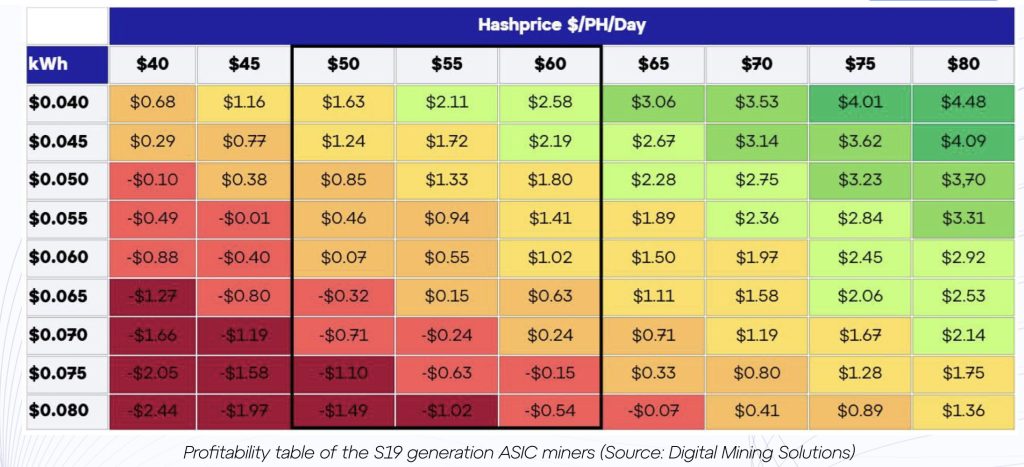
While the S19 has been a workhorse since its release five years ago, it is now a liability for many mining farms. The narrowing profit margins are an indicator of how quickly economic viability can shift, particularly in an industry facing both internal halving events and external competition from AI infrastructure players, GoMining Institutional reports.

Outlook: More Than Just Block Rewards

The report concludes that the first half of 2025 has revealed that Bitcoin mining is no longer a closed system. It’s now a frontline industry operating at the intersection of capital, energy, and compute.

As the network seeks equilibrium after April’s halving, miners must make tough decisions about scale, strategy, and survival.

The second half of the year promises no less intensity—but the winners will be those who can work within capital markets as well as they can manage hashpower.

Piyasa Fırsatı
Threshold Logosu
Threshold Fiyatı(T)
$0,009259
$0,009259$0,009259
+0,60%
USD
Threshold (T) Canlı Fiyat Grafiği
Sorumluluk Reddi: Bu sitede yeniden yayınlanan makaleler, halka açık platformlardan alınmıştır ve yalnızca bilgilendirme amaçlıdır. MEXC'nin görüşlerini yansıtmayabilir. Tüm hakları telif sahiplerine aittir. Herhangi bir içeriğin üçüncü taraf haklarını ihlal ettiğini düşünüyorsanız, kaldırılması için lütfen [email protected] ile iletişime geçin. MEXC, içeriğin doğruluğu, eksiksizliği veya güncelliği konusunda hiçbir garanti vermez ve sağlanan bilgilere dayalı olarak alınan herhangi bir eylemden sorumlu değildir. İçerik, finansal, yasal veya diğer profesyonel tavsiye niteliğinde değildir ve MEXC tarafından bir tavsiye veya onay olarak değerlendirilmemelidir.

Ayrıca Şunları da Beğenebilirsiniz

Santander’s Openbank Sparks Crypto Frenzy in Germany

Santander’s Openbank Sparks Crypto Frenzy in Germany

 In Germany, the digital bank Santander Openbank introduces trading in crypto, which offers BTC, ETH, LTC, POL, and ADA in the MiCA framework of the EU. Santander, the largest bank in Spain, has officially introduced cryptocurrency trading to its clients in Germany, using its digital division, Openbank.  With this new service, users can purchase, sell, […] The post Santander’s Openbank Sparks Crypto Frenzy in Germany appeared first on Live Bitcoin News.
Paylaş
LiveBitcoinNews2025/09/18 04:30
The GENIUS Act Is Already Law. Banks Shouldn’t Try to Rewrite It Now

The GENIUS Act Is Already Law. Banks Shouldn’t Try to Rewrite It Now

The post The GENIUS Act Is Already Law. Banks Shouldn’t Try to Rewrite It Now appeared on BitcoinEthereumNews.com. Healthy competition drives innovation and better products for consumers; it is at the center of American economic leadership. Unfortunately, now that the bipartisan GENIUS Act has been signed into law, major legacy financial institutions seem to be having second thoughts about the innovations that stablecoins can bring to financial markets. Bank lobbying groups and public affairs teams have been peppering Congress with complaints about the law, urging members to reopen debate and introduce changes to the legislation that will ensure the stablecoin market doesn’t grow too quickly, protecting banks’ profits and stifling consumer choice. This reactionary response is both overblown and unnecessary. What legacy financial firms should do instead is embrace competition and offer exciting new products and services that consumers want, not try to kneecap emerging players through anti-innovation rules and regulations. The GENIUS Act was carefully designed with a thorough bipartisan process to strengthen consumer safeguards, ensure regulatory oversight, and preserve financial stability. Efforts to roll back its provisions are less about protecting families and more about protecting entrenched banking interests from the competition that helps ensure the U.S. banking system stays the strongest and most innovative in the world. Critics warn that allowing stablecoins to provide rewards could lead to massive deposit outflows from community banks, with figures as high as $6.6 trillion cited. But closer examination shows this fear is unfounded. A July 2025 analysis by consulting firm Charles River Associates found no statistically significant relationship between stablecoin adoption and community bank deposit outflows. In fact, the overwhelming majority of stablecoin reserves remain in the traditional financial system — either in commercial bank accounts or in short-term Treasuries — where they continue to support liquidity and credit in the broader U.S. economy. The dire estimates rely on unrealistic assumptions that every dollar of stablecoin issuance permanently…
Paylaş
BitcoinEthereumNews2025/09/18 09:39
Grayscale’s GDLC Fund, Holding SOL and ADA, Receives SEC Approval for NYSE Listing

Grayscale’s GDLC Fund, Holding SOL and ADA, Receives SEC Approval for NYSE Listing

Grayscale’s GDLC Fund, holding BTC, ETH, XRP, SOL, and ADA, receives SEC approval to list on NYSE Arca, offering crypto exposure.   Grayscale’s Digital Large Cap Fund (GDLC) holds major cryptocurrencies like Bitcoin, Ethereum, XRP, Solana, and Cardano. The U.S. SEC has approved GDLC to list on NYSE Arca. This gives investors regulated access to […] The post Grayscale’s GDLC Fund, Holding SOL and ADA, Receives SEC Approval for NYSE Listing appeared first on Live Bitcoin News.
Paylaş
LiveBitcoinNews2025/09/18 19:30