Connecticut Governor Ned Lamont has officially signed into law a comprehensive “Bitcoin Reserve Ban” that prohibits the state from accepting, holding, or investing in digital asset. The legislation, known as H.B. 7082, passed unanimously through both the state House of Representatives and Senate without a single opposing vote. Source: cga.ct.gov The new law explicitly bars Connecticut and its political subdivisions from accepting virtual currency as payment or establishing any form of digital asset reserve . This positions Connecticut as one of the most restrictive states regarding cryptocurrency adoption, contrasting sharply with the growing trend of Bitcoin reserve legislation across the United States. The timing appears particularly significant, as 26 states have introduced 47 Bitcoin reserve bills, with Texas, New Hampshire, and Arizona already having approved state-level Bitcoin reserve frameworks. Connecticut’s decision effectively removes it from the national conversation around strategic crypto adoption for public treasuries. The legislation extends beyond investment restrictions to comprehensive regulations governing the transmission of money. Crypto businesses must now provide extensive disclosures about material risks, including warnings about fraud potential, market volatility, and the irreversible nature of transactions. Additional protections require parental verification for users under 18 years old. 🚨 NEW: Connecticut Governor Ned Lamont officially signed into law the state's 'Bitcoin Reserve Ban' today. Connecticut is now prohibited from accepting, holding, or investing in digital assets. https://t.co/vIXIkprdHI — Bitcoin Laws (@Bitcoin_Laws) July 1, 2025 States Rally Around Bitcoin Adoption Despite Federal Uncertainty Crypto adoption at the state level is aggressively growing and starkly contrasts with this new Connecticut move. Texas leads the movement with Governor Greg Abbott signing Senate Bill 21 , establishing America’s first state-funded Bitcoin reserve entirely separate from the state treasury. ✅ Texas has officially joined the small but growing list of U.S. states moving toward on-chain finance, passing a bill that protects Bitcoin reserves. #Texas #Bitcoin https://t.co/kBh6nFgROs — Cryptonews.com (@cryptonews) June 22, 2025 Texas Comptroller Glenn Hegar will oversee the fund, with companion legislation HB 4488 protecting reserves from routine fund reallocations. Senator Charles Schwertner led the initiative, arguing, “ the state of Texas should have the option of evaluating the best performing asset over the last 10 years. “ New Hampshire also achieved a historic milestone by becoming the first state to pass laws allowing public funds to be invested in Bitcoin reserves . Governor Kelly Ayotte signed legislation permitting up to a 5% allocation in digital assets with a market capitalization exceeding $500 billion, effectively targeting Bitcoin exclusively. California is also not left out with its progressive adoption through Assembly Bill 1180 , which unanimously passed with 78 Assembly Members supporting pilot programs for digital asset fee payments. The Department of Financial Protection and Innovation will create frameworks for cryptocurrency-based government transactions by 2025. Arizona, however, presents a complex picture, with Governor Katie Hobbs vetoing comprehensive Bitcoin reserve legislation while simultaneously signing HB 2749, which creates frameworks for managing unclaimed digital assets. The state maintains multiple active bills, including revised HB2324, which recently passed Senate reconsideration. Corporate adoption accelerates regardless of state-level policies, with 252 entities now holding Bitcoin, representing approximately 16.57% of the total supply. Source: BitcoinTreasuries Strategy maintains the largest position at 597,325 BTC worth $63.93 billion, with the most recent purchase being 4,980 Bitcoin for $531.1 million, at an average price of approximately $106,801 per bitcoin. Source: SaylorTracker Regulatory Patchwork Creates Compliance Challenges Notably, the new Connecticut law mandates extensive compliance measures, including customer identification protocols, transaction receipt requirements, and robust risk disclosure frameworks that exceed federal minimums. Money transmission licensees must maintain virtual currency holdings equal to customer obligations while prohibiting unauthorized use of controlled assets. The legislation establishes that virtual currency held by licensees becomes property interests of claimants, creating additional legal protections for consumers. Several states have abandoned their efforts to reserve Bitcoin, creating an inconsistent national landscape. Florida withdrew House Bill 487 and Senate Bill 550 during legislative sessions, joining Wyoming , South Dakota, North Dakota , Pennsylvania, Montana, and Oklahoma in failed adoption attempts. Positively, some other states are still in the process. For instance, Michigan introduced House Bill 4087 , which allows for a 10% treasury allocation to cryptocurrencies. 🇺🇸 The Michigan House Bill was introduced by Representatives Bryan Posthumus and Ron Robinson to push for a strategic Bitcoin reserve. #BitcoinReserve #Michigan https://t.co/fXJSPOQ6gs — Cryptonews.com (@cryptonews) February 14, 2025 At the same time, Ohio advanced Senate Bill 57 , which creates exclusive Bitcoin reserve funds with mandatory five-year holding periods. Similarly, North Carolina also passed legislation permitting a 5% investment allocation pending validation by third-party oversight. Additionally, West Virginia’s Inflation Protection Act proposes a 10% treasury allocation to digital assets with a market capitalization exceeding $750 billion, effectively limiting investments to Bitcoin and select stablecoins. The legislation positions precious metals and cryptocurrencies as inflation hedges against government spending deficits. Oklahoma has also approved the Strategic Bitcoin Reserve Act through the House Committee with a 12-2 vote, allowing for a 10% public fund allocation to digital assets that meet market capitalization thresholds. The state previously passed Bitcoin Rights legislation protecting self-custody rights and transaction freedoms.Connecticut Governor Ned Lamont has officially signed into law a comprehensive “Bitcoin Reserve Ban” that prohibits the state from accepting, holding, or investing in digital asset. The legislation, known as H.B. 7082, passed unanimously through both the state House of Representatives and Senate without a single opposing vote. Source: cga.ct.gov The new law explicitly bars Connecticut and its political subdivisions from accepting virtual currency as payment or establishing any form of digital asset reserve . This positions Connecticut as one of the most restrictive states regarding cryptocurrency adoption, contrasting sharply with the growing trend of Bitcoin reserve legislation across the United States. The timing appears particularly significant, as 26 states have introduced 47 Bitcoin reserve bills, with Texas, New Hampshire, and Arizona already having approved state-level Bitcoin reserve frameworks. Connecticut’s decision effectively removes it from the national conversation around strategic crypto adoption for public treasuries. The legislation extends beyond investment restrictions to comprehensive regulations governing the transmission of money. Crypto businesses must now provide extensive disclosures about material risks, including warnings about fraud potential, market volatility, and the irreversible nature of transactions. Additional protections require parental verification for users under 18 years old. 🚨 NEW: Connecticut Governor Ned Lamont officially signed into law the state's 'Bitcoin Reserve Ban' today. Connecticut is now prohibited from accepting, holding, or investing in digital assets. https://t.co/vIXIkprdHI — Bitcoin Laws (@Bitcoin_Laws) July 1, 2025 States Rally Around Bitcoin Adoption Despite Federal Uncertainty Crypto adoption at the state level is aggressively growing and starkly contrasts with this new Connecticut move. Texas leads the movement with Governor Greg Abbott signing Senate Bill 21 , establishing America’s first state-funded Bitcoin reserve entirely separate from the state treasury. ✅ Texas has officially joined the small but growing list of U.S. states moving toward on-chain finance, passing a bill that protects Bitcoin reserves. #Texas #Bitcoin https://t.co/kBh6nFgROs — Cryptonews.com (@cryptonews) June 22, 2025 Texas Comptroller Glenn Hegar will oversee the fund, with companion legislation HB 4488 protecting reserves from routine fund reallocations. Senator Charles Schwertner led the initiative, arguing, “ the state of Texas should have the option of evaluating the best performing asset over the last 10 years. “ New Hampshire also achieved a historic milestone by becoming the first state to pass laws allowing public funds to be invested in Bitcoin reserves . Governor Kelly Ayotte signed legislation permitting up to a 5% allocation in digital assets with a market capitalization exceeding $500 billion, effectively targeting Bitcoin exclusively. California is also not left out with its progressive adoption through Assembly Bill 1180 , which unanimously passed with 78 Assembly Members supporting pilot programs for digital asset fee payments. The Department of Financial Protection and Innovation will create frameworks for cryptocurrency-based government transactions by 2025. Arizona, however, presents a complex picture, with Governor Katie Hobbs vetoing comprehensive Bitcoin reserve legislation while simultaneously signing HB 2749, which creates frameworks for managing unclaimed digital assets. The state maintains multiple active bills, including revised HB2324, which recently passed Senate reconsideration. Corporate adoption accelerates regardless of state-level policies, with 252 entities now holding Bitcoin, representing approximately 16.57% of the total supply. Source: BitcoinTreasuries Strategy maintains the largest position at 597,325 BTC worth $63.93 billion, with the most recent purchase being 4,980 Bitcoin for $531.1 million, at an average price of approximately $106,801 per bitcoin. Source: SaylorTracker Regulatory Patchwork Creates Compliance Challenges Notably, the new Connecticut law mandates extensive compliance measures, including customer identification protocols, transaction receipt requirements, and robust risk disclosure frameworks that exceed federal minimums. Money transmission licensees must maintain virtual currency holdings equal to customer obligations while prohibiting unauthorized use of controlled assets. The legislation establishes that virtual currency held by licensees becomes property interests of claimants, creating additional legal protections for consumers. Several states have abandoned their efforts to reserve Bitcoin, creating an inconsistent national landscape. Florida withdrew House Bill 487 and Senate Bill 550 during legislative sessions, joining Wyoming , South Dakota, North Dakota , Pennsylvania, Montana, and Oklahoma in failed adoption attempts. Positively, some other states are still in the process. For instance, Michigan introduced House Bill 4087 , which allows for a 10% treasury allocation to cryptocurrencies. 🇺🇸 The Michigan House Bill was introduced by Representatives Bryan Posthumus and Ron Robinson to push for a strategic Bitcoin reserve. #BitcoinReserve #Michigan https://t.co/fXJSPOQ6gs — Cryptonews.com (@cryptonews) February 14, 2025 At the same time, Ohio advanced Senate Bill 57 , which creates exclusive Bitcoin reserve funds with mandatory five-year holding periods. Similarly, North Carolina also passed legislation permitting a 5% investment allocation pending validation by third-party oversight. Additionally, West Virginia’s Inflation Protection Act proposes a 10% treasury allocation to digital assets with a market capitalization exceeding $750 billion, effectively limiting investments to Bitcoin and select stablecoins. The legislation positions precious metals and cryptocurrencies as inflation hedges against government spending deficits. Oklahoma has also approved the Strategic Bitcoin Reserve Act through the House Committee with a 12-2 vote, allowing for a 10% public fund allocation to digital assets that meet market capitalization thresholds. The state previously passed Bitcoin Rights legislation protecting self-custody rights and transaction freedoms.

Connecticut Goes Anti-Crypto as Governor Lamont Signs Bill Banning State Digital Asset Investments

Connecticut Governor Ned Lamont has officially signed into law a comprehensive “Bitcoin Reserve Ban” that prohibits the state from accepting, holding, or investing in digital asset.

The legislation, known as H.B. 7082, passed unanimously through both the state House of Representatives and Senate without a single opposing vote.
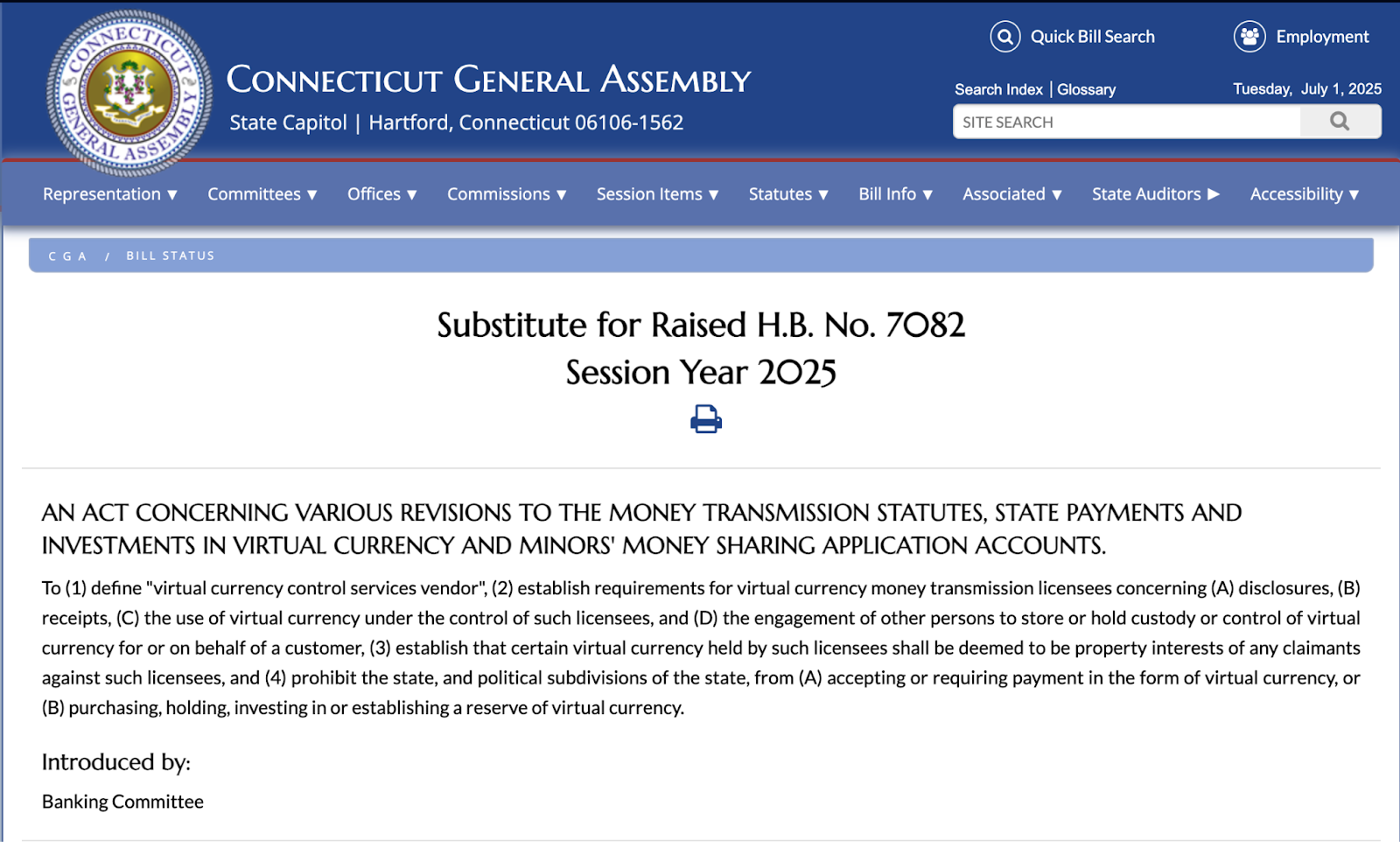
Connecticut Goes Anti-Crypto as Governor Lamont Signs Bill Banning State Digital Asset InvestmentsSource: cga.ct.gov

The new law explicitly bars Connecticut and its political subdivisions from accepting virtual currency as payment or establishing any form of digital asset reserve.

This positions Connecticut as one of the most restrictive states regarding cryptocurrency adoption, contrasting sharply with the growing trend of Bitcoin reserve legislation across the United States.

The timing appears particularly significant, as 26 states have introduced 47 Bitcoin reserve bills, with Texas, New Hampshire, and Arizona already having approved state-level Bitcoin reserve frameworks.

Connecticut’s decision effectively removes it from the national conversation around strategic crypto adoption for public treasuries.

The legislation extends beyond investment restrictions to comprehensive regulations governing the transmission of money.

Crypto businesses must now provide extensive disclosures about material risks, including warnings about fraud potential, market volatility, and the irreversible nature of transactions.

Additional protections require parental verification for users under 18 years old.

States Rally Around Bitcoin Adoption Despite Federal Uncertainty

Crypto adoption at the state level is aggressively growing and starkly contrasts with this new Connecticut move.

Texas leads the movement with Governor Greg Abbott signing Senate Bill 21, establishing America’s first state-funded Bitcoin reserve entirely separate from the state treasury.

Texas Comptroller Glenn Hegar will oversee the fund, with companion legislation HB 4488 protecting reserves from routine fund reallocations.

Senator Charles Schwertner led the initiative, arguing, “the state of Texas should have the option of evaluating the best performing asset over the last 10 years.

New Hampshire also achieved a historic milestone by becoming the first state to pass laws allowing public funds to be invested in Bitcoin reserves.

Governor Kelly Ayotte signed legislation permitting up to a 5% allocation in digital assets with a market capitalization exceeding $500 billion, effectively targeting Bitcoin exclusively.

California is also not left out with its progressive adoption through Assembly Bill 1180, which unanimously passed with 78 Assembly Members supporting pilot programs for digital asset fee payments.

The Department of Financial Protection and Innovation will create frameworks for cryptocurrency-based government transactions by 2025.

Arizona, however, presents a complex picture, with Governor Katie Hobbs vetoing comprehensive Bitcoin reserve legislation while simultaneously signing HB 2749, which creates frameworks for managing unclaimed digital assets.

The state maintains multiple active bills, including revised HB2324, which recently passed Senate reconsideration.

Corporate adoption accelerates regardless of state-level policies, with 252 entities now holding Bitcoin, representing approximately 16.57% of the total supply.

Connecticut Goes Anti-Crypto as Governor Lamont Signs Bill Banning State Digital Asset InvestmentsSource: BitcoinTreasuries

Strategy maintains the largest position at 597,325 BTC worth $63.93 billion, with the most recent purchase being 4,980 Bitcoin for $531.1 million, at an average price of approximately $106,801 per bitcoin.

Connecticut Goes Anti-Crypto as Governor Lamont Signs Bill Banning State Digital Asset InvestmentsSource: SaylorTracker

Regulatory Patchwork Creates Compliance Challenges

Notably, the new Connecticut law mandates extensive compliance measures, including customer identification protocols, transaction receipt requirements, and robust risk disclosure frameworks that exceed federal minimums.

Money transmission licensees must maintain virtual currency holdings equal to customer obligations while prohibiting unauthorized use of controlled assets.

The legislation establishes that virtual currency held by licensees becomes property interests of claimants, creating additional legal protections for consumers.

Several states have abandoned their efforts to reserve Bitcoin, creating an inconsistent national landscape.

Florida withdrew House Bill 487 and Senate Bill 550 during legislative sessions, joining Wyoming, South Dakota, North Dakota, Pennsylvania, Montana, and Oklahoma in failed adoption attempts.

Positively, some other states are still in the process. For instance, Michigan introduced House Bill 4087, which allows for a 10% treasury allocation to cryptocurrencies.

At the same time, Ohio advanced Senate Bill 57, which creates exclusive Bitcoin reserve funds with mandatory five-year holding periods.

Similarly, North Carolina also passed legislation permitting a 5% investment allocation pending validation by third-party oversight.

Additionally, West Virginia’s Inflation Protection Act proposes a 10% treasury allocation to digital assets with a market capitalization exceeding $750 billion, effectively limiting investments to Bitcoin and select stablecoins.

The legislation positions precious metals and cryptocurrencies as inflation hedges against government spending deficits.

Oklahoma has also approved the Strategic Bitcoin Reserve Act through the House Committee with a 12-2 vote, allowing for a 10% public fund allocation to digital assets that meet market capitalization thresholds.

The state previously passed Bitcoin Rights legislation protecting self-custody rights and transaction freedoms.

Piyasa Fırsatı
B Logosu
B Fiyatı(B)
$0,17901
$0,17901$0,17901
-%3,08
USD
B (B) Canlı Fiyat Grafiği
Sorumluluk Reddi: Bu sitede yeniden yayınlanan makaleler, halka açık platformlardan alınmıştır ve yalnızca bilgilendirme amaçlıdır. MEXC'nin görüşlerini yansıtmayabilir. Tüm hakları telif sahiplerine aittir. Herhangi bir içeriğin üçüncü taraf haklarını ihlal ettiğini düşünüyorsanız, kaldırılması için lütfen [email protected] ile iletişime geçin. MEXC, içeriğin doğruluğu, eksiksizliği veya güncelliği konusunda hiçbir garanti vermez ve sağlanan bilgilere dayalı olarak alınan herhangi bir eylemden sorumlu değildir. İçerik, finansal, yasal veya diğer profesyonel tavsiye niteliğinde değildir ve MEXC tarafından bir tavsiye veya onay olarak değerlendirilmemelidir.

Ayrıca Şunları da Beğenebilirsiniz

Ethereum unveils roadmap focusing on scaling, interoperability, and security at Japan Dev Conference

Ethereum unveils roadmap focusing on scaling, interoperability, and security at Japan Dev Conference

The post Ethereum unveils roadmap focusing on scaling, interoperability, and security at Japan Dev Conference appeared on BitcoinEthereumNews.com. Key Takeaways Ethereum’s new roadmap was presented by Vitalik Buterin at the Japan Dev Conference. Short-term priorities include Layer 1 scaling and raising gas limits to enhance transaction throughput. Vitalik Buterin presented Ethereum’s development roadmap at the Japan Dev Conference today, outlining the blockchain platform’s priorities across multiple timeframes. The short-term goals focus on scaling solutions and increasing Layer 1 gas limits to improve transaction capacity. Mid-term objectives target enhanced cross-Layer 2 interoperability and faster network responsiveness to create a more seamless user experience across different scaling solutions. The long-term vision emphasizes building a secure, simple, quantum-resistant, and formally verified minimalist Ethereum network. This approach aims to future-proof the platform against emerging technological threats while maintaining its core functionality. The roadmap presentation comes as Ethereum continues to compete with other blockchain platforms for market share in the smart contract and decentralized application space. Source: https://cryptobriefing.com/ethereum-roadmap-scaling-interoperability-security-japan/
Paylaş
BitcoinEthereumNews2025/09/18 00:25
Shocking OpenVPP Partnership Claim Draws Urgent Scrutiny

Shocking OpenVPP Partnership Claim Draws Urgent Scrutiny

The post Shocking OpenVPP Partnership Claim Draws Urgent Scrutiny appeared on BitcoinEthereumNews.com. The cryptocurrency world is buzzing with a recent controversy surrounding a bold OpenVPP partnership claim. This week, OpenVPP (OVPP) announced what it presented as a significant collaboration with the U.S. government in the innovative field of energy tokenization. However, this claim quickly drew the sharp eye of on-chain analyst ZachXBT, who highlighted a swift and official rebuttal that has sent ripples through the digital asset community. What Sparked the OpenVPP Partnership Claim Controversy? The core of the issue revolves around OpenVPP’s assertion of a U.S. government partnership. This kind of collaboration would typically be a monumental endorsement for any private cryptocurrency project, especially given the current regulatory climate. Such a partnership could signify a new era of mainstream adoption and legitimacy for energy tokenization initiatives. OpenVPP initially claimed cooperation with the U.S. government. This alleged partnership was said to be in the domain of energy tokenization. The announcement generated considerable interest and discussion online. ZachXBT, known for his diligent on-chain investigations, was quick to flag the development. He brought attention to the fact that U.S. Securities and Exchange Commission (SEC) Commissioner Hester Peirce had directly addressed the OpenVPP partnership claim. Her response, delivered within hours, was unequivocal and starkly contradicted OpenVPP’s narrative. How Did Regulatory Authorities Respond to the OpenVPP Partnership Claim? Commissioner Hester Peirce’s statement was a crucial turning point in this unfolding story. She clearly stated that the SEC, as an agency, does not engage in partnerships with private cryptocurrency projects. This response effectively dismantled the credibility of OpenVPP’s initial announcement regarding their supposed government collaboration. Peirce’s swift clarification underscores a fundamental principle of regulatory bodies: maintaining impartiality and avoiding endorsements of private entities. Her statement serves as a vital reminder to the crypto community about the official stance of government agencies concerning private ventures. Moreover, ZachXBT’s analysis…
Paylaş
BitcoinEthereumNews2025/09/18 02:13
Gemini Exchange Launches BNB Trading and Custody Services

Gemini Exchange Launches BNB Trading and Custody Services

The post Gemini Exchange Launches BNB Trading and Custody Services appeared on BitcoinEthereumNews.com. TLDR: Gemini becomes latest major U.S. exchange to offer
Paylaş
BitcoinEthereumNews2025/12/26 16:43