By Ethan, Odaily Planet Daily In the DeFi world, TVL is a crucial metric—it serves as both a symbol of protocol strength and a barometer of user trust. However, a controversy surrounding the fabrication of $12 billion in Reliable Validation Area (RWA) assets quickly eroded user trust. On September 10, Figure co-founder Mike Cagney took the lead in firing on the X platform, publicly accusing the on-chain data platform DefiLlama of refusing to display its RWA TVL simply because of "insufficient number of fans on social platforms" and questioning the fairness of its "decentralization standard." A few days later, DefiLlama co-founder 0xngmi published a long article titled "The Problem in RWA Metrics" in response, revealing the data anomalies behind Figure's claimed $12 billion scale, pointing out that its on-chain data is unverifiable, the assets lack a real transfer path, and there is even suspicion of evading due diligence. As a result, a full-scale battle for trust over "on-chain verifiability" and "off-chain mapping logic" broke out. Timeline of events: Figure initiated the attack, and DefiLlama responded strongly. The controversy was sparked by a tweet from Figure co-founder Mike Cagney. On September 10th, he announced on the X platform that Figure's home equity line of credit (HELOCs) had been successfully listed on CoinGecko. He also accused DefiLlama of refusing to display Figure's $13 billion TVL on the Provenance Chain. He directly criticized DefiLlama's "censorship logic," even claiming that they denied its inclusion on the list due to "X's insufficient number of followers." (Odaily Note: Mike Cagney's reference to $13 billion here is inconsistent with the $12 billion figure reported in 0xngmi's response later in the article.) About an hour after this statement was made, Provenance Blockchain CEO Anthony Moro (who, judging by the context, appears to have intervened without fully understanding the background) commented on the same thread, expressing strong distrust of the industry data platform DefiLlama: Later, Figure co-founder Mike Cagney added that he understood the development costs of integrating the new L1, but also said that Coingecko and DefiLlama had never asked Figure for fees or tokens to clarify their implication of "paying to be on the list." On September 12, Jon Ma, co-founder and CEO of L1 data dashboard Artemis (also seemingly without full knowledge of the details of the dispute), publicly extended an olive branch. During this period, public opinion clearly favored Figure - many onlookers pointed the finger at DefiLlama's "credibility and neutrality." It wasn't until September 13th that DefiLlama co-founder 0xngmi published a lengthy article titled "The Problem in RWA Metrics," systematically disclosing his due diligence findings and four questions, that the narrative began to reverse. Opinion leaders like ZachXBT then reposted the article in support, emphasizing that "these metrics are not 100% verifiable on-chain," and DefiLlama's position gained wider support. DefiLlama's findings: Data mismatch In the long article "The Problem in RWA Metrics", 0xngmi announced the results of the DefiLlama team's due diligence on Figure, listing multiple anomalies one by one: The scale of assets on the chain is seriously inconsistent with the declared scale Figure claims that the scale of RWA issued on its chain has reached 12 billion US dollars, but the actual assets that can be verified on the chain are only about 5 million US dollars of BTC and 4 million US dollars of ETH. Among them, the 24-hour trading volume of BTC is even only 2,000 US dollars. Insufficient stablecoin supply The total supply of Figure's own stablecoin YLDS is only 20 million. In theory, all RWA transactions should be based on this, but the supply is far from enough to support a transaction volume of US$12 billion. Suspicious asset transfer patterns Most RWA asset transfers are not initiated by the actual asset holders, but rather through other accounts. Many addresses themselves have almost no on-chain interactions and are suspected to be just database mirrors. Lack of on-chain payment traces The vast majority of Figure's loan processes are still completed using fiat currency, and there are almost no corresponding payment and repayment records on the chain. 0xngmi added: “We’re unsure how Figure’s $12 billion in assets are actually being traded. Most holders don’t appear to be using their own keys to transfer these assets — are they simply mirroring their internal databases onto the chain?” Community Statement: DefiLlama Receives Overwhelming Support As the controversy spread, community opinion almost overwhelmingly supported DefiLlama, but in the process, some voices from different perspectives also emerged. ZachXBT (Chain Detective): They bluntly stated that Figure’s actions were “blatant pressure” and made it clear: “No, your company is trying to use indicators that are not 100% verifiable on the chain to publicly pressure participants like DefiLlama who have been proven to be honest.” Conor Grogan (Coinbase Board Member): He directed his criticism at those institutional figures who were lobbied by Figure and who privately questioned DefiLlama when the controversy was still murky. He wrote: "I have received numerous private inquiries from individuals from large cryptocurrency institutions and venture capital firms to contact DefiLlama and our partners. Every one of these people needs to be called out and asked how they can work in this industry if they can't even verify things themselves." Conor's remarks echoed the thoughts of many people: if even basic on-chain verification cannot be completed independently, then the credibility of these institutions in the RWA and DeFi sectors will be greatly reduced. Ian Kane (Head of Partnerships, Midnight Network): A more technical suggestion was made, suggesting that DefiLlama could add a new metric, "active TVL," in addition to the existing TVL tracking, to show the actual transfer rate of RWA over a given period. He gave an example: "For example, two DApps each minted $100 billion in TVL (a total of $200 billion). DApp 1 has $100 billion sitting idle, with perhaps only 2% of its funds flowing, generating $2 billion in active locked value. DApp 2, on the other hand, has 30% of its funds flowing, generating $30 billion in active locked value (15 times that of DApp 1)." In his opinion, such a dimension can not only show the total scale, but also avoid "stagnant or show-off TVL." At the same time, ZachXBT also noticed that Figure co-founder Mike Cagney kept forwarding some "support comments" that were suspected to be automatically generated by AI, and publicly pointed this out, further arousing disgust with Figure's public opinion manipulation. Conclusion: The price of trust has just begun to show The dispute between Figure and DefiLlama may seem like a ranking issue, but it actually hits the core weakness of the RWA track - what exactly is considered an "on-chain asset." The core contradiction of this turmoil is actually on-chain fundamentalism vs. off-chain mapping logic. DefiLlama insists on only counting TVL that can be verified on the chain, adhering to open source adapter logic, and refusing to accept asset data that fails to meet transparency requirements. Figure's model: While assets may exist in the real world, the business logic relies heavily on traditional financial systems, with the on-chain portion merely being a database echo. In other words, users cannot use on-chain transactions to prove the transfer of assets, which conflicts with the "verifiability" standard of DeFi natives. The so-called $12 billion is equal to 0 if it cannot be verified on the chain. In an industry where transparency and verifiability are the bottom line, any attempt to bypass on-chain verification and use database numbers to impersonate on-chain TVL will ultimately undermine user and market trust. This controversy may just be the beginning. Similar issues will continue to arise as more RWA protocols emerge. The industry urgently needs to establish clear and unified verification standards, otherwise "virtual TVL" will continue to expand, becoming the next landmine that erodes trust.By Ethan, Odaily Planet Daily In the DeFi world, TVL is a crucial metric—it serves as both a symbol of protocol strength and a barometer of user trust. However, a controversy surrounding the fabrication of $12 billion in Reliable Validation Area (RWA) assets quickly eroded user trust. On September 10, Figure co-founder Mike Cagney took the lead in firing on the X platform, publicly accusing the on-chain data platform DefiLlama of refusing to display its RWA TVL simply because of "insufficient number of fans on social platforms" and questioning the fairness of its "decentralization standard." A few days later, DefiLlama co-founder 0xngmi published a long article titled "The Problem in RWA Metrics" in response, revealing the data anomalies behind Figure's claimed $12 billion scale, pointing out that its on-chain data is unverifiable, the assets lack a real transfer path, and there is even suspicion of evading due diligence. As a result, a full-scale battle for trust over "on-chain verifiability" and "off-chain mapping logic" broke out. Timeline of events: Figure initiated the attack, and DefiLlama responded strongly. The controversy was sparked by a tweet from Figure co-founder Mike Cagney. On September 10th, he announced on the X platform that Figure's home equity line of credit (HELOCs) had been successfully listed on CoinGecko. He also accused DefiLlama of refusing to display Figure's $13 billion TVL on the Provenance Chain. He directly criticized DefiLlama's "censorship logic," even claiming that they denied its inclusion on the list due to "X's insufficient number of followers." (Odaily Note: Mike Cagney's reference to $13 billion here is inconsistent with the $12 billion figure reported in 0xngmi's response later in the article.) About an hour after this statement was made, Provenance Blockchain CEO Anthony Moro (who, judging by the context, appears to have intervened without fully understanding the background) commented on the same thread, expressing strong distrust of the industry data platform DefiLlama: Later, Figure co-founder Mike Cagney added that he understood the development costs of integrating the new L1, but also said that Coingecko and DefiLlama had never asked Figure for fees or tokens to clarify their implication of "paying to be on the list." On September 12, Jon Ma, co-founder and CEO of L1 data dashboard Artemis (also seemingly without full knowledge of the details of the dispute), publicly extended an olive branch. During this period, public opinion clearly favored Figure - many onlookers pointed the finger at DefiLlama's "credibility and neutrality." It wasn't until September 13th that DefiLlama co-founder 0xngmi published a lengthy article titled "The Problem in RWA Metrics," systematically disclosing his due diligence findings and four questions, that the narrative began to reverse. Opinion leaders like ZachXBT then reposted the article in support, emphasizing that "these metrics are not 100% verifiable on-chain," and DefiLlama's position gained wider support. DefiLlama's findings: Data mismatch In the long article "The Problem in RWA Metrics", 0xngmi announced the results of the DefiLlama team's due diligence on Figure, listing multiple anomalies one by one: The scale of assets on the chain is seriously inconsistent with the declared scale Figure claims that the scale of RWA issued on its chain has reached 12 billion US dollars, but the actual assets that can be verified on the chain are only about 5 million US dollars of BTC and 4 million US dollars of ETH. Among them, the 24-hour trading volume of BTC is even only 2,000 US dollars. Insufficient stablecoin supply The total supply of Figure's own stablecoin YLDS is only 20 million. In theory, all RWA transactions should be based on this, but the supply is far from enough to support a transaction volume of US$12 billion. Suspicious asset transfer patterns Most RWA asset transfers are not initiated by the actual asset holders, but rather through other accounts. Many addresses themselves have almost no on-chain interactions and are suspected to be just database mirrors. Lack of on-chain payment traces The vast majority of Figure's loan processes are still completed using fiat currency, and there are almost no corresponding payment and repayment records on the chain. 0xngmi added: “We’re unsure how Figure’s $12 billion in assets are actually being traded. Most holders don’t appear to be using their own keys to transfer these assets — are they simply mirroring their internal databases onto the chain?” Community Statement: DefiLlama Receives Overwhelming Support As the controversy spread, community opinion almost overwhelmingly supported DefiLlama, but in the process, some voices from different perspectives also emerged. ZachXBT (Chain Detective): They bluntly stated that Figure’s actions were “blatant pressure” and made it clear: “No, your company is trying to use indicators that are not 100% verifiable on the chain to publicly pressure participants like DefiLlama who have been proven to be honest.” Conor Grogan (Coinbase Board Member): He directed his criticism at those institutional figures who were lobbied by Figure and who privately questioned DefiLlama when the controversy was still murky. He wrote: "I have received numerous private inquiries from individuals from large cryptocurrency institutions and venture capital firms to contact DefiLlama and our partners. Every one of these people needs to be called out and asked how they can work in this industry if they can't even verify things themselves." Conor's remarks echoed the thoughts of many people: if even basic on-chain verification cannot be completed independently, then the credibility of these institutions in the RWA and DeFi sectors will be greatly reduced. Ian Kane (Head of Partnerships, Midnight Network): A more technical suggestion was made, suggesting that DefiLlama could add a new metric, "active TVL," in addition to the existing TVL tracking, to show the actual transfer rate of RWA over a given period. He gave an example: "For example, two DApps each minted $100 billion in TVL (a total of $200 billion). DApp 1 has $100 billion sitting idle, with perhaps only 2% of its funds flowing, generating $2 billion in active locked value. DApp 2, on the other hand, has 30% of its funds flowing, generating $30 billion in active locked value (15 times that of DApp 1)." In his opinion, such a dimension can not only show the total scale, but also avoid "stagnant or show-off TVL." At the same time, ZachXBT also noticed that Figure co-founder Mike Cagney kept forwarding some "support comments" that were suspected to be automatically generated by AI, and publicly pointed this out, further arousing disgust with Figure's public opinion manipulation. Conclusion: The price of trust has just begun to show The dispute between Figure and DefiLlama may seem like a ranking issue, but it actually hits the core weakness of the RWA track - what exactly is considered an "on-chain asset." The core contradiction of this turmoil is actually on-chain fundamentalism vs. off-chain mapping logic. DefiLlama insists on only counting TVL that can be verified on the chain, adhering to open source adapter logic, and refusing to accept asset data that fails to meet transparency requirements. Figure's model: While assets may exist in the real world, the business logic relies heavily on traditional financial systems, with the on-chain portion merely being a database echo. In other words, users cannot use on-chain transactions to prove the transfer of assets, which conflicts with the "verifiability" standard of DeFi natives. The so-called $12 billion is equal to 0 if it cannot be verified on the chain. In an industry where transparency and verifiability are the bottom line, any attempt to bypass on-chain verification and use database numbers to impersonate on-chain TVL will ultimately undermine user and market trust. This controversy may just be the beginning. Similar issues will continue to arise as more RWA protocols emerge. The industry urgently needs to establish clear and unified verification standards, otherwise "virtual TVL" will continue to expand, becoming the next landmine that erodes trust.

Figure and DefiLlama’s “RWA Data Falsification” Dispute: What Qualifies as an “On-Chain Asset”?

2025/09/15 07:30

By Ethan, Odaily Planet Daily

In the DeFi world, TVL is a crucial metric—it serves as both a symbol of protocol strength and a barometer of user trust. However, a controversy surrounding the fabrication of $12 billion in Reliable Validation Area (RWA) assets quickly eroded user trust.

On September 10, Figure co-founder Mike Cagney took the lead in firing on the X platform, publicly accusing the on-chain data platform DefiLlama of refusing to display its RWA TVL simply because of "insufficient number of fans on social platforms" and questioning the fairness of its "decentralization standard."

A few days later, DefiLlama co-founder 0xngmi published a long article titled "The Problem in RWA Metrics" in response, revealing the data anomalies behind Figure's claimed $12 billion scale, pointing out that its on-chain data is unverifiable, the assets lack a real transfer path, and there is even suspicion of evading due diligence.

As a result, a full-scale battle for trust over "on-chain verifiability" and "off-chain mapping logic" broke out.

Timeline of events: Figure initiated the attack, and DefiLlama responded strongly.

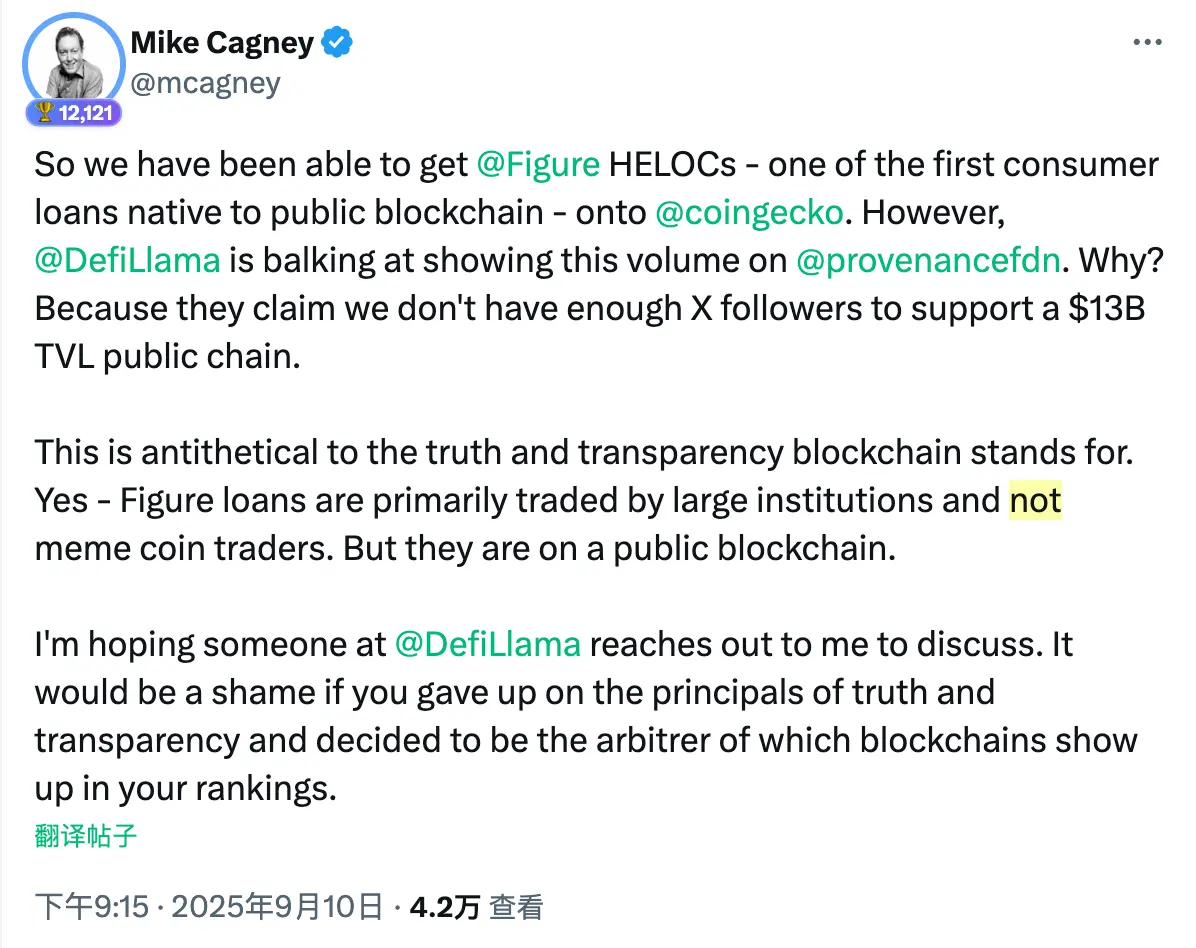
The controversy was sparked by a tweet from Figure co-founder Mike Cagney.

On September 10th, he announced on the X platform that Figure's home equity line of credit (HELOCs) had been successfully listed on CoinGecko. He also accused DefiLlama of refusing to display Figure's $13 billion TVL on the Provenance Chain. He directly criticized DefiLlama's "censorship logic," even claiming that they denied its inclusion on the list due to "X's insufficient number of followers." (Odaily Note: Mike Cagney's reference to $13 billion here is inconsistent with the $12 billion figure reported in 0xngmi's response later in the article.)
About an hour after this statement was made, Provenance Blockchain CEO Anthony Moro (who, judging by the context, appears to have intervened without fully understanding the background) commented on the same thread, expressing strong distrust of the industry data platform DefiLlama:
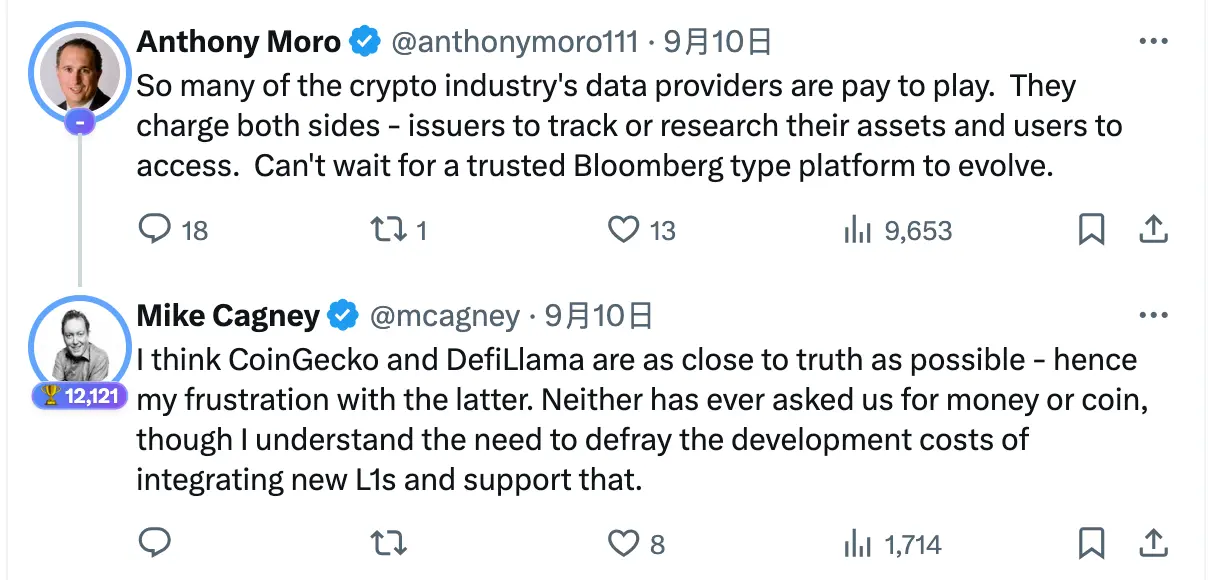
Later, Figure co-founder Mike Cagney added that he understood the development costs of integrating the new L1, but also said that Coingecko and DefiLlama had never asked Figure for fees or tokens to clarify their implication of "paying to be on the list."

On September 12, Jon Ma, co-founder and CEO of L1 data dashboard Artemis (also seemingly without full knowledge of the details of the dispute), publicly extended an olive branch.

During this period, public opinion clearly favored Figure - many onlookers pointed the finger at DefiLlama's "credibility and neutrality."

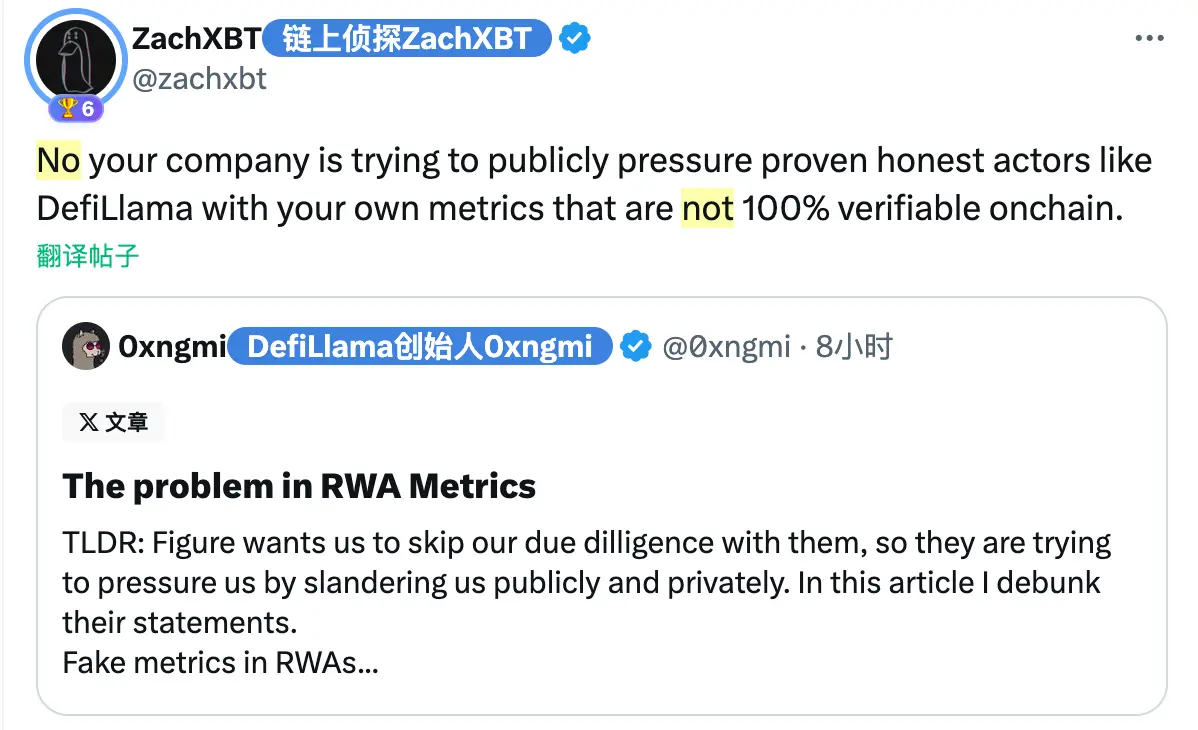
It wasn't until September 13th that DefiLlama co-founder 0xngmi published a lengthy article titled "The Problem in RWA Metrics," systematically disclosing his due diligence findings and four questions, that the narrative began to reverse. Opinion leaders like ZachXBT then reposted the article in support, emphasizing that "these metrics are not 100% verifiable on-chain," and DefiLlama's position gained wider support.
DefiLlama's findings: Data mismatch

In the long article "The Problem in RWA Metrics", 0xngmi announced the results of the DefiLlama team's due diligence on Figure, listing multiple anomalies one by one:

The scale of assets on the chain is seriously inconsistent with the declared scale

Figure claims that the scale of RWA issued on its chain has reached 12 billion US dollars, but the actual assets that can be verified on the chain are only about 5 million US dollars of BTC and 4 million US dollars of ETH. Among them, the 24-hour trading volume of BTC is even only 2,000 US dollars.

Insufficient stablecoin supply

The total supply of Figure's own stablecoin YLDS is only 20 million. In theory, all RWA transactions should be based on this, but the supply is far from enough to support a transaction volume of US$12 billion.

Suspicious asset transfer patterns

Most RWA asset transfers are not initiated by the actual asset holders, but rather through other accounts. Many addresses themselves have almost no on-chain interactions and are suspected to be just database mirrors.

Lack of on-chain payment traces

The vast majority of Figure's loan processes are still completed using fiat currency, and there are almost no corresponding payment and repayment records on the chain.

0xngmi added: “We’re unsure how Figure’s $12 billion in assets are actually being traded. Most holders don’t appear to be using their own keys to transfer these assets — are they simply mirroring their internal databases onto the chain?”

Community Statement: DefiLlama Receives Overwhelming Support

As the controversy spread, community opinion almost overwhelmingly supported DefiLlama, but in the process, some voices from different perspectives also emerged.

ZachXBT (Chain Detective):

They bluntly stated that Figure’s actions were “blatant pressure” and made it clear: “No, your company is trying to use indicators that are not 100% verifiable on the chain to publicly pressure participants like DefiLlama who have been proven to be honest.”

Conor Grogan (Coinbase Board Member):

He directed his criticism at those institutional figures who were lobbied by Figure and who privately questioned DefiLlama when the controversy was still murky. He wrote: "I have received numerous private inquiries from individuals from large cryptocurrency institutions and venture capital firms to contact DefiLlama and our partners. Every one of these people needs to be called out and asked how they can work in this industry if they can't even verify things themselves."

Conor's remarks echoed the thoughts of many people: if even basic on-chain verification cannot be completed independently, then the credibility of these institutions in the RWA and DeFi sectors will be greatly reduced.

Ian Kane (Head of Partnerships, Midnight Network):

A more technical suggestion was made, suggesting that DefiLlama could add a new metric, "active TVL," in addition to the existing TVL tracking, to show the actual transfer rate of RWA over a given period. He gave an example: "For example, two DApps each minted $100 billion in TVL (a total of $200 billion). DApp 1 has $100 billion sitting idle, with perhaps only 2% of its funds flowing, generating $2 billion in active locked value. DApp 2, on the other hand, has 30% of its funds flowing, generating $30 billion in active locked value (15 times that of DApp 1)."

In his opinion, such a dimension can not only show the total scale, but also avoid "stagnant or show-off TVL."

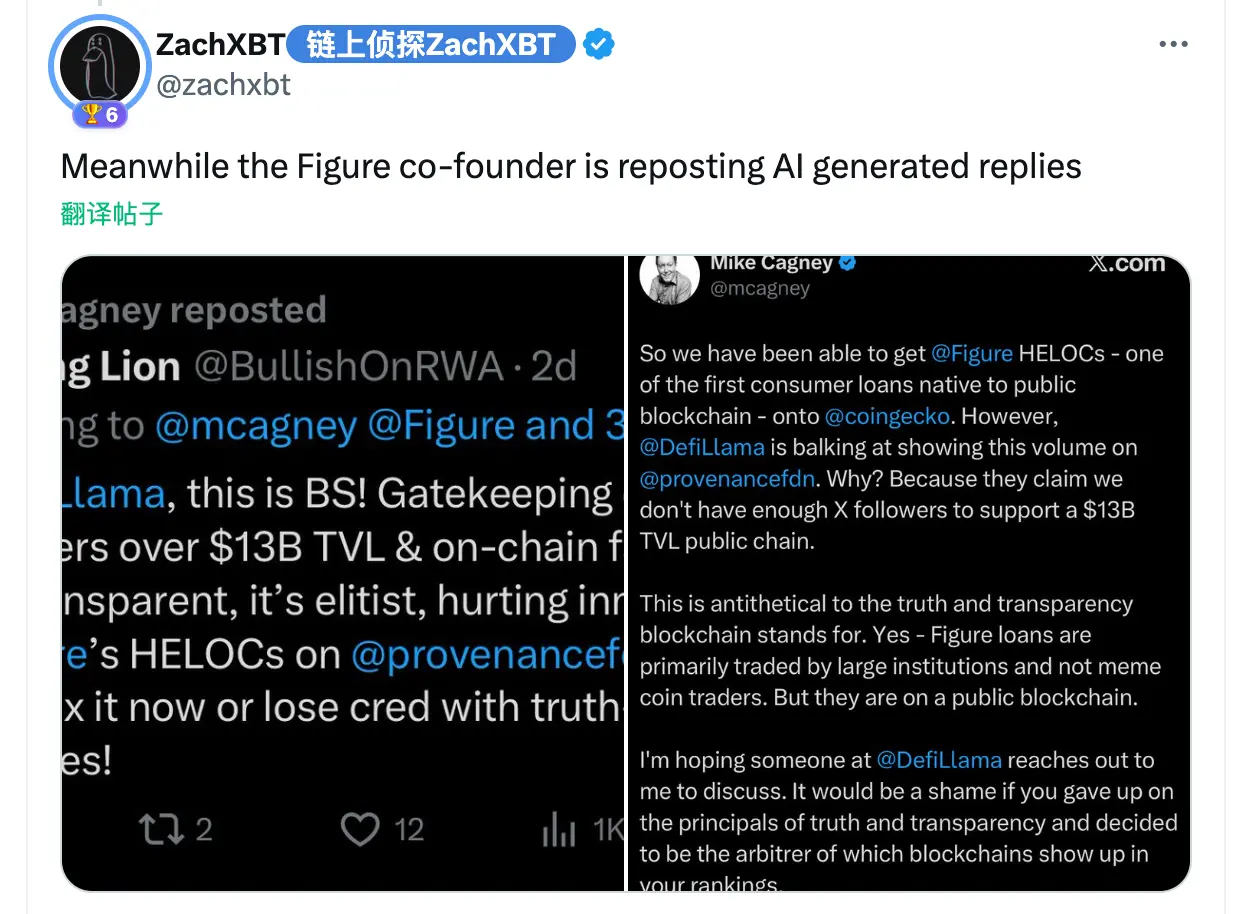
At the same time, ZachXBT also noticed that Figure co-founder Mike Cagney kept forwarding some "support comments" that were suspected to be automatically generated by AI, and publicly pointed this out, further arousing disgust with Figure's public opinion manipulation.
Conclusion: The price of trust has just begun to show

The dispute between Figure and DefiLlama may seem like a ranking issue, but it actually hits the core weakness of the RWA track - what exactly is considered an "on-chain asset."

The core contradiction of this turmoil is actually on-chain fundamentalism vs. off-chain mapping logic.

  • DefiLlama insists on only counting TVL that can be verified on the chain, adhering to open source adapter logic, and refusing to accept asset data that fails to meet transparency requirements.
  • Figure's model: While assets may exist in the real world, the business logic relies heavily on traditional financial systems, with the on-chain portion merely being a database echo. In other words, users cannot use on-chain transactions to prove the transfer of assets, which conflicts with the "verifiability" standard of DeFi natives.

The so-called $12 billion is equal to 0 if it cannot be verified on the chain.

In an industry where transparency and verifiability are the bottom line, any attempt to bypass on-chain verification and use database numbers to impersonate on-chain TVL will ultimately undermine user and market trust.

This controversy may just be the beginning. Similar issues will continue to arise as more RWA protocols emerge. The industry urgently needs to establish clear and unified verification standards, otherwise "virtual TVL" will continue to expand, becoming the next landmine that erodes trust.

Piyasa Fırsatı
Threshold Logosu
Threshold Fiyatı(T)
$0.008825
$0.008825$0.008825
+2.37%
USD
Threshold (T) Canlı Fiyat Grafiği
Sorumluluk Reddi: Bu sitede yeniden yayınlanan makaleler, halka açık platformlardan alınmıştır ve yalnızca bilgilendirme amaçlıdır. MEXC'nin görüşlerini yansıtmayabilir. Tüm hakları telif sahiplerine aittir. Herhangi bir içeriğin üçüncü taraf haklarını ihlal ettiğini düşünüyorsanız, kaldırılması için lütfen [email protected] ile iletişime geçin. MEXC, içeriğin doğruluğu, eksiksizliği veya güncelliği konusunda hiçbir garanti vermez ve sağlanan bilgilere dayalı olarak alınan herhangi bir eylemden sorumlu değildir. İçerik, finansal, yasal veya diğer profesyonel tavsiye niteliğinde değildir ve MEXC tarafından bir tavsiye veya onay olarak değerlendirilmemelidir.

Ayrıca Şunları da Beğenebilirsiniz

XRP may peak in 2026. How can I reliably earn 2000 XRP per da

XRP may peak in 2026. How can I reliably earn 2000 XRP per da

Steven McClurg, CEO of Canary Capital, stated that while Bitcoin may face correction pressure in the coming cycle, XRP is expected to reach a cyclical peak in 2026
Paylaş
AI Journal2026/01/02 19:33
How to earn from cloud mining: IeByte’s upgraded auto-cloud mining platform unlocks genuine passive earnings

How to earn from cloud mining: IeByte’s upgraded auto-cloud mining platform unlocks genuine passive earnings

The post How to earn from cloud mining: IeByte’s upgraded auto-cloud mining platform unlocks genuine passive earnings appeared on BitcoinEthereumNews.com. contributor Posted: September 17, 2025 As digital assets continue to reshape global finance, cloud mining has become one of the most effective ways for investors to generate stable passive income. Addressing the growing demand for simplicity, security, and profitability, IeByte has officially upgraded its fully automated cloud mining platform, empowering both beginners and experienced investors to earn Bitcoin, Dogecoin, and other mainstream cryptocurrencies without the need for hardware or technical expertise. Why cloud mining in 2025? Traditional crypto mining requires expensive hardware, high electricity costs, and constant maintenance. In 2025, with blockchain networks becoming more competitive, these barriers have grown even higher. Cloud mining solves this by allowing users to lease professional mining power remotely, eliminating the upfront costs and complexity. IeByte stands at the forefront of this transformation, offering investors a transparent and seamless path to daily earnings. IeByte’s upgraded auto-cloud mining platform With its latest upgrade, IeByte introduces: Full Automation: Mining contracts can be activated in just one click, with all processes handled by IeByte’s servers. Enhanced Security: Bank-grade encryption, cold wallets, and real-time monitoring protect every transaction. Scalable Options: From starter packages to high-level investment contracts, investors can choose the plan that matches their goals. Global Reach: Already trusted by users in over 100 countries. Mining contracts for 2025 IeByte offers a wide range of contracts tailored for every investor level. From entry-level plans with daily returns to premium high-yield packages, the platform ensures maximum accessibility. Contract Type Duration Price Daily Reward Total Earnings (Principal + Profit) Starter Contract 1 Day $200 $6 $200 + $6 + $10 bonus Bronze Basic Contract 2 Days $500 $13.5 $500 + $27 Bronze Basic Contract 3 Days $1,200 $36 $1,200 + $108 Silver Advanced Contract 1 Day $5,000 $175 $5,000 + $175 Silver Advanced Contract 2 Days $8,000 $320 $8,000 + $640 Silver…
Paylaş
BitcoinEthereumNews2025/09/17 23:48
Tokenized Assets Shift From Wrappers to Building Blocks in DeFi

Tokenized Assets Shift From Wrappers to Building Blocks in DeFi

The post Tokenized Assets Shift From Wrappers to Building Blocks in DeFi appeared on BitcoinEthereumNews.com. RWAs are rapidly moving on-chain, unlocking new opportunities for investors and DeFi protocols, according to a new report from Dune and RWAxyz. Tokenized real-world assets (RWAs) are moving beyond digital versions of traditional securities to become key building blocks of decentralized finance (DeFi), according to the 2025 RWA Report from Dune and RWAxyz. The report notes that Treasuries, bonds, credit, and equities are now being used in DeFi as collateral, trading instruments, and yield products. This marks tokenization’s “real breakthrough” – composability, or the ability to combine and reuse assets across different protocols. Projects are already showing how this works in practice. Asset manager Maple Finance’s syrupUSDC, for example, has grown to $2.5 billion, with more than 30% placed in DeFi apps like Spark ($570 million). Centrifuge’s new deJAAA token, a wrapper for Janus Henderson’s AAA CLO fund, is already trading on Aerodrome, Coinbase and other exchanges, with Stellar planned next. Meanwhile, Aave’s Horizon RWA Market now lets institutional users post tokenized Treasuries and CLOs as collateral. This trend underscores a bigger shift: RWAs are no longer just copies of traditional assets; instead, they are becoming core parts of on-chain finance, powering lending, liquidity, and yield, and helping to close the gap between traditional finance (TradFi) and DeFi. “RWAs have crossed the chasm from experimentation to execution,” Sid Powell, CEO of Maple Finance, says in the report. “Our growth to $3.5B AUM reflects a broader shift: traditional financial services are adopting crypto assets while institutions seek exposure to on-chain markets.” Investor demand for higher returns and more diversified options is mainly driving this growth. Tokenized Treasuries proved there is strong demand, with $7.3 billion issued by September 2025 – up 85% year-to-date. The growth was led by BlackRock, WisdomTree, Ondo, and Centrifuge’s JTRSY (Janus Henderson Anemoy Treasury Fund). Spark’s $1…
Paylaş
BitcoinEthereumNews2025/09/18 06:10