2025 Cognitive Compulsory Course: What is the difference between L1 and L2?2025 Cognitive Compulsory Course: What is the difference between L1 and L2?

From trust mechanism to valuation logic, in-depth analysis of the subtle "father-son relationship" between L1 and L2

2025/03/28 18:15

Author: taetaehoho, Eclipse CSO

Compiled by: Tim, PANews
From trust mechanism to valuation logic, in-depth analysis of the subtle "father-son relationship" between L1 and L2

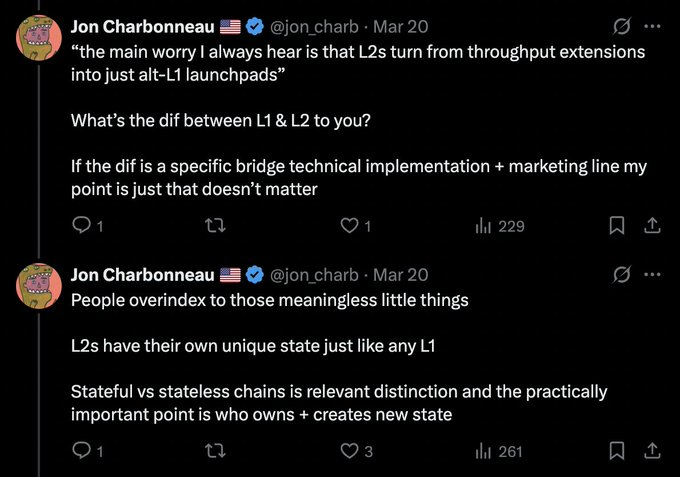
 The tweet in the picture means: People are worried that L2 will change from a scaling solution to an L1 enabler, so what is the difference between L2 and L1? 
From trust mechanism to valuation logic, in-depth analysis of the subtle "father-son relationship" between L1 and L2

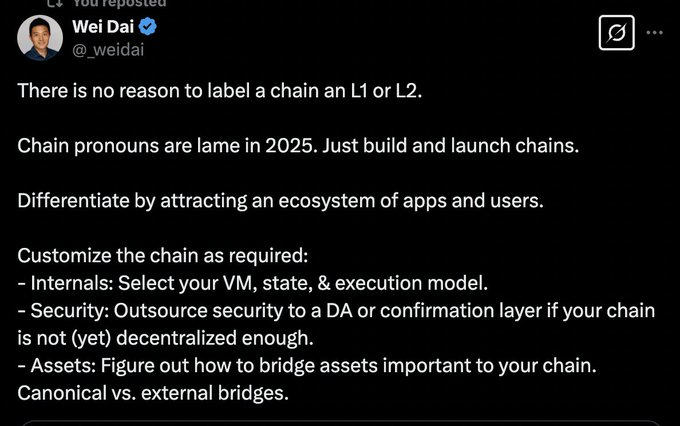
 The tweet in the picture means: The generational division of the chain in 2025 is outdated. There is no need to distinguish between L1 and L2. The real difference is the users and the ecosystem.

You should reread these tweets 100 times.

There is no product difference between L1 and L2 in terms of end-user perception. There is also no fundamental difference between L1 and L2 in terms of liquidity. A new L1 must be launched by bridging the liquidity of stablecoins or non-native assets to its chain. Similarly, an L2 also needs to be launched by bridging the liquidity of stablecoins or non-native assets to its chain. The difference between L2 is that it gets a trust-minimized bridge from L1, while Alt-L1 has no such mechanism but must rely on cross-chain message bridges. We have already seen that some whales are very sensitive to these trust assumptions, but many ordinary users don't care.

One view among the middle-of-the-road group (mainly from the Alt-L1 team) is that "L2 will lead to liquidity fragmentation."

One L2 only allows trust-minimized bridging from L1, but every L2 launched today will connect with Alt-L1 and other L2s.
From trust mechanism to valuation logic, in-depth analysis of the subtle "father-son relationship" between L1 and L2

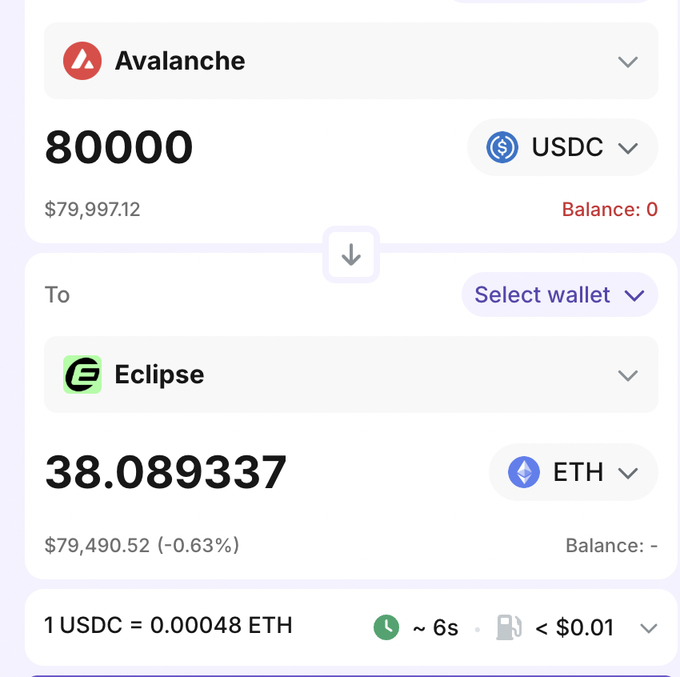
Every L2 worth its salt will deploy a cross-chain message bridge when it launches. Any user connected to a base chain (such as Ethereum, Solana) can use this as a relay to transfer large amounts of assets between Alt-L1 and L2. If an Alt-L1 does not have its own L2, it may make it difficult for liquidity to flow outward, but if it also integrates a cross-chain message bridge, this creates a paradox.

The essence of an L2 product is not defined by its association with L1. It is simply an execution layer, just like any other execution layer with different characteristics.

So, why is L1 more valuable than L2?

Look at it from two perspectives.

1. Angle 1: Differences in the valuation logic of L1\L2 in the primary market and the secondary market

a. The valuation logic is the same in the secondary market

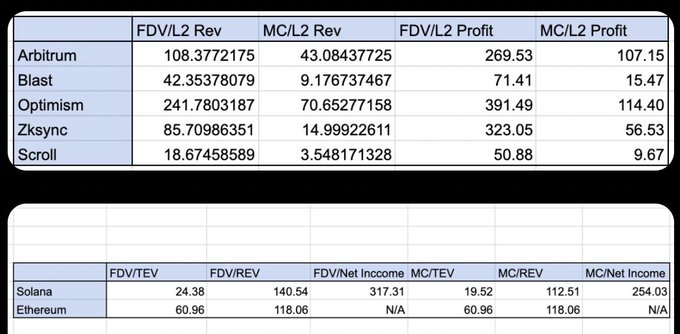
L1 has higher network activity. Solana/ETH is valued at ~100x annualized revenue, while mature L2s are in a similar range (10-200x). (Data from October 2024, but the argument still stands).
From trust mechanism to valuation logic, in-depth analysis of the subtle "father-son relationship" between L1 and L2

As indicated by fundamental valuation multiples, mature L1s and mature L2s are currently trading at relatively close valuation multiples (Arbitrum/Optimism vs. Solana/Ethereum).

b. Different valuation logic in the primary market

Compared with the secondary market, there are more unexplained extreme valuation multiples outliers in the primary market. In other words, there are projects with valuations of billions of dollars even though trading activity is not high. These phenomena tend to occur more in the primary market than in the secondary market.

Representative Projects

  • L1: Sui, Mantra, Pi, ICP, IP (and many old projects from different periods)
  • L2: MOVE

In my opinion, this is a misunderstanding of the initial L2 project in terms of framework setting. Arbitrum and Optimism position themselves as Ethereum's extended network, as an execution layer to help ETH expand. This positioning combined with Ethereum's "Rollup-centric roadmap" is indeed an excellent way to cold start.

But the disadvantage of this approach is that it limits the entire target market to the Ethereum user group, thereby limiting the overall liquidity, industry awareness, and revenue scale that these chains (such as Arbitrum/OP) can capture. Although Arbitrum and Optimism are fully capable of attracting new decentralized applications and ecosystem participants (including those who have never been involved in Ethereum), their initial go-to-market strategy (GTM) overemphasized themselves as "Ethereum's extended network." This positioning has led the market to always regard them as a subsidiary ecosystem of Ethereum (so the valuation is only seen as a percentage of Ethereum's value). To be honest, when these teams were launched, there was indeed only Ethereum, the mainstream ecosystem, in the market.

2. Angle 2: Token Model

An L1 token model has a fundamental network flywheel effect. When the L1 chain activity increases, it will directly drive the demand for tokens from two independent participants, namely on-chain speculators and stakers.

The more frequent the on-chain activity, the higher the fees on-chain speculators are willing to pay to include transactions in the block. The uncertainty brought by diversified activities increases the probability, frequency and scale of wealth opportunities, triggering people to compete for these opportunities. In terms of staking, the more fees a blockchain earns, the more people are willing to stake its native tokens to gain exposure to this part of the economic benefits. In addition, on-chain activities are often related to the issuance of net new assets, which are usually traded in pairs with native tokens. People need to buy these native tokens to participate in related trading activities (such as minting NFTs with ETH and buying Meme coins with SOL).
From trust mechanism to valuation logic, in-depth analysis of the subtle "father-son relationship" between L1 and L2

How should L2 deal with these problems?

Change your mindset

What L2 needs to decide clearly is: do you want to be an L2 focused on ecological collaboration, or do you want to attract users from any source? The construction of L2 should make full use of its unique second-layer technology advantages (trusted/customized block construction, performance optimization, and shareable profits).

Optimizing the token economic model

L2 should optimize its token economic model to form a flywheel effect where the growth of network activity can stimulate token demand on both the supply and demand sides. The current L2 attempt to use custom gas tokens has solved the incentive problem of on-chain speculation, but has failed to allow stakers to share this part of the revenue. In theory, since most L2s put the sorter revenue into the DAO treasury, and the token controls the DAO treasury, this is equivalent to distributing fair expectations of revenue to token holders. However, to achieve the same effect at the cognitive level of token holders, token holders must be given more complete governance rights.

Piyasa Fırsatı
L1 Logosu
L1 Fiyatı(L1)
$0,003165
$0,003165$0,003165
-6,93%
USD
L1 (L1) Canlı Fiyat Grafiği
Sorumluluk Reddi: Bu sitede yeniden yayınlanan makaleler, halka açık platformlardan alınmıştır ve yalnızca bilgilendirme amaçlıdır. MEXC'nin görüşlerini yansıtmayabilir. Tüm hakları telif sahiplerine aittir. Herhangi bir içeriğin üçüncü taraf haklarını ihlal ettiğini düşünüyorsanız, kaldırılması için lütfen [email protected] ile iletişime geçin. MEXC, içeriğin doğruluğu, eksiksizliği veya güncelliği konusunda hiçbir garanti vermez ve sağlanan bilgilere dayalı olarak alınan herhangi bir eylemden sorumlu değildir. İçerik, finansal, yasal veya diğer profesyonel tavsiye niteliğinde değildir ve MEXC tarafından bir tavsiye veya onay olarak değerlendirilmemelidir.

Ayrıca Şunları da Beğenebilirsiniz

More On-Chain Activity as Over 131,000 Cardano Transactions Feature NIGHT Tokens

More On-Chain Activity as Over 131,000 Cardano Transactions Feature NIGHT Tokens

The launch of NIGHT, the native token of Midnight, has significantly impacted the number of transactions across the broader Cardano ecosystem. Cardano founder Charles
Paylaş
Coinstats2025/12/18 15:13
What is Ethereum’s Fusaka Upgrade? Everything You Need to Know

What is Ethereum’s Fusaka Upgrade? Everything You Need to Know

Over the past few weeks, one of the most talked-about topics within the crypto community has been Ethereum’s Fusaka upgrade. What exactly is this upgrade, and how does it affect the Ethereum blockchain and the average crypto investor? This article will be the only explainer guide you need to understand the details of this upgrade within the Ethereum ecosystem. Why Does Ethereum Undergo Upgrades? To understand what the Fusaka upgrade will achieve, it is essential to comprehend what Ethereum’s upgrades aim to accomplish. The layer-1 Ethereum network was originally designed as a proof-of-work (PoW) blockchain. This implied that miners were actively behind the block mining process. While this consensus mechanism ensured security for the L1 blockchain, it also triggered slower transactions. The Ethereum development team unveiled a detailed roadmap, outlining various upgrades that will fix most of the network’s issues. These problems include its scalability issue, which refers to the network’s ability to process transactions faster. Currently, the Ethereum blockchain processes fewer transactions per second compared to most blockchains using the proof-of-stake (PoS) consensus mechanism. Over the past decade, Ethereum’s developers have implemented most of these upgrades, enhancing the blockchain’s overall performance. Here is a list of the upgrades that Ethereum has undergone: Frontier: July 2015 Frontier Thawing: September 2015 Homestead: March 2016 DAO Fork: July 2016 Tangerine Whistle: October 2016 Spurious Dragon: November 2016 Byzantium: October 2017 Constantinople: February 2019 Petersburg: February 2019 Istanbul: December 2019 Muir Glacier: January 2020 Berlin: April 2021 London: August 2021 Arrow Glacier: December 2021 Gray Glacier: June 2022 The Merge: September 2022 Bellatrix: September 2022 Paris: September 2022 Shanghai: April 2023 Capella: April 2023 Dencun (Cancun-Deneb): March 2024 Pectra (Prague-Electra): May 2025 Most of these upgrades (forks) addressed various Ethereum Improvement Proposals (EIPs) geared towards driving the blockchain’s growth. For instance, the Merge enabled the transition from the PoW model to a proof of stake (PoS) algorithm. This brought staking and network validators into the Ethereum mainnet. Still, this upgrade failed to unlock the much-needed scalability. For most of Ethereum’s existence, it has housed layer-2 networks, which leverage Ethereum’s infrastructure to tackle the scalability issue. While benefiting from the L1 blockchain’s security and decentralization, these L2 networks enable users to execute lightning-fast transactions. Last year’s Dencun upgrade made transacting on layer-2 networks even easier with the introduction of proto-danksharding (EIP-4844). Poised to address the scalability issue, this upgrade introduces data blobs. You can think of these blobs as temporary, large data containers that enable cheaper, yet temporary, storage of transactions on L2 networks. The effect? It reduces gas fees, facilitating cheaper transaction costs on these L2 rollups. The Pectra upgrade, unveiled earlier this year, also included EIPs addressing the scalability issue plaguing the Ethereum ecosystem. The upcoming upgrade, Fusaka, will help the decade-old blockchain network to become more efficient by improving the blob capacity. What is Ethereum’s Fusaka Upgrade? Fusaka is an upgrade that addresses Ethereum’s scalability issue, thereby making the blockchain network more efficient. As mentioned earlier, Fusaka will bolster the blob capacity for layer-2 blockchains, which refers to the amount of temporary data the network can process. This will help facilitate faster transactions on these L2 scaling solutions. It is worth noting that upon Fusaka’s completion, users will be able to save more when performing transactions across layer-2 networks like Polygon, Arbitrum, and Base. The upgrade has no direct positive impact on the L1 blockchain itself. On September 18th, Christine Kim, representing Ethereum core developers, confirmed the launch date for Fusaka via an X post. Following an All Core Developers Consensus (ACDC) call, the developer announced that the Ethereum Fusaka upgrade will take place on December 3rd. Ahead of the upgrade, there will be three public testnets. Fusaka will first be deployed on Holesky around October 1st. If that goes smoothly, it will move to Sepolia on October 14th. Finally, it will be on the Hoodi testnet on October 28th. Each stage provides developers and node operators with an opportunity to identify and address bugs, run stress tests, and verify that the network can effectively handle the new features. Running through all three testnets ensures that by the time the upgrade is ready for mainnet, it will have been thoroughly tested in different environments. Crucial to the Fusaka upgrade are the Blob Parameter Only (BPO) forks, which will enhance the blob capacity without requiring end-users of the blockchain network to undergo any software changes. For several months, the Ethereum development team has been working towards unveiling the BPO-1 and BPO-2 forks. Blockchain developers have pooled resources to develop Fusaka through devnets. Following performances from devnet-5, developers within the ecosystem confirmed that the BPO upgrades will come shortly after the Fusaka mainnet debut. Approximately two weeks after the mainnet launch, on December 17th, the BPO-1 fork will increase the blob target/max from 6/9 to 10/15. Then, two weeks later, on January 7th, 2026, the BPO-2 fork is expected to expand capacity further to a metric of 14/21. Ultimately, the Fusaka upgrade would have doubled the blob capacity, marking a pivotal move for the Ethereum ecosystem. Impact on the Ethereum Ecosystem Admittedly, the Ethereum ecosystem is expected to see more developers and users join the bandwagon. With the introduction of faster and cheaper transactions, developers and business owners can explore more efficient ways to build on the L1 blockchain. This means we can see initiatives like crypto payment solutions and more decentralized finance (DeFi) projects enter the Ethereum bandwagon. Users, on the other hand, will benefit as they execute cheaper on-chain transactions. Despite the benefits from this initiative, some in the crypto community worry about the reduction in Ethereum’s gwei (the smallest unit of the Ether coin). Shortly after the Dencun upgrade, Ethereum’s median gas fee dropped to 1.7 gwei. Fast-forward to the present, and the median gas fee sits at 0.41 gwei, according to public data on Dune. This drop hints at the drastic reduction in gas fees, which could affect those staking their crypto holdings on the L1 blockchain, making it less attractive to stakers. Since the Fusaka upgrade aims to reduce the L2 network gas fee further, some observers may worry that crypto stakers will receive fewer block rewards. Time will tell if the Ethereum development team will explore new incentives for those participating in staking. Will Ether’s Price Pump? There is no guarantee that Ether (ETH) will jump following Fusaka’s launch in December. This is because the second-largest cryptocurrency saw no significant price movement during past major upgrades. According to data from CoinMarketCap, ETH sold for approximately $4,400 at the time of writing. Notably, the coin saw its current all-time high (ATH) of $4,900 roughly a month ago. The price pump was fueled by consistent Ether acquisitions by exchange-traded fund (ETF) buyers and crypto treasury firms. Source: CoinMarketCap Although these upgrades do not guarantee a surge in ETH’s price, they have a lasting impact on the underlying Ethereum blockchain. Conclusion Over the past 10 years, the Ethereum network has had no rest as it constantly ships out new upgrades to make its mainnet more scalable. The Fusaka upgrade aims to make Ethereum layer-2 networks cheaper to use. To ensure its smooth usage, several testnets are lined up. Stay tuned for updates on how Ethereum will be post-Fusaka. The post What is Ethereum’s Fusaka Upgrade? Everything You Need to Know appeared first on Cointab.
Paylaş
Coinstats2025/09/20 06:57
Vitalik Buterin Suggests Simplifying Ethereum to Boost User Understanding

Vitalik Buterin Suggests Simplifying Ethereum to Boost User Understanding

The post Vitalik Buterin Suggests Simplifying Ethereum to Boost User Understanding appeared on BitcoinEthereumNews.com. Ethereum trustlessness requires broader
Paylaş
BitcoinEthereumNews2025/12/18 15:13