Google Cloud Challenges Ripple, Stripe And Circle With New Layer-1 Blockchain For Financial Institutions
Google Cloud is launching its own layer-1 blockchain for financial institutions, taking on Ripple, Circle, and Stripe in payments.
Google Cloud’s Web3 Head of Strategy, Rich Widmann, shared new details about the blockchain, called the Google Cloud Universal Ledger (GCUL), in an Aug. 26 post on Linkedin.
“GCUL brings together years of R&D at Google to provide financial institutions with a novel Layer 1 that is performant, credibly neutral and enables Python-based smart contracts,” Widmann wrote.
“Besides bringing to bear Google’s distribution, GCUL is a neutral infrastructure layer,” Widmann added. “Tether won’t use Circle’s blockchain – and Adyen probably won’t use Stripe’s blockchain. But any financial institution can build with GCUL.”
By moving into blockchain payments infrastructure, Google Cloud is positioning itself to compete over the financial rails that could shape the future of payments. At stake may be who ultimately controls the backbone of digital finance: established tech giants or crypto pioneers.
Google Cloud also wrote in an official blog post that GCUL “simplifies the management of commercial bank money accounts and facilitates transfers via a distributed ledger, empowering financial institutions and intermediaries to meet the demands of their most discerning clients and compete effectively.”
Increasing Number Of Companies Launching Their Own Blockchains Amid The Growing Regulatory Clarity
Google Cloud is the latest company to announce that it is working on its own layer-1 blockchain network. USD Coin (USDC) issuer Circle, and payments giant Stripe, are among others that have announced similar developments in recent months.
That’s as the Web3 industry gains more regulatory clarity in the US under the Trump Administration.
Widmann also shared a table comparing Google Cloud’s GCUL with Circle’s Arc and Stripe’s Tempo blockchains.
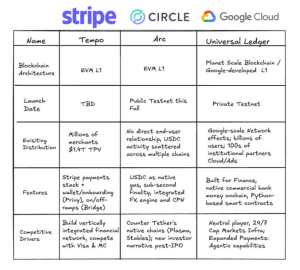
Table comparing GCUL with Arc and Tempo (Source: Linkedin)
According to the table, Google Cloud’s blockchain network will tap into the tech giant’s existing user base of “billions of users” and “100s of institutional partners.”
Its main competitive aim is to become a 24/7 infrastructure provider for the global capital markets. The team will also look to expand payments and enable agentic capabilities with its chain.
Google Cloud described its blockchain as a private and “permissioned system” in its blog post. It did, however, say that it might make the network “more open as regulations evolve.”
That closed-off nature has drawn criticism from crypto and Web3 purists who argue that the network’s principles go against the decentralized and permissionless values the community is built on.
“It’s a permissioned chain, ran by an American corporation with close ties to the government,” one X user said. ”I don’t think these people understand what ‘credibly neutral’ means in the context of blockchains, because this is literally the exact opposite of ‘credibly neutral’.”
Starknet CEO Eli Ben-Sasson also commented on the project. Responding to an X post about the blockchain, he said he thinks that corporations creating their own layer-1 chains are not going to make it.
Google Cloud Will Enable Python-Based Smart Contracts
Ethereum has enjoyed a first-mover advantage in the market since its inception back in July 2015, being the first distributed ledger to make it possible for programmers to create decentralized applications (dApps) on a blockchain network.
Several financial institutions have utilized that capability to explore how it can be used to create new financial products.
According to DeFillama, Ethereum still accounts for the majority of the value that is locked up in the blockchain space. With around $94.261 billion in total value locked (TVL), Ethereum currently has a 60.41% share of the market.
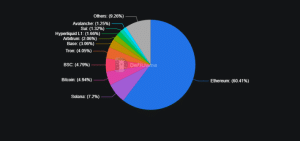
TVL breakdown by blockchain (Source: DeFiLlama)
The next biggest market share goes to Solana, with its $11.231 billion TVL accounting for 7.2% of the value currently locked up on blockchains.
However, Ethereum’s smart contracts operate on a new programming language called Solidity. Many software developers have learned how to write smart contracts using Solidity, but the need to learn a new software does present an obstacle for adoption.
Google Cloud will address that issue by making it possible for developers to write smart contracts using Python, which is one of the most popular and widely used programming languages globally.
According to a Statista survey, Python was the third most popular programming language as of July 2024, with 51% of the survey’s 60,171 respondents showing a preference for Python, while only 1.1% preferred Solidity.
Ayrıca Şunları da Beğenebilirsiniz

Bitcoin ETF by BlackRock Draws Billions in 2025 Despite Price Decline

Best Crypto to Buy as Saylor & Crypto Execs Meet in US Treasury Council