In Q1 2025, crypto media in Western Europe entered a phase of noticeable realignment. As the soft enforcement of MiCA began reshaping content boundaries—particularly around what qualifies as promotional—publishers also faced algorithmic turbulence from Google’s March core update and evolving…In Q1 2025, crypto media in Western Europe entered a phase of noticeable realignment. As the soft enforcement of MiCA began reshaping content boundaries—particularly around what qualifies as promotional—publishers also faced algorithmic turbulence from Google’s March core update and evolving…

Q1 2025 reveals crypto media’s visibility reset in Western Europe

In Q1 2025, crypto media in Western Europe entered a phase of noticeable realignment. As the soft enforcement of MiCA began reshaping content boundaries—particularly around what qualifies as promotional—publishers also faced algorithmic turbulence from Google’s March core update and evolving discovery standards across platforms. Many crypto-focused outlets—lacking the compliance readiness, structural rigor, and content governance now expected in regulated discovery ecosystems—appeared unprepared for these shifts and saw their reach decline. Yet a small segment not only held ground—they grew.

Building on Outset PR’s earlier report  on Latin America’s crypto media landscape, we analyzed the Q1 2025 performance of 133 publications across Western Europe, including 87 crypto-native and 46 generalist outlets. We break down what the data shows—and how a few standout platforms have found new ways to win the visibility game in crypto media.

Visibility can no longer be assumed

Drawing on SimilarWeb data, we found that between January and March 2025, 82% of crypto-native publications tracked by Outset PR experienced a decline in web traffic. Total traffic fell from 26.57 million visits in January to 22.85 million in February, and then to 22.22 million in March—a cumulative drop of 16.3%.

This was not a one-time anomaly. It marked a turning point shaped by overlapping forces: the soft rollout of MiCA enforcement, evolving definitions of promotional content, Google’s March core algorithm update, new platform content standards, and search behavior shaped by macroeconomic uncertainty.

Traffic concentration follows a power-law pattern

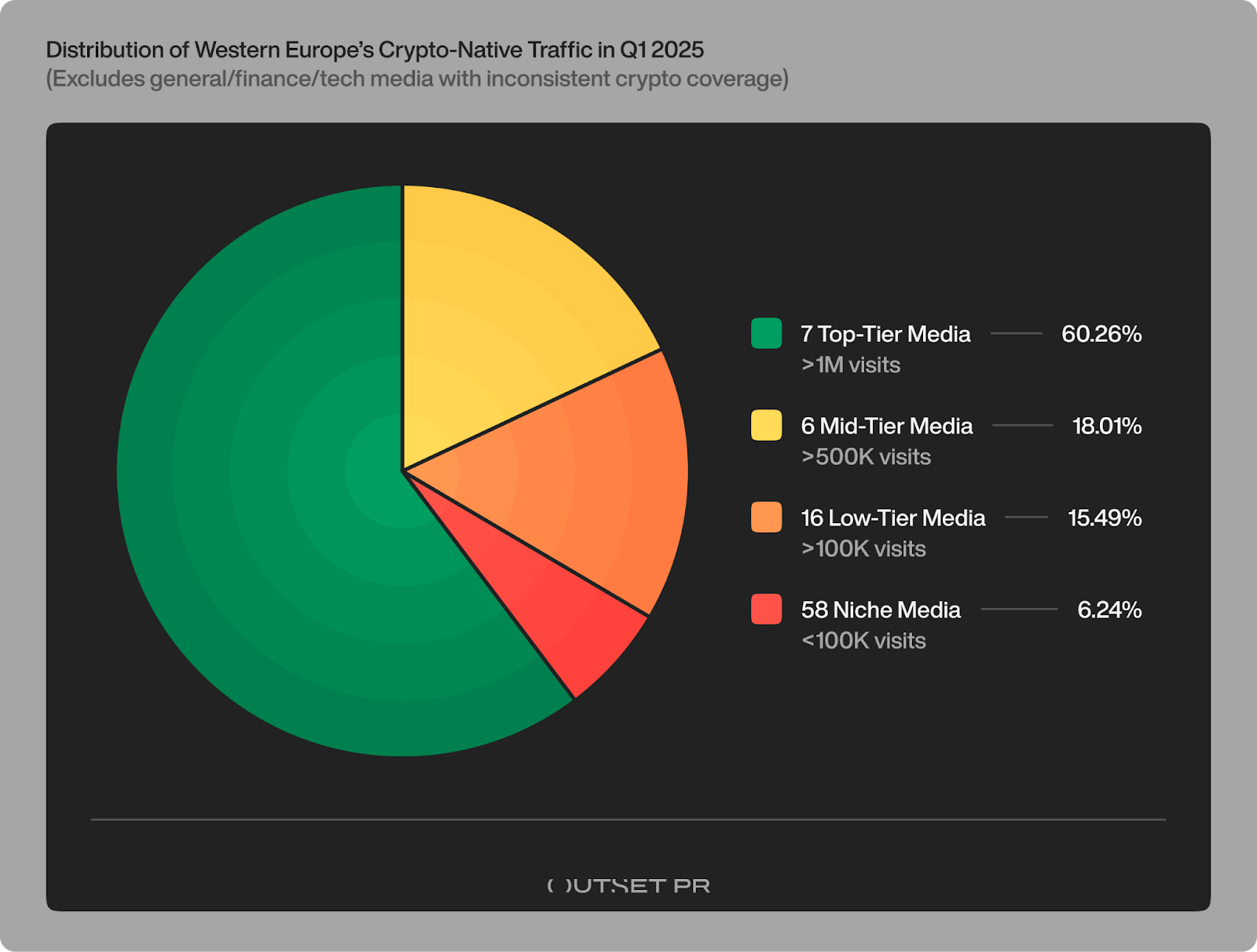
Among the 87 crypto-native publications analyzed, traffic distribution followed a sharp power-law curve—revealing how a small number of high-performing platforms dominate visibility:

  • Only seven outlets exceeded 1 million monthly visits, yet they accounted for 60.26% of all crypto-native traffic. Their edge came from strong regional presence, solid SEO, and the ability to meet compliance standards.
  • The next six outlets, with between 500,000 to 900,000 visits, accounted for 18.01% of total traffic.
  • Sixteen mid-tier outlets (100,000–500,000) contributed just 15.49%, typically showing niche authority without scalable infrastructure.
  • The remaining 58 outlets attracted fewer than 100,000 monthly visits each—collectively representing only 6.24% of total traffic. Notably, this segment includes 13 of Q1’s 16 growing outlets—underscoring that while some platforms are gaining momentum, their absolute reach remains modest. Growth alone does not guarantee influence in a fragmented visibility landscape.
Q1 2025 reveals crypto media’s visibility reset in Western Europe - 1

Distribution of Western Europe’s Crypto-Native Traffic, Q1 2025. Source: Outset PR analysis, based on SimilarWeb data

This stark concentration highlights a growing visibility gap: access to trusted narratives is increasingly filtered through a few structurally resilient channels. 

Country-level hubs of visibility

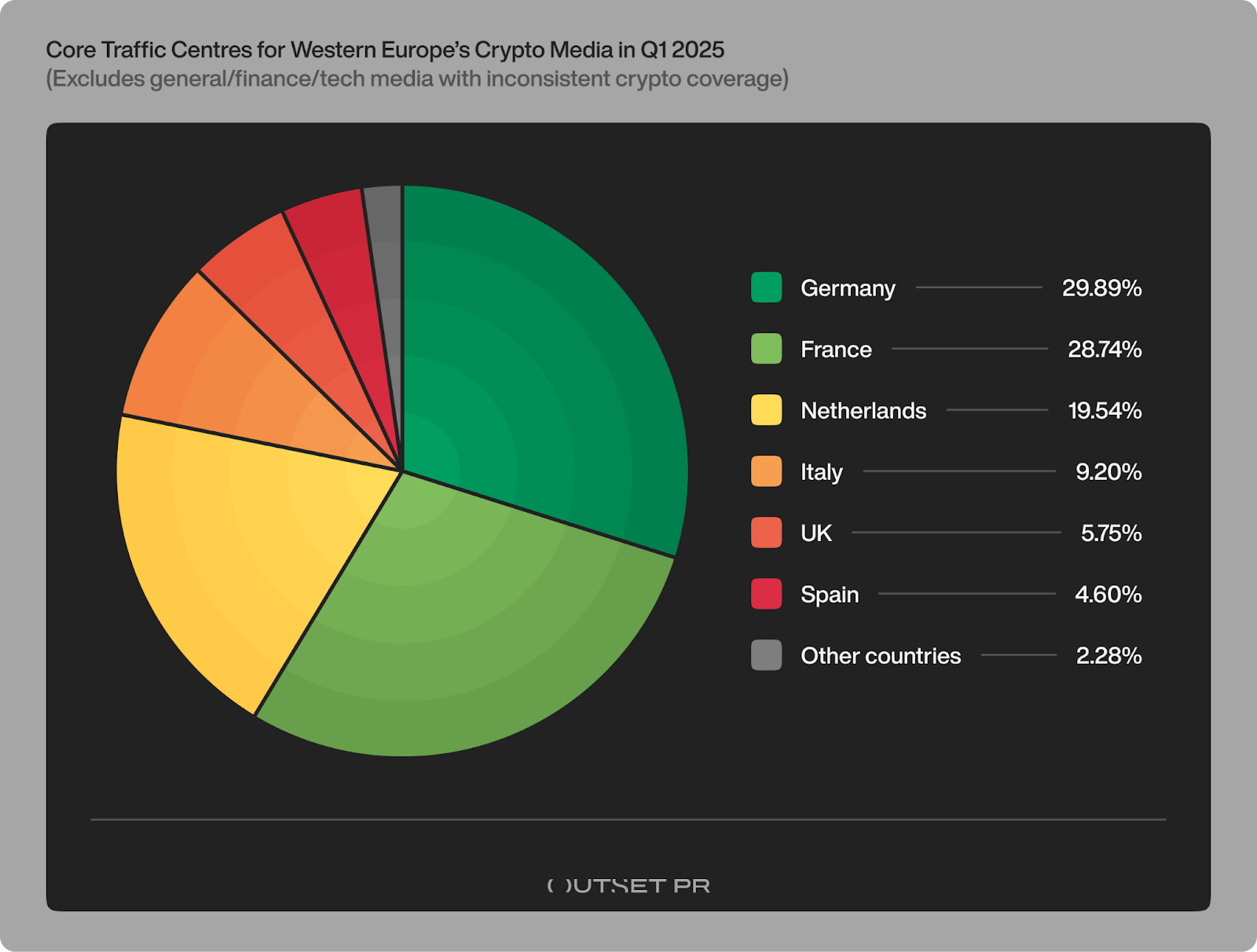
While MiCA applies regionally, traffic and media influence remain concentrated in specific geographic areas:

  • Germany (29.89%) and France (28.74%) emerged as the two largest crypto media hubs, hosting several high-traffic platforms with consistent reach and compliance structures.
  • The Netherlands (19.54%) followed with notable performance, though skewed toward a few leading outlets.
  • Italy (9.20%), the United Kingdom (5.75%) showed more limited reach, with no crypto-native outlet exceeding 500K monthly visits.
  • Spain (4.60%), though lower in total share, stood out as an exception—hosting at least one crypto-native platform with over 1 million monthly visits.
Q1 2025 reveals crypto media’s visibility reset in Western Europe - 2

Core Traffic Centres for Western Europe’s Crypto Media, Q1 2025. Source: Outset PR analysis, based on SimilarWeb data

Markets with mature compliance cultures and robust editorial ecosystems were better positioned to maintain visibility in the post-MiCA environment, while others lacked scalable platforms capable of withstanding regulatory and algorithmic shifts.

Why generalist outlets stayed on top

Generalist outlets held a clear upper hand over crypto-native platforms in Q1 2025. Among the 46 non-crypto-dedicated publications studied, total traffic reached 106.25 million visits—more than four times the combined reach of crypto-native sites. Notably, 19 finance-focused outlets consistently exceeded 1 million monthly visits, accounting for 95.29% of total generalist traffic.

Their edge likely comes from greater editorial depth, topic diversity, and technical infrastructure, allowing them to adapt more easily to shifting market and compliance demands.

A key factor driving this dominance was Google Discover visibility. According to data from SimilarWeb, Ahrefs, and Outset PR’s internal testing, only 29.89% of crypto-native sites were eligible for Discover listings, and just 22.99% had consistent visibility. In contrast, 32.61% of generalist platforms maintained steady Discover presence—giving them a structural advantage in traffic acquisition.

With Discover increasingly favoring structured, compliant, and authoritative content, generalist outlets were better positioned to capture algorithmic preference and sustain long-term reach in a post-MiCA ecosystem.

Lessons from the resilient few

  • Multilingual expansion: Several growing outlets expanded across multiple Western European languages. Regionally adapted domains, clearer disclaimers, and SEO-tuned editorial structures may have helped align with MiCA expectations while preserving visibility.
  • Group infrastructure & compliance support: Top performers often belonged to larger media groups. Shared SEO systems, internal compliance, and performance-focused editorial workflows provided the agility needed to adapt.
  • Niche positioning & local authority: Outlets focused on specific jurisdictions or verticals with structured content and localized credibility showed consistent performance, indicating that specialization offers resilience.
  •  Editorial flexibility: For several Q1 gainers, growth followed visible shifts in editorial strategy: away from repetitive or AI-generated content, and toward informative, transparent, and regulation-aware reporting.

Final thought

Media is how crypto tells its story. And as expectations rise—from platforms, regulators, and users—visibility may increasingly depend on structure, clarity, and responsiveness.

Crypto has always evolved under pressure—and so has the information ecosystem around it. Q1 2025 may mark the start of a new phase: one where presence is filtered not just by reach, but by resilience and readiness.

No longer shaped by volume alone, this environment rewards trust, transparency, and the ability to stay relevant as standards continue to shift. If that trend holds, the outlets adapting today could become tomorrow’s benchmarks in crypto storytelling.

Piyasa Fırsatı
Core DAO Logosu
Core DAO Fiyatı(CORE)
$0,115
$0,115$0,115
-2,54%
USD
Core DAO (CORE) Canlı Fiyat Grafiği
Sorumluluk Reddi: Bu sitede yeniden yayınlanan makaleler, halka açık platformlardan alınmıştır ve yalnızca bilgilendirme amaçlıdır. MEXC'nin görüşlerini yansıtmayabilir. Tüm hakları telif sahiplerine aittir. Herhangi bir içeriğin üçüncü taraf haklarını ihlal ettiğini düşünüyorsanız, kaldırılması için lütfen [email protected] ile iletişime geçin. MEXC, içeriğin doğruluğu, eksiksizliği veya güncelliği konusunda hiçbir garanti vermez ve sağlanan bilgilere dayalı olarak alınan herhangi bir eylemden sorumlu değildir. İçerik, finansal, yasal veya diğer profesyonel tavsiye niteliğinde değildir ve MEXC tarafından bir tavsiye veya onay olarak değerlendirilmemelidir.

Ayrıca Şunları da Beğenebilirsiniz

Why 100 Percent Test Coverage is Not Possible — Lessons from Testing Banking and Healthcare Systems

Why 100 Percent Test Coverage is Not Possible — Lessons from Testing Banking and Healthcare Systems

Quality is not about testing everything; quality is about testing what is most important.
Paylaş
Hackernoon2025/12/26 16:05
US eyes crypto mining at disputed nuclear plant in Russia-Ukraine conflict: report

US eyes crypto mining at disputed nuclear plant in Russia-Ukraine conflict: report

The plant is located in Ukraine and has been under Russian control since 2022, with its future management a key issue in peace talks.
Paylaş
Coinstats2025/12/26 18:58
Google's AP2 protocol has been released. Does encrypted AI still have a chance?

Google's AP2 protocol has been released. Does encrypted AI still have a chance?

Following the MCP and A2A protocols, the AI Agent market has seen another blockbuster arrival: the Agent Payments Protocol (AP2), developed by Google. This will clearly further enhance AI Agents' autonomous multi-tasking capabilities, but the unfortunate reality is that it has little to do with web3AI. Let's take a closer look: What problem does AP2 solve? Simply put, the MCP protocol is like a universal hook, enabling AI agents to connect to various external tools and data sources; A2A is a team collaboration communication protocol that allows multiple AI agents to cooperate with each other to complete complex tasks; AP2 completes the last piece of the puzzle - payment capability. In other words, MCP opens up connectivity, A2A promotes collaboration efficiency, and AP2 achieves value exchange. The arrival of AP2 truly injects "soul" into the autonomous collaboration and task execution of Multi-Agents. Imagine AI Agents connecting Qunar, Meituan, and Didi to complete the booking of flights, hotels, and car rentals, but then getting stuck at the point of "self-payment." What's the point of all that multitasking? So, remember this: AP2 is an extension of MCP+A2A, solving the last mile problem of AI Agent automated execution. What are the technical highlights of AP2? The core innovation of AP2 is the Mandates mechanism, which is divided into real-time authorization mode and delegated authorization mode. Real-time authorization is easy to understand. The AI Agent finds the product and shows it to you. The operation can only be performed after the user signs. Delegated authorization requires the user to set rules in advance, such as only buying the iPhone 17 when the price drops to 5,000. The AI Agent monitors the trigger conditions and executes automatically. The implementation logic is cryptographically signed using Verifiable Credentials (VCs). Users can set complex commission conditions, including price ranges, time limits, and payment method priorities, forming a tamper-proof digital contract. Once signed, the AI Agent executes according to the conditions, with VCs ensuring auditability and security at every step. Of particular note is the "A2A x402" extension, a technical component developed by Google specifically for crypto payments, developed in collaboration with Coinbase and the Ethereum Foundation. This extension enables AI Agents to seamlessly process stablecoins, ETH, and other blockchain assets, supporting native payment scenarios within the Web3 ecosystem. What kind of imagination space can AP2 bring? After analyzing the technical principles, do you think that's it? Yes, in fact, the AP2 is boring when it is disassembled alone. Its real charm lies in connecting and opening up the "MCP+A2A+AP2" technology stack, completely opening up the complete link of AI Agent's autonomous analysis+execution+payment. From now on, AI Agents can open up many application scenarios. For example, AI Agents for stock investment and financial management can help us monitor the market 24/7 and conduct independent transactions. Enterprise procurement AI Agents can automatically replenish and renew without human intervention. AP2's complementary payment capabilities will further expand the penetration of the Agent-to-Agent economy into more scenarios. Google obviously understands that after the technical framework is established, the ecological implementation must be relied upon, so it has brought in more than 60 partners to develop it, almost covering the entire payment and business ecosystem. Interestingly, it also involves major Crypto players such as Ethereum, Coinbase, MetaMask, and Sui. Combined with the current trend of currency and stock integration, the imagination space has been doubled. Is web3 AI really dead? Not entirely. Google's AP2 looks complete, but it only achieves technical compatibility with Crypto payments. It can only be regarded as an extension of the traditional authorization framework and belongs to the category of automated execution. There is a "paradigm" difference between it and the autonomous asset management pursued by pure Crypto native solutions. The Crypto-native solutions under exploration are taking the "decentralized custody + on-chain verification" route, including AI Agent autonomous asset management, AI Agent autonomous transactions (DeFAI), AI Agent digital identity and on-chain reputation system (ERC-8004...), AI Agent on-chain governance DAO framework, AI Agent NPC and digital avatars, and many other interesting and fun directions. Ultimately, once users get used to AI Agent payments in traditional fields, their acceptance of AI Agents autonomously owning digital assets will also increase. And for those scenarios that AP2 cannot reach, such as anonymous transactions, censorship-resistant payments, and decentralized asset management, there will always be a time for crypto-native solutions to show their strength? The two are more likely to be complementary rather than competitive, but to be honest, the key technological advancements behind AI Agents currently all come from web2AI, and web3AI still needs to keep up the good work!
Paylaş
PANews2025/09/18 07:00