A new type of atomic arbitrage is becoming the main source of transactions on the Solana chain. Now, one out of every two transactions on the Solana chain may be used for atomic arbitrage.A new type of atomic arbitrage is becoming the main source of transactions on the Solana chain. Now, one out of every two transactions on the Solana chain may be used for atomic arbitrage.

Solana presents a new way to play MEV, with atomic arbitrage accounting for half of the transactions. Is it a hidden vault or a new sickle?

2025/05/07 15:42

Author: Frank, PANews

As various DEXs began to provide personalized priority fee options and anti-sandwich measures, the income from sandwich attacks on Solana has declined significantly. As of May 6, this figure has dropped to 582 SOLs, while a few months ago, the average daily income of a single sandwich attack robot could basically reach 10,000 SOLs. But this is not the end of MEV, a new type of atomic arbitrage is becoming the main source of transactions on the Solana chain.

According to data from sandwiched.me, the proportion of atomic arbitrage on the chain has reached an exaggerated level. On April 8, the tip ratio contributed by atomic arbitrage reached 74.12%, and at other times, it basically remained above 50%. In other words, now for every two transactions on the Solana chain, one may be used for atomic arbitrage.
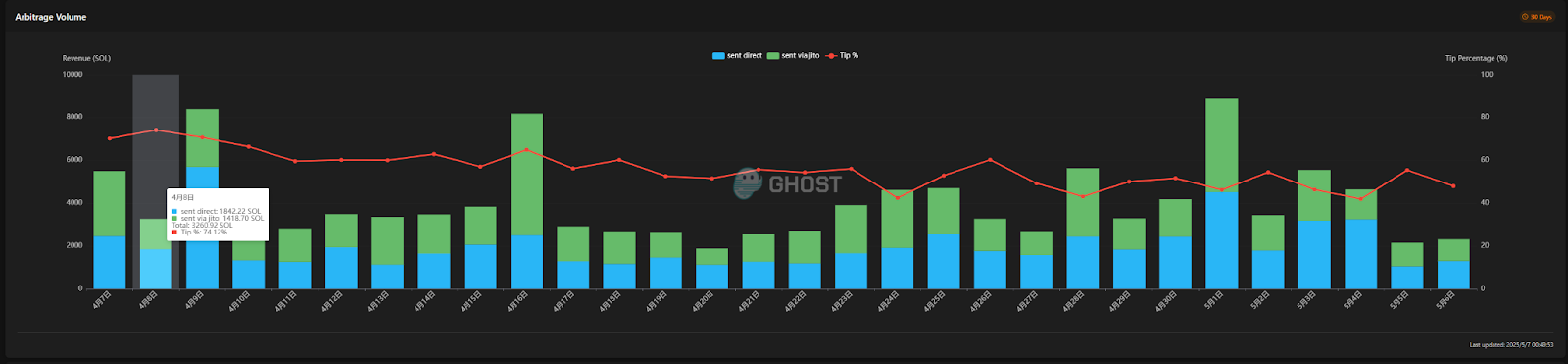
Solana presents a new way to play MEV, with atomic arbitrage accounting for half of the transactions. Is it a hidden vault or a new sickle?

But there is almost no discussion of atomic arbitrage on social media. Is this new type of arbitrage opportunity a hidden treasure trove or just another fancy sickle?

Atomic arbitrage, a new way of trading MEV

First, let's understand what atomic arbitrage is? Atomic arbitrage refers to the execution of multiple-step arbitrage operations in a single, atomic blockchain transaction. Typical atomic arbitrage involves buying an asset at a lower price on a decentralized exchange (DEX) and then selling the asset at a higher price on another DEX in the same transaction. Since the entire process is encapsulated in a single atomic transaction, it naturally eliminates the counterparty risk and part of the execution risk present in traditional cross-exchange arbitrage or non-atomic arbitrage. If the transaction is successful, the profit will be locked in; if the transaction fails, in addition to the loss of transaction fees, the arbitrageur's asset status will be restored to its original state, and there will be no situation where only the purchase is completed but the sale is not completed.

Atomicity is not a feature designed for arbitrage, but a fundamental property inherent in blockchain to ensure state consistency. Arbitrageurs cleverly exploit this guarantee to bundle operations (buy, sell) that originally need to be executed step by step and carry execution risks into one atomic unit, thereby eliminating execution risks at the technical level.

In the past, sandwich attacks or automated trading robots focused on finding profitable opportunities in the same trading pair. They then sandwiched the opponent's transactions in the middle by means of packaged transactions or simply sent transactions one after another to create opportunities. Atomic arbitrage is essentially also a packaged transaction method, but it focuses more on finding price differences in multiple trading pools to obtain arbitrage opportunities.

The myth of huge profits and the cruel reality

Judging from the current data, this kind of atomic arbitrage seems to have a good profit margin. In the past month, atomic arbitrage on the Solana chain has made a profit of 120,000 SOL (worth about 17 million US dollars), and the address with the most profit only spent 128.53 SOL, and the profit reached 14,129 SOL, with a return rate of 109 times. The largest single profit only cost 1.76 SOL and earned 1,354 SOL, with a single return rate of 769 times.
Solana presents a new way to play MEV, with atomic arbitrage accounting for half of the transactions. Is it a hidden vault or a new sickle?

There are currently 5,656 atomic arbitrage robots in the statistics, with an average profit of 24.48 SOL (3,071 USD) per address and an average cost of about 870 USD. Although this value is not as high as the previous sandwich attacker, it seems to be a good business idea, after all, the monthly return rate can reach 352%.

However, it is worth noting that the costs shown here are only the costs of on-chain transactions. Atomic arbitrage requires more investment.

According to the webpage information made by a MEV developer, there are several hardware requirements for performing atomic arbitrage, including a private RPC and an 8-core 8G server. From a cost perspective, the cost of a server is between $100 and $300 per month, and the minimum cost of building a private server is about $50 per month. The overall monthly cost is around $150 to $500, and this is just the minimum threshold. In addition, in order to perform arbitrage faster, servers with multiple IP addresses are usually configured at the same time.

From an example, we can see on a certain atomic arbitrage deployment website that only 15 addresses have earned more than 1 SOL in the past week, with the largest being 15 SOL. The other addresses have earned less than 1 SOL in the past week, and many are in a loss-making state. If we take into account the server and node costs, basically all the robots on this platform may be in a loss-making state. And it can be clearly seen that many addresses have chosen to stop arbitrage.

Who is making a profit? Uncovering the mystery of arbitrage that is “guaranteed to make a profit”

Of course, reality seems to conflict with big data. From the overall data, the robots that perform atomic arbitrage on Solana are still profitable. This is also difficult to escape the constraints of the "80/20 rule". A few high-level arbitrage robots have obtained a lot of profits. The others are still reduced to new leeks.

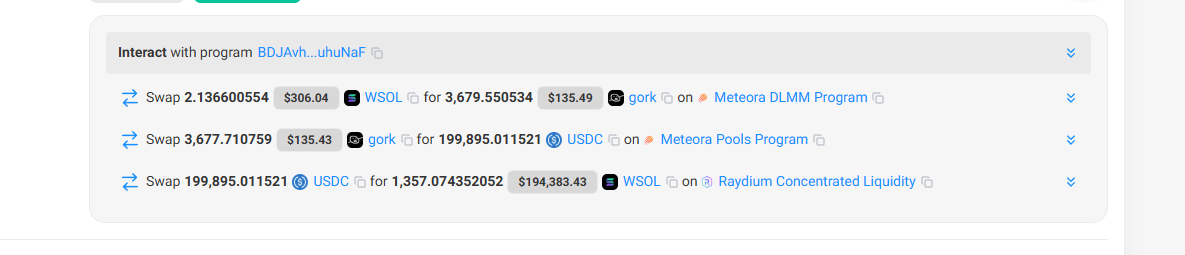
Looking back at the overall logic of atomic arbitrage, it is not difficult to find that the most important point to achieve profitability is to find arbitrage opportunities. Taking the most profitable arbitrage as an example, this transaction initially used 2.13 SOL to purchase 3,679 grok tokens (at a unit price of about $0.08), and then sold them for $199,000 (at a unit price of about $54.36). Obviously, the success of this arbitrage also seized the loophole of scarce liquidity in a certain trading pool, and was paid by a large investor who did not pay attention to the depth of the pool.

Solana presents a new way to play MEV, with atomic arbitrage accounting for half of the transactions. Is it a hidden vault or a new sickle?

But in essence, such opportunities are rare, and since almost all robots on the chain are eyeing similar opportunities, such occasional large arbitrage opportunities are more like winning the lottery.

The recent rise of atomic arbitrage may be due to some developers packaging this arbitrage opportunity as a sure-win business and developing a free version for novice users to use for free, and providing tutorials. They only receive 10% of the profits when the arbitrage is profitable. In addition, these teams also charge subscription fees by assisting in setting up nodes and servers, and providing more IP services.

In fact, since most users do not have a deep understanding of the technology and use similar arbitrage opportunity monitoring tools, the profits they make are not much and cannot cover the basic expenses.

According to PANews’ observation, unless you have a certain technical foundation, unique arbitrage opportunity monitoring tools, and high-performance servers and nodes, most players who want to participate in atomic arbitrage are simply being cheated by buying servers and subscription fees instead of being cut from speculating in coins. And as more and more people participate, the probability of this arbitrage failure is also increasing. Take the highest-yielding program on sandwiched.me as an example. The program’s current transaction failure rate has reached more than 99%, which means that basically all transactions have failed, and the participating robots still have to pay on-chain fees.
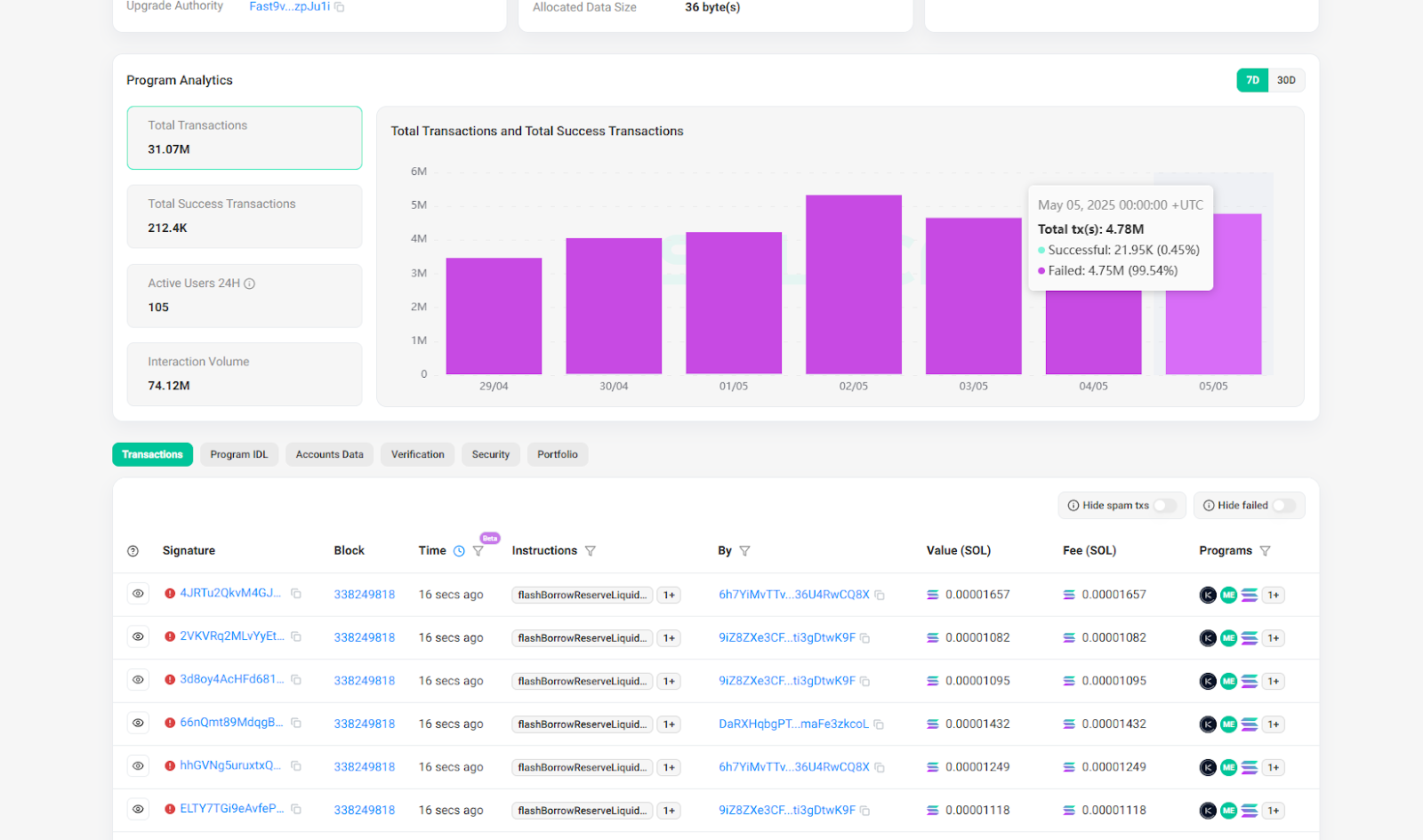
Solana presents a new way to play MEV, with atomic arbitrage accounting for half of the transactions. Is it a hidden vault or a new sickle?

Before plunging into this seemingly tempting wave of "atomic arbitrage", every potential participant should keep a clear head, fully evaluate their own resources and capabilities, be wary of over-packaged promises of "guaranteed profits", and avoid becoming another wave of leeks in this new "gold rush".

Piyasa Fırsatı
PlaysOut Logosu
PlaysOut Fiyatı(PLAY)
$0.03266
$0.03266$0.03266
-0.03%
USD
PlaysOut (PLAY) Canlı Fiyat Grafiği
Sorumluluk Reddi: Bu sitede yeniden yayınlanan makaleler, halka açık platformlardan alınmıştır ve yalnızca bilgilendirme amaçlıdır. MEXC'nin görüşlerini yansıtmayabilir. Tüm hakları telif sahiplerine aittir. Herhangi bir içeriğin üçüncü taraf haklarını ihlal ettiğini düşünüyorsanız, kaldırılması için lütfen [email protected] ile iletişime geçin. MEXC, içeriğin doğruluğu, eksiksizliği veya güncelliği konusunda hiçbir garanti vermez ve sağlanan bilgilere dayalı olarak alınan herhangi bir eylemden sorumlu değildir. İçerik, finansal, yasal veya diğer profesyonel tavsiye niteliğinde değildir ve MEXC tarafından bir tavsiye veya onay olarak değerlendirilmemelidir.

Ayrıca Şunları da Beğenebilirsiniz

Wormhole launches reserve tying protocol revenue to token

Wormhole launches reserve tying protocol revenue to token

The post Wormhole launches reserve tying protocol revenue to token appeared on BitcoinEthereumNews.com. Wormhole is changing how its W token works by creating a new reserve designed to hold value for the long term. Announced on Wednesday, the Wormhole Reserve will collect onchain and offchain revenues and other value generated across the protocol and its applications (including Portal) and accumulate them into W, locking the tokens within the reserve. The reserve is part of a broader update called W 2.0. Other changes include a 4% targeted base yield for tokenholders who stake and take part in governance. While staking rewards will vary, Wormhole said active users of ecosystem apps can earn boosted yields through features like Portal Earn. The team stressed that no new tokens are being minted; rewards come from existing supply and protocol revenues, keeping the cap fixed at 10 billion. Wormhole is also overhauling its token release schedule. Instead of releasing large amounts of W at once under the old “cliff” model, the network will shift to steady, bi-weekly unlocks starting October 3, 2025. The aim is to avoid sharp periods of selling pressure and create a more predictable environment for investors. Lockups for some groups, including validators and investors, will extend an additional six months, until October 2028. Core contributor tokens remain under longer contractual time locks. Wormhole launched in 2020 as a cross-chain bridge and now connects more than 40 blockchains. The W token powers governance and staking, with a capped supply of 10 billion. By redirecting fees and revenues into the new reserve, Wormhole is betting that its token can maintain value as demand for moving assets and data between chains grows. This is a developing story. This article was generated with the assistance of AI and reviewed by editor Jeffrey Albus before publication. Get the news in your inbox. Explore Blockworks newsletters: Source: https://blockworks.co/news/wormhole-launches-reserve
Paylaş
BitcoinEthereumNews2025/09/18 01:55
Fed forecasts only one rate cut in 2026, a more conservative outlook than expected

Fed forecasts only one rate cut in 2026, a more conservative outlook than expected

The post Fed forecasts only one rate cut in 2026, a more conservative outlook than expected appeared on BitcoinEthereumNews.com. Federal Reserve Chairman Jerome Powell talks to reporters following the regular Federal Open Market Committee meetings at the Fed on July 30, 2025 in Washington, DC. Chip Somodevilla | Getty Images The Federal Reserve is projecting only one rate cut in 2026, fewer than expected, according to its median projection. The central bank’s so-called dot plot, which shows 19 individual members’ expectations anonymously, indicated a median estimate of 3.4% for the federal funds rate at the end of 2026. That compares to a median estimate of 3.6% for the end of this year following two expected cuts on top of Wednesday’s reduction. A single quarter-point reduction next year is significantly more conservative than current market pricing. Traders are currently pricing in at two to three more rate cuts next year, according to the CME Group’s FedWatch tool, updated shortly after the decision. The gauge uses prices on 30-day fed funds futures contracts to determine market-implied odds for rate moves. Here are the Fed’s latest targets from 19 FOMC members, both voters and nonvoters: Zoom In IconArrows pointing outwards The forecasts, however, showed a large difference of opinion with two voting members seeing as many as four cuts. Three officials penciled in three rate reductions next year. “Next year’s dot plot is a mosaic of different perspectives and is an accurate reflection of a confusing economic outlook, muddied by labor supply shifts, data measurement concerns, and government policy upheaval and uncertainty,” said Seema Shah, chief global strategist at Principal Asset Management. The central bank has two policy meetings left for the year, one in October and one in December. Economic projections from the Fed saw slightly faster economic growth in 2026 than was projected in June, while the outlook for inflation was updated modestly higher for next year. There’s a lot of uncertainty…
Paylaş
BitcoinEthereumNews2025/09/18 02:59
Best Crypto to Buy as Saylor & Crypto Execs Meet in US Treasury Council

Best Crypto to Buy as Saylor & Crypto Execs Meet in US Treasury Council

The post Best Crypto to Buy as Saylor & Crypto Execs Meet in US Treasury Council appeared on BitcoinEthereumNews.com. Michael Saylor and a group of crypto executives met in Washington, D.C. yesterday to push for the Strategic Bitcoin Reserve Bill (the BITCOIN Act), which would see the U.S. acquire up to 1M $BTC over five years. With Bitcoin being positioned yet again as a cornerstone of national monetary policy, many investors are turning their eyes to projects that lean into this narrative – altcoins, meme coins, and presales that could ride on the same wave. Read on for three of the best crypto projects that seem especially well‐suited to benefit from this macro shift:  Bitcoin Hyper, Best Wallet Token, and Remittix. These projects stand out for having a strong use case and high adoption potential, especially given the push for a U.S. Bitcoin reserve.   Why the Bitcoin Reserve Bill Matters for Crypto Markets The strategic Bitcoin Reserve Bill could mark a turning point for the U.S. approach to digital assets. The proposal would see America build a long-term Bitcoin reserve by acquiring up to one million $BTC over five years. To make this happen, lawmakers are exploring creative funding methods such as revaluing old gold certificates. The plan also leans on confiscated Bitcoin already held by the government, worth an estimated $15–20B. This isn’t just a headline for policy wonks. It signals that Bitcoin is moving from the margins into the core of financial strategy. Industry figures like Michael Saylor, Senator Cynthia Lummis, and Marathon Digital’s Fred Thiel are all backing the bill. They see Bitcoin not just as an investment, but as a hedge against systemic risks. For the wider crypto market, this opens the door for projects tied to Bitcoin and the infrastructure that supports it. 1. Bitcoin Hyper ($HYPER) – Turning Bitcoin Into More Than Just Digital Gold The U.S. may soon treat Bitcoin as…
Paylaş
BitcoinEthereumNews2025/09/18 00:27