📑 Table of Contents What Makes Uniswap a DeFi Giant? The Origins and Background of Uniswap Inside the Technology: How Uniswap Works Ecosystem & Strategic Partnerships Practical Use Cases of Uniswap UNI Tokenomics Explained Latest Uniswap News & Developments Final Thoughts on Uniswap FAQ: 10 Unanswered Questions About Uniswap 🚀 What Makes Uniswap a DeFi [...]]]>📑 Table of Contents What Makes Uniswap a DeFi Giant? The Origins and Background of Uniswap Inside the Technology: How Uniswap Works Ecosystem & Strategic Partnerships Practical Use Cases of Uniswap UNI Tokenomics Explained Latest Uniswap News & Developments Final Thoughts on Uniswap FAQ: 10 Unanswered Questions About Uniswap 🚀 What Makes Uniswap a DeFi [...]]]>

Uniswap (UNI) Explained 2025: How the Leading DEX is Shaping DeFi

📑 Table of Contents

  • What Makes Uniswap a DeFi Giant?
  • The Origins and Background of Uniswap
  • Inside the Technology: How Uniswap Works
  • Ecosystem & Strategic Partnerships
  • Practical Use Cases of Uniswap
  • UNI Tokenomics Explained
  • Latest Uniswap News & Developments
  • Final Thoughts on Uniswap
  • FAQ: 10 Unanswered Questions About Uniswap

🚀 What Makes Uniswap a DeFi Giant?

Uniswap is one of the largest decentralized exchanges (DEX) built on the Ethereum blockchain. It enables users worldwide to trade cryptocurrencies without centralized intermediaries or order books. Instead, Uniswap uses an Automated Market Maker (AMM) powered by liquidity pools. The governance token UNI allows holders to vote on protocol changes. Since its launch in 2018, Uniswap’s trading volume has exceeded $1.5 trillion, making it one of the most influential platforms in the DeFi space.


📜 The Origins and Background of Uniswap

Uniswap was founded in 2018 by engineer Hayden Adams, inspired by Ethereum co-founder Vitalik Buterin. In 2020, the UNI governance token was launched and distributed to more than 250,000 platform users. The project was funded by the Ethereum Foundation, Uniswap Labs, and various venture capital firms. Today, the platform manages assets worth between $4–5 billion, cementing its place among the largest DEXs in the DeFi ecosystem.

⚙ Inside the Technology: How Uniswap Works

The core of Uniswap is the Automated Market Maker (AMM). Users deposit tokens into liquidity pools and receive a proportional share of the 0.3% fee generated by every swap. The system uses the constant product formula (x * y = k) to ensure liquidity is always available while determining token prices. Built on Ethereum, Uniswap also supports Layer-2 solutions such as Base, Arbitrum, and Optimism, significantly reducing fees. All operations are handled by smart contracts, ensuring that users retain full control of their wallets without centralized intermediaries.

Constant Product Formula:x * y = k

(Ensures liquidity and pricing across Uniswap pools)

🌐 Ecosystem & Strategic Partnerships

Uniswap and UNI tokens are deeply embedded in the DeFi sector. Leading protocols such as Compound, Aave, and MakerDAO leverage Uniswap’s liquidity pools for lending and stablecoin issuance. Major wallets like Coinbase, MetaMask, and Trust Wallet integrate Uniswap directly for token swaps. Through multi-chain deployment, millions of users worldwide can access Uniswap. Institutional adoption is growing too, with partnerships involving Fireblocks and Anchorage to offer secure access for regulated financial institutions.
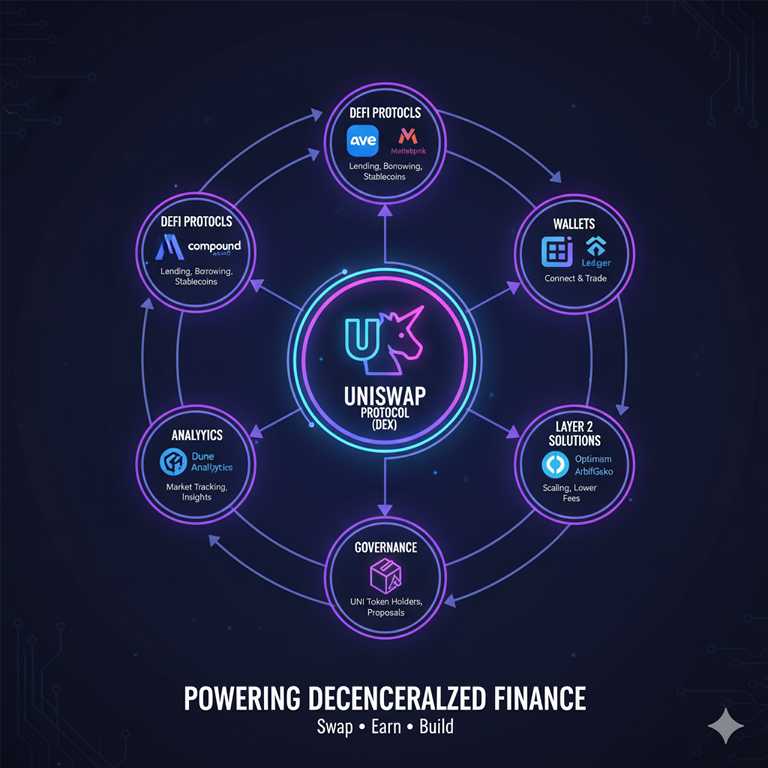
infographic showing Uniswap ecosystem connections with DeFi protocols and wallets

💡 Practical Use Cases of Uniswap

Uniswap plays a vital role in the DeFi landscape, with multiple real-world applications:

  • Token Swaps: Instantly exchange cryptocurrencies, with stablecoins like USDC, DAI, and USDT among the most traded pairs.
  • Liquidity Provision: Users deposit assets into pools and earn fees and yield-farming rewards, with potential returns of up to 30% annually.
  • Arbitrage Opportunities: Traders exploit price differences between centralized exchanges and DEX liquidity pools.

💰 UNI Tokenomics Explained

The UNI token has a fixed supply of 1 billion tokens distributed over four years. Allocation includes 60% to the community, 21.5% to the Uniswap team, 17.8% to investors, and 0.7% to advisors. Token holders vote on governance issues such as fee adjustments and new integrations. UNI also incentivizes liquidity providers, accelerating the growth of Uniswap’s pools and overall adoption.

CategoryAllocation
Community60%
Team21.5%
Investors17.8%
Advisors0.7%

📰 Latest Uniswap News & Developments

Despite significant volatility in the UNI token price, Uniswap continues to grow thanks to multi-chain adoption. In 2024, Uniswap recorded daily trading volumes exceeding $1 billion on Arbitrum alone. However, regulatory scrutiny is rising. Both U.S. and European regulators are debating whether DEX operators should face the same regulatory frameworks as centralized exchanges, which could shape Uniswap’s future trajectory.

❓ FAQ: 10 Unanswered Questions About Uniswap

1. How will Uniswap adapt to stricter global regulations?
Uniswap may need to adopt compliance layers such as on-chain KYC solutions, regional restrictions, or integrate optional compliance modules. Governance votes could also shift toward balancing decentralization with regulatory requirements.
2. Can Uniswap remain dominant against other DEXs like Curve or SushiSwap?
Yes, but competition is increasing. Curve dominates stablecoin swaps, while SushiSwap targets multi-chain adoption. Uniswap’s brand, user trust, and deep liquidity pools still give it a significant edge.
3. How does Uniswap handle front-running and MEV attacks?
Uniswap is exploring solutions like TWAMM (Time-Weighted Average Market Maker), batch auctions, and MEV-resistant relayers. These aim to reduce sandwich attacks and ensure fairer execution for traders.
4. Will UNI become a deflationary token?
Currently, UNI is not deflationary. It is used for governance and incentives. However, governance proposals could one day introduce token burns or fee redistributions that make UNI deflationary.
5. How sustainable are 30% yield farming returns?
Such high yields are usually temporary and linked to incentive programs. As liquidity grows and competition increases, returns typically decline to single-digit percentages.
6. Can Uniswap expand beyond Ethereum and L2s?
Yes, cross-chain deployments are being tested. While Ethereum and Layer-2s remain primary, expansion to non-EVM chains could increase Uniswap’s reach if technical and governance challenges are overcome.
7. How will institutions influence Uniswap’s governance?
Institutions could provide stability, liquidity, and credibility. However, their influence might also raise centralization concerns if voting power becomes concentrated. Balancing this will be a key governance challenge.
8. What risks exist for liquidity providers?
Liquidity providers face impermanent loss when asset prices diverge, smart contract vulnerabilities, regulatory risks, and declining yield incentives as pools mature.
9. Could Uniswap integrate with CBDCs in the future?
Potentially yes. If CBDCs become interoperable with DeFi, Uniswap could integrate them into its pools. This would require strong regulatory clarity and secure bridging solutions.
10. What’s next for Uniswap’s Layer-2 growth?
Adoption on Layer-2 networks like Arbitrum, Optimism, and Base will likely expand further, offering cheaper and faster transactions. This could bring in more retail and institutional users alike.
]]>
Piyasa Fırsatı
UNISWAP Logosu
UNISWAP Fiyatı(UNI)
$5.793
$5.793$5.793
-1.91%
USD
UNISWAP (UNI) Canlı Fiyat Grafiği
Sorumluluk Reddi: Bu sitede yeniden yayınlanan makaleler, halka açık platformlardan alınmıştır ve yalnızca bilgilendirme amaçlıdır. MEXC'nin görüşlerini yansıtmayabilir. Tüm hakları telif sahiplerine aittir. Herhangi bir içeriğin üçüncü taraf haklarını ihlal ettiğini düşünüyorsanız, kaldırılması için lütfen [email protected] ile iletişime geçin. MEXC, içeriğin doğruluğu, eksiksizliği veya güncelliği konusunda hiçbir garanti vermez ve sağlanan bilgilere dayalı olarak alınan herhangi bir eylemden sorumlu değildir. İçerik, finansal, yasal veya diğer profesyonel tavsiye niteliğinde değildir ve MEXC tarafından bir tavsiye veya onay olarak değerlendirilmemelidir.

Ayrıca Şunları da Beğenebilirsiniz

Fed Q1 2026 Outlook and Its Potential Impact on Crypto Markets

Fed Q1 2026 Outlook and Its Potential Impact on Crypto Markets

The post Fed Q1 2026 Outlook and Its Potential Impact on Crypto Markets appeared on BitcoinEthereumNews.com. Key takeaways: Fed pauses could pressure crypto, but
Paylaş
BitcoinEthereumNews2025/12/26 07:41
Taiko Makes Chainlink Data Streams Its Official Oracle

Taiko Makes Chainlink Data Streams Its Official Oracle

The post Taiko Makes Chainlink Data Streams Its Official Oracle appeared on BitcoinEthereumNews.com. Key Notes Taiko has officially integrated Chainlink Data Streams for its Layer 2 network. The integration provides developers with high-speed market data to build advanced DeFi applications. The move aims to improve security and attract institutional adoption by using Chainlink’s established infrastructure. Taiko, an Ethereum-based ETH $4 514 24h volatility: 0.4% Market cap: $545.57 B Vol. 24h: $28.23 B Layer 2 rollup, has announced the integration of Chainlink LINK $23.26 24h volatility: 1.7% Market cap: $15.75 B Vol. 24h: $787.15 M Data Streams. The development comes as the underlying Ethereum network continues to see significant on-chain activity, including large sales from ETH whales. The partnership establishes Chainlink as the official oracle infrastructure for the network. It is designed to provide developers on the Taiko platform with reliable and high-speed market data, essential for building a wide range of decentralized finance (DeFi) applications, from complex derivatives platforms to more niche projects involving unique token governance models. According to the project’s official announcement on Sept. 17, the integration enables the creation of more advanced on-chain products that require high-quality, tamper-proof data to function securely. Taiko operates as a “based rollup,” which means it leverages Ethereum validators for transaction sequencing for strong decentralization. Boosting DeFi and Institutional Interest Oracles are fundamental services in the blockchain industry. They act as secure bridges that feed external, off-chain information to on-chain smart contracts. DeFi protocols, in particular, rely on oracles for accurate, real-time price feeds. Taiko leadership stated that using Chainlink’s infrastructure aligns with its goals. The team hopes the partnership will help attract institutional crypto investment and support the development of real-world applications, a goal that aligns with Chainlink’s broader mission to bring global data on-chain. Integrating real-world economic information is part of a broader industry trend. Just last week, Chainlink partnered with the Sei…
Paylaş
BitcoinEthereumNews2025/09/18 03:34
Choosing an AI for Coding: A Practical Guide

Choosing an AI for Coding: A Practical Guide

There are now so many AI tools for coding that it can be confusing to know which one to pick. Some act as simple helpers (Assistant), while others can do the work
Paylaş
Hackernoon2025/12/26 02:00