Linqto, a once-prominent private investment platform promising everyday investors access to pre-IPO tech giants, has filed for Chapter 11 bankruptcy, and with it, a disturbing revelation: customers may never have truly owned the shares they believed they were buying. Source: Epiq The San Jose-based fintech firm submitted its bankruptcy filing in the Southern District of Texas on Monday, listing both assets and liabilities estimated between $500 million and $1 billion. The company also disclosed that more than 10,000 creditors could be affected. At the heart of the fallout is Linqto’s widely marketed access to private shares in high-profile firms like Ripple and CoreWeave. But the court filing on Tuesday paints a grimmer picture, alleging that “years of mismanagement” have left the company possibly insolvent and that prior executives “knowingly failed to cure extensive and serious securities law violations that began as early as 2020,” according to Chief Restructuring Officer Jeffrey Stein. Linqto, Inc. Files Chapter 11 Bankruptcy 🚨 BANKRUPTCY FILING ALERT 🚨 LINQTO, INC. Chapter 11 – SOUTHERN DISTRICT OF TEXAS Filed: July 7, 2025 Case No. 25-90187 📊 Assets: $500M-$1B | Liabilities: $500M-$1B | Total Creditors: 10,001-25,000 | Industry: Professional,… pic.twitter.com/YAUQTrpZQA — RK | Consultants (@_RKConsultants) July 8, 2025 SEC Investigates Linqto Over Misleading Retail Sales of Ripple ‘Units’ Among Linqto’s most popular offerings were secondary market shares in Ripple Labs. The company claims to hold 4.7 million Ripple shares through its investment vehicle, Linqto Liquidshares, a position that could be worth roughly $450 million at current secondary prices. But questions about actual ownership have sparked alarm. Notably, the Tuesday bankruptcy filing revealed that Linqto structured its offerings through series limited liability companies, a setup that lacked necessary transfer permissions from issuers like Ripple. Furthermore, Ripple CEO Brad Garlinghouse took to X last week to distance the crypto firm from Linqto, clarifying that while Linqto owns the shares, it has never had a business relationship with Ripple. “Apart from Linqto being a shareholder, Ripple has never had a business relationship with Linqto, nor have they participated in our financing rounds,” Garlinghouse wrote. He added that Ripple ceased approving Linqto purchases in late 2024 as concerns mounted. Understandably, there have been many questions from those who believed they were buying Ripple shares from Linqto, and what happens next. To be clear, on Ripple’s end: What we know from our records is Linqto owns 4.7M shares of Ripple, solely purchased on the secondary market… https://t.co/XHstpwwmIL — Brad Garlinghouse (@bgarlinghouse) July 2, 2025 With the confusion steering investors’ curiosity, the U.S. Securities and Exchange Commission started an investigation into whether Linqto allowed ineligible investors to purchase securities and whether its former leadership misled customers into thinking they owned actual shares, rather than indirect “representative units” with unclear legal standing. The illusion of ownership is at the center of the controversy. According to an internal investigation initiated by new CEO Dan Siciliano, Linqto’s previous management marketed investments in a way that may have misrepresented what customers were actually buying. “Much of what we discovered about the prior business practices at Linqto is disturbing,” Siciliano reportedly told staff. “These practices aren’t small one-off compliance or common regulatory missteps.” Linqto Collapse Shakes Faith in Retail Access to Private Equity Linqto’s downfall was first hinted at on June 30 when The Wall Street Journal reported the company faced federal probes and a possible bankruptcy. The outlet cited internal memos suggesting that customers never owned the securities they believed they had purchased. Further scrutiny fell on the company’s former leadership. Former CEO William Sarris allegedly tried to offer Ripple shares to Linqto’s 11,000 users at a markup exceeding 60%, violating SEC rules that limit such increases to 10%. Though Sarris resigned, he still sits on the company’s board. Former Chief Revenue Officer Gene Zawrotny had already left the company and later filed a lawsuit alleging serious compliance failures and retaliation. Now, under bankruptcy protection, Linqto is attempting to restructure. It has appointed restructuring expert Jeffrey Stein to lead the turnaround and retained several firms, including Triple P TRS, LLC, and Epiq Corporate Restructuring, for legal and administrative support. The company aims to negotiate with the SEC and other regulators to settle outstanding liabilities and litigations in a way that “treats everyone equitably and fairly,” according to Stein’s statement. 🔍 Refunding profitable investments through Linqto may let the platform retain investor gains, attorney @JohnEDeaton1 warns. #Linqto #Circle https://t.co/5CaGEbo0Sk — Cryptonews.com (@cryptonews) June 30, 2025 Still, the broader damage is already rippling through the alternative investment sector. Linqto’s promise, democratizing access to the private market, appealed to thousands of retail investors eager to get in early on unicorn startups. But the platform shuttered on March 13, cutting off all revenue streams. Now, many of those investors are grappling with the realization that the shares they thought they owned may have been little more than a promise, one that has vanished into bankruptcy court. As Garlinghouse emphasized, “I have no idea how Linqto managed the participants to whom they sold ‘representative units’ of Ripple shares… I can’t provide any reassurance about Linqto’s business practices or how they will handle it now.” True to our long-standing compliance roots, @Ripple is applying for a national bank charter from the OCC. If approved, we would have both state (via NYDFS) and federal oversight, a new (and unique!) benchmark for trust in the stablecoin market. Earlier in the week via… https://t.co/IdiR7x3eWZ — Brad Garlinghouse (@bgarlinghouse) July 2, 2025 He added, however, that the underlying value of Ripple shares has increased and “there should be considerable gains on those shares for ‘Linqto unitholders.’” Whether those unitholders ever see those gains or any restitution at all now depends on what unfolds in bankruptcy court. Linqto’s first hearing is scheduled for Tuesday, where the scope of the damage and the prospects for recovery may finally begin to take shape.Linqto, a once-prominent private investment platform promising everyday investors access to pre-IPO tech giants, has filed for Chapter 11 bankruptcy, and with it, a disturbing revelation: customers may never have truly owned the shares they believed they were buying. Source: Epiq The San Jose-based fintech firm submitted its bankruptcy filing in the Southern District of Texas on Monday, listing both assets and liabilities estimated between $500 million and $1 billion. The company also disclosed that more than 10,000 creditors could be affected. At the heart of the fallout is Linqto’s widely marketed access to private shares in high-profile firms like Ripple and CoreWeave. But the court filing on Tuesday paints a grimmer picture, alleging that “years of mismanagement” have left the company possibly insolvent and that prior executives “knowingly failed to cure extensive and serious securities law violations that began as early as 2020,” according to Chief Restructuring Officer Jeffrey Stein. Linqto, Inc. Files Chapter 11 Bankruptcy 🚨 BANKRUPTCY FILING ALERT 🚨 LINQTO, INC. Chapter 11 – SOUTHERN DISTRICT OF TEXAS Filed: July 7, 2025 Case No. 25-90187 📊 Assets: $500M-$1B | Liabilities: $500M-$1B | Total Creditors: 10,001-25,000 | Industry: Professional,… pic.twitter.com/YAUQTrpZQA — RK | Consultants (@_RKConsultants) July 8, 2025 SEC Investigates Linqto Over Misleading Retail Sales of Ripple ‘Units’ Among Linqto’s most popular offerings were secondary market shares in Ripple Labs. The company claims to hold 4.7 million Ripple shares through its investment vehicle, Linqto Liquidshares, a position that could be worth roughly $450 million at current secondary prices. But questions about actual ownership have sparked alarm. Notably, the Tuesday bankruptcy filing revealed that Linqto structured its offerings through series limited liability companies, a setup that lacked necessary transfer permissions from issuers like Ripple. Furthermore, Ripple CEO Brad Garlinghouse took to X last week to distance the crypto firm from Linqto, clarifying that while Linqto owns the shares, it has never had a business relationship with Ripple. “Apart from Linqto being a shareholder, Ripple has never had a business relationship with Linqto, nor have they participated in our financing rounds,” Garlinghouse wrote. He added that Ripple ceased approving Linqto purchases in late 2024 as concerns mounted. Understandably, there have been many questions from those who believed they were buying Ripple shares from Linqto, and what happens next. To be clear, on Ripple’s end: What we know from our records is Linqto owns 4.7M shares of Ripple, solely purchased on the secondary market… https://t.co/XHstpwwmIL — Brad Garlinghouse (@bgarlinghouse) July 2, 2025 With the confusion steering investors’ curiosity, the U.S. Securities and Exchange Commission started an investigation into whether Linqto allowed ineligible investors to purchase securities and whether its former leadership misled customers into thinking they owned actual shares, rather than indirect “representative units” with unclear legal standing. The illusion of ownership is at the center of the controversy. According to an internal investigation initiated by new CEO Dan Siciliano, Linqto’s previous management marketed investments in a way that may have misrepresented what customers were actually buying. “Much of what we discovered about the prior business practices at Linqto is disturbing,” Siciliano reportedly told staff. “These practices aren’t small one-off compliance or common regulatory missteps.” Linqto Collapse Shakes Faith in Retail Access to Private Equity Linqto’s downfall was first hinted at on June 30 when The Wall Street Journal reported the company faced federal probes and a possible bankruptcy. The outlet cited internal memos suggesting that customers never owned the securities they believed they had purchased. Further scrutiny fell on the company’s former leadership. Former CEO William Sarris allegedly tried to offer Ripple shares to Linqto’s 11,000 users at a markup exceeding 60%, violating SEC rules that limit such increases to 10%. Though Sarris resigned, he still sits on the company’s board. Former Chief Revenue Officer Gene Zawrotny had already left the company and later filed a lawsuit alleging serious compliance failures and retaliation. Now, under bankruptcy protection, Linqto is attempting to restructure. It has appointed restructuring expert Jeffrey Stein to lead the turnaround and retained several firms, including Triple P TRS, LLC, and Epiq Corporate Restructuring, for legal and administrative support. The company aims to negotiate with the SEC and other regulators to settle outstanding liabilities and litigations in a way that “treats everyone equitably and fairly,” according to Stein’s statement. 🔍 Refunding profitable investments through Linqto may let the platform retain investor gains, attorney @JohnEDeaton1 warns. #Linqto #Circle https://t.co/5CaGEbo0Sk — Cryptonews.com (@cryptonews) June 30, 2025 Still, the broader damage is already rippling through the alternative investment sector. Linqto’s promise, democratizing access to the private market, appealed to thousands of retail investors eager to get in early on unicorn startups. But the platform shuttered on March 13, cutting off all revenue streams. Now, many of those investors are grappling with the realization that the shares they thought they owned may have been little more than a promise, one that has vanished into bankruptcy court. As Garlinghouse emphasized, “I have no idea how Linqto managed the participants to whom they sold ‘representative units’ of Ripple shares… I can’t provide any reassurance about Linqto’s business practices or how they will handle it now.” True to our long-standing compliance roots, @Ripple is applying for a national bank charter from the OCC. If approved, we would have both state (via NYDFS) and federal oversight, a new (and unique!) benchmark for trust in the stablecoin market. Earlier in the week via… https://t.co/IdiR7x3eWZ — Brad Garlinghouse (@bgarlinghouse) July 2, 2025 He added, however, that the underlying value of Ripple shares has increased and “there should be considerable gains on those shares for ‘Linqto unitholders.’” Whether those unitholders ever see those gains or any restitution at all now depends on what unfolds in bankruptcy court. Linqto’s first hearing is scheduled for Tuesday, where the scope of the damage and the prospects for recovery may finally begin to take shape.

“You Never Owned the Shares”: Linqto Bankruptcy Exposes Pre-IPO Illusion

Linqto, a once-prominent private investment platform promising everyday investors access to pre-IPO tech giants, has filed for Chapter 11 bankruptcy, and with it, a disturbing revelation: customers may never have truly owned the shares they believed they were buying.
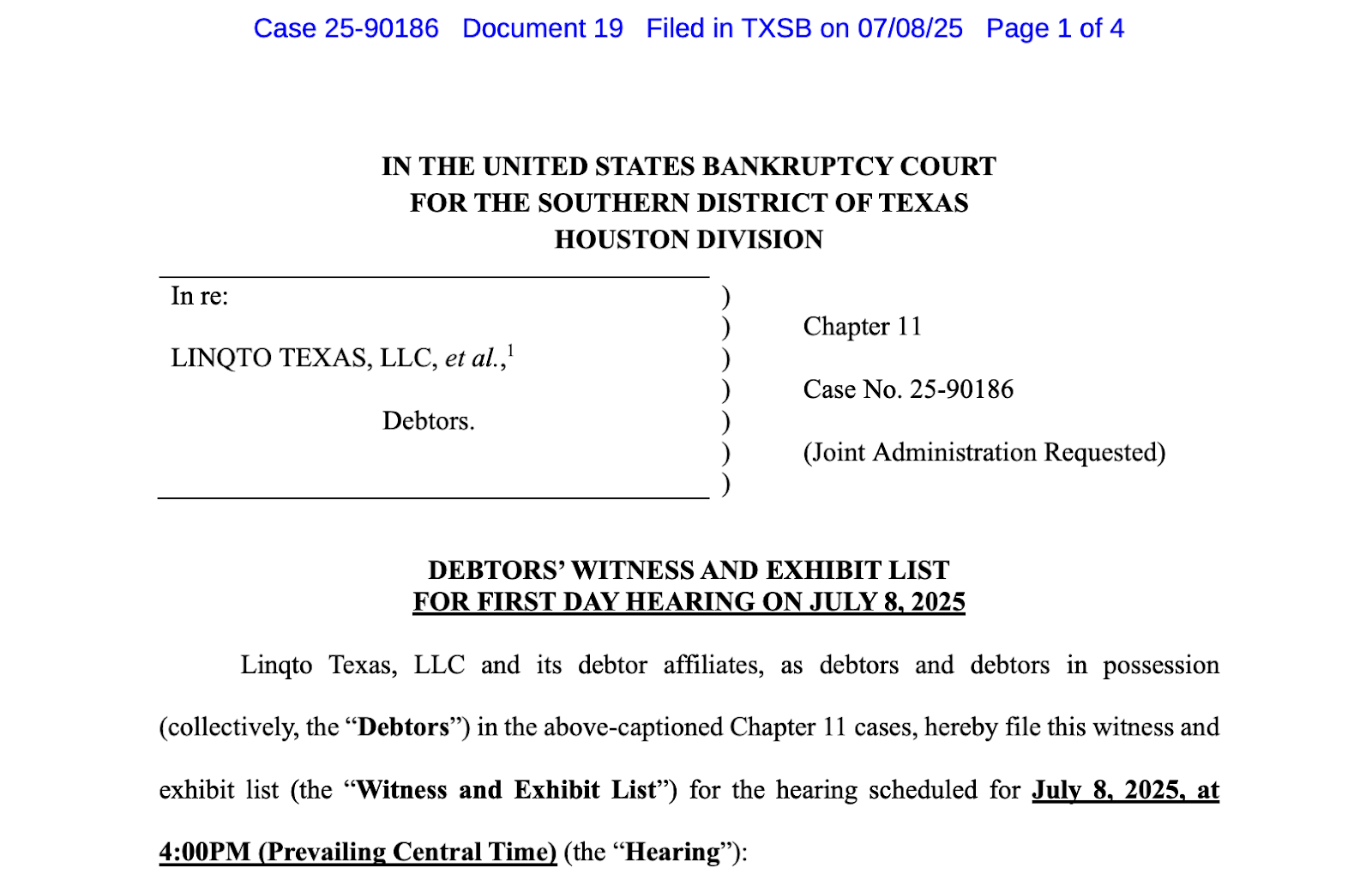
Source: Epiq

The San Jose-based fintech firm submitted its bankruptcy filing in the Southern District of Texas on Monday, listing both assets and liabilities estimated between $500 million and $1 billion. The company also disclosed that more than 10,000 creditors could be affected.

At the heart of the fallout is Linqto’s widely marketed access to private shares in high-profile firms like Ripple and CoreWeave.

But the court filing on Tuesday paints a grimmer picture, alleging that “years of mismanagement” have left the company possibly insolvent and that prior executives “knowingly failed to cure extensive and serious securities law violations that began as early as 2020,” according to Chief Restructuring Officer Jeffrey Stein.

SEC Investigates Linqto Over Misleading Retail Sales of Ripple ‘Units’

Among Linqto’s most popular offerings were secondary market shares in Ripple Labs. The company claims to hold 4.7 million Ripple shares through its investment vehicle, Linqto Liquidshares, a position that could be worth roughly $450 million at current secondary prices. But questions about actual ownership have sparked alarm.

Notably, the Tuesday bankruptcy filing revealed that Linqto structured its offerings through series limited liability companies, a setup that lacked necessary transfer permissions from issuers like Ripple.

Furthermore, Ripple CEO Brad Garlinghouse took to X last week to distance the crypto firm from Linqto, clarifying that while Linqto owns the shares, it has never had a business relationship with Ripple.

“Apart from Linqto being a shareholder, Ripple has never had a business relationship with Linqto, nor have they participated in our financing rounds,” Garlinghouse wrote. He added that Ripple ceased approving Linqto purchases in late 2024 as concerns mounted.

With the confusion steering investors’ curiosity, the U.S. Securities and Exchange Commission started an investigation into whether Linqto allowed ineligible investors to purchase securities and whether its former leadership misled customers into thinking they owned actual shares, rather than indirect “representative units” with unclear legal standing.

The illusion of ownership is at the center of the controversy. According to an internal investigation initiated by new CEO Dan Siciliano, Linqto’s previous management marketed investments in a way that may have misrepresented what customers were actually buying.

“Much of what we discovered about the prior business practices at Linqto is disturbing,” Siciliano reportedly told staff. “These practices aren’t small one-off compliance or common regulatory missteps.”

Linqto Collapse Shakes Faith in Retail Access to Private Equity

Linqto’s downfall was first hinted at on June 30 when The Wall Street Journal reported the company faced federal probes and a possible bankruptcy.

The outlet cited internal memos suggesting that customers never owned the securities they believed they had purchased.

Further scrutiny fell on the company’s former leadership. Former CEO William Sarris allegedly tried to offer Ripple shares to Linqto’s 11,000 users at a markup exceeding 60%, violating SEC rules that limit such increases to 10%.

Though Sarris resigned, he still sits on the company’s board. Former Chief Revenue Officer Gene Zawrotny had already left the company and later filed a lawsuit alleging serious compliance failures and retaliation.

Now, under bankruptcy protection, Linqto is attempting to restructure. It has appointed restructuring expert Jeffrey Stein to lead the turnaround and retained several firms, including Triple P TRS, LLC, and Epiq Corporate Restructuring, for legal and administrative support.

The company aims to negotiate with the SEC and other regulators to settle outstanding liabilities and litigations in a way that “treats everyone equitably and fairly,” according to Stein’s statement.

Still, the broader damage is already rippling through the alternative investment sector. Linqto’s promise, democratizing access to the private market, appealed to thousands of retail investors eager to get in early on unicorn startups.

But the platform shuttered on March 13, cutting off all revenue streams. Now, many of those investors are grappling with the realization that the shares they thought they owned may have been little more than a promise, one that has vanished into bankruptcy court.

As Garlinghouse emphasized, “I have no idea how Linqto managed the participants to whom they sold ‘representative units’ of Ripple shares… I can’t provide any reassurance about Linqto’s business practices or how they will handle it now.”

He added, however, that the underlying value of Ripple shares has increased and “there should be considerable gains on those shares for ‘Linqto unitholders.’”

Whether those unitholders ever see those gains or any restitution at all now depends on what unfolds in bankruptcy court.

Linqto’s first hearing is scheduled for Tuesday, where the scope of the damage and the prospects for recovery may finally begin to take shape.

Piyasa Fırsatı
Threshold Logosu
Threshold Fiyatı(T)
$0.008632
$0.008632$0.008632
-2.03%
USD
Threshold (T) Canlı Fiyat Grafiği
Sorumluluk Reddi: Bu sitede yeniden yayınlanan makaleler, halka açık platformlardan alınmıştır ve yalnızca bilgilendirme amaçlıdır. MEXC'nin görüşlerini yansıtmayabilir. Tüm hakları telif sahiplerine aittir. Herhangi bir içeriğin üçüncü taraf haklarını ihlal ettiğini düşünüyorsanız, kaldırılması için lütfen [email protected] ile iletişime geçin. MEXC, içeriğin doğruluğu, eksiksizliği veya güncelliği konusunda hiçbir garanti vermez ve sağlanan bilgilere dayalı olarak alınan herhangi bir eylemden sorumlu değildir. İçerik, finansal, yasal veya diğer profesyonel tavsiye niteliğinde değildir ve MEXC tarafından bir tavsiye veya onay olarak değerlendirilmemelidir.

Ayrıca Şunları da Beğenebilirsiniz

Ethereum unveils roadmap focusing on scaling, interoperability, and security at Japan Dev Conference

Ethereum unveils roadmap focusing on scaling, interoperability, and security at Japan Dev Conference

The post Ethereum unveils roadmap focusing on scaling, interoperability, and security at Japan Dev Conference appeared on BitcoinEthereumNews.com. Key Takeaways Ethereum’s new roadmap was presented by Vitalik Buterin at the Japan Dev Conference. Short-term priorities include Layer 1 scaling and raising gas limits to enhance transaction throughput. Vitalik Buterin presented Ethereum’s development roadmap at the Japan Dev Conference today, outlining the blockchain platform’s priorities across multiple timeframes. The short-term goals focus on scaling solutions and increasing Layer 1 gas limits to improve transaction capacity. Mid-term objectives target enhanced cross-Layer 2 interoperability and faster network responsiveness to create a more seamless user experience across different scaling solutions. The long-term vision emphasizes building a secure, simple, quantum-resistant, and formally verified minimalist Ethereum network. This approach aims to future-proof the platform against emerging technological threats while maintaining its core functionality. The roadmap presentation comes as Ethereum continues to compete with other blockchain platforms for market share in the smart contract and decentralized application space. Source: https://cryptobriefing.com/ethereum-roadmap-scaling-interoperability-security-japan/
Paylaş
BitcoinEthereumNews2025/09/18 00:25
Shocking OpenVPP Partnership Claim Draws Urgent Scrutiny

Shocking OpenVPP Partnership Claim Draws Urgent Scrutiny

The post Shocking OpenVPP Partnership Claim Draws Urgent Scrutiny appeared on BitcoinEthereumNews.com. The cryptocurrency world is buzzing with a recent controversy surrounding a bold OpenVPP partnership claim. This week, OpenVPP (OVPP) announced what it presented as a significant collaboration with the U.S. government in the innovative field of energy tokenization. However, this claim quickly drew the sharp eye of on-chain analyst ZachXBT, who highlighted a swift and official rebuttal that has sent ripples through the digital asset community. What Sparked the OpenVPP Partnership Claim Controversy? The core of the issue revolves around OpenVPP’s assertion of a U.S. government partnership. This kind of collaboration would typically be a monumental endorsement for any private cryptocurrency project, especially given the current regulatory climate. Such a partnership could signify a new era of mainstream adoption and legitimacy for energy tokenization initiatives. OpenVPP initially claimed cooperation with the U.S. government. This alleged partnership was said to be in the domain of energy tokenization. The announcement generated considerable interest and discussion online. ZachXBT, known for his diligent on-chain investigations, was quick to flag the development. He brought attention to the fact that U.S. Securities and Exchange Commission (SEC) Commissioner Hester Peirce had directly addressed the OpenVPP partnership claim. Her response, delivered within hours, was unequivocal and starkly contradicted OpenVPP’s narrative. How Did Regulatory Authorities Respond to the OpenVPP Partnership Claim? Commissioner Hester Peirce’s statement was a crucial turning point in this unfolding story. She clearly stated that the SEC, as an agency, does not engage in partnerships with private cryptocurrency projects. This response effectively dismantled the credibility of OpenVPP’s initial announcement regarding their supposed government collaboration. Peirce’s swift clarification underscores a fundamental principle of regulatory bodies: maintaining impartiality and avoiding endorsements of private entities. Her statement serves as a vital reminder to the crypto community about the official stance of government agencies concerning private ventures. Moreover, ZachXBT’s analysis…
Paylaş
BitcoinEthereumNews2025/09/18 02:13
Gemini Exchange Launches BNB Trading and Custody Services

Gemini Exchange Launches BNB Trading and Custody Services

The post Gemini Exchange Launches BNB Trading and Custody Services appeared on BitcoinEthereumNews.com. TLDR: Gemini becomes latest major U.S. exchange to offer
Paylaş
BitcoinEthereumNews2025/12/26 16:43