DeFi protocol Abracadabra lost $1.8 million after an attacker exploited a simple logic mistake in its batch function. Analysts at Hacken say the attacker already laundered funds via Tornado Cash. In early October, Abracadabra, a DeFi lending protocol that lets…DeFi protocol Abracadabra lost $1.8 million after an attacker exploited a simple logic mistake in its batch function. Analysts at Hacken say the attacker already laundered funds via Tornado Cash. In early October, Abracadabra, a DeFi lending protocol that lets…

Abracadabra $1.8m hack repeats earlier fork flaw, Hacken reveals

DeFi protocol Abracadabra lost $1.8 million after an attacker exploited a simple logic mistake in its batch function. Analysts at Hacken say the attacker already laundered funds via Tornado Cash.

Summary
  • Abracadabra lost almost $2 million after an attacker exploited a simple logic mistake in its batch function, similar to an attack on a forked project days earlier.
  • The attacker bypassed a safety flag meant to check if borrowers had enough collateral and drained six Cauldrons in one go before swapping the stolen MIM for ETH and routing it through Tornado Cash.
  • This isn’t the first time Abracadabra’s code has been targeted, but the incident highlights how a small unimplemented function can let hackers take advantage, even when the same flaw was visible in a fork.

In early October, Abracadabra, a DeFi lending protocol that lets people borrow its stablecoin MIM using deposited tokens as collateral and suffered multiple hacker attacks before, this time once again lost about $1.8 million after an attacker used a simple logic mistake in the protocol’s batch function to borrow without putting up any collateral, in the same way a forked project had been hit just days before, analysts at blockchain security firm Hacken said in a research note shared with crypto.news.

Abracadabra launched as a way for people to use interest-bearing tokens as collateral and borrow a U.S. dollar-pegged token called Magic Internet Money, or MIM. The system is built around two pieces: Cauldrons, which handle the borrowing rules, and DegenBox, the shared vault that actually holds tokens. In short: you put up collateral in a Cauldron, and the DegenBox keeps track of the money behind the scenes.

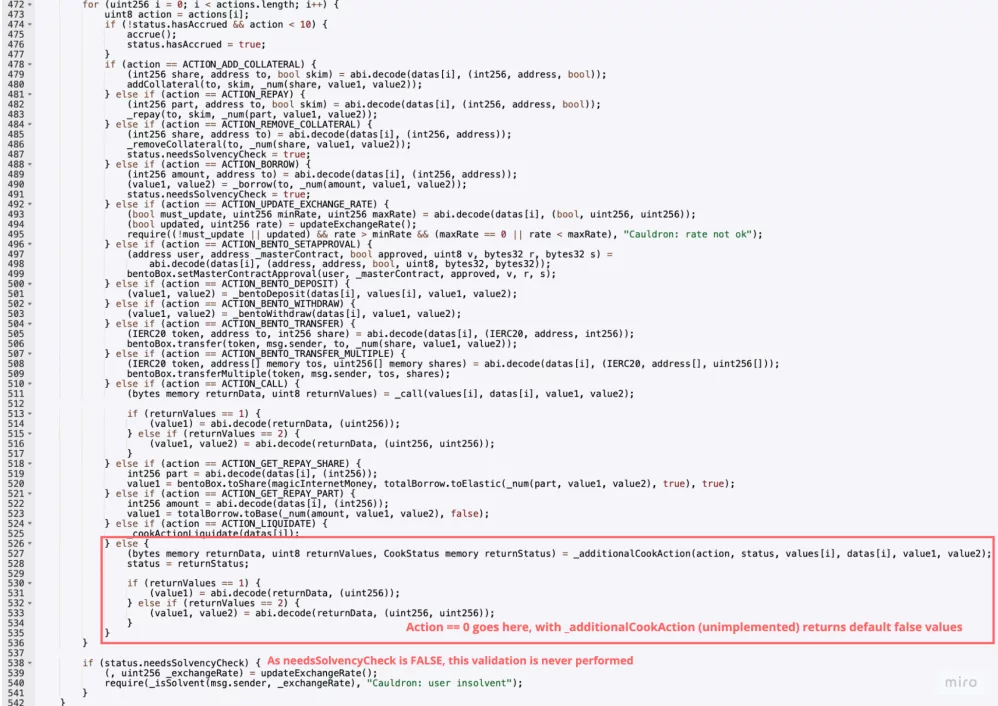
The short version of what went wrong is this: a safety flag that’s supposed to force a final check on whether a borrower actually has collateral got turned off inside a single transaction. As Hacken’s report lays out, the attacker “exploited a logic flaw in Abracadabra’s cook() function where they could borrow MIM tokens and then immediately reset the validation flag that was supposed to check if they had enough collateral.” That allowed a one-shot, uncollateralized borrow across multiple Cauldrons.

Under the microscope

Here’s how the flow worked, in plain terms. Abracadabra uses a batched function called cook() so users can do several actions in one transaction. Say, deposit collateral and borrow in the same click. One of those actions, like the “borrow” step, sets a flag named needsSolvencyCheck to true, meaning “at the end of this transaction, check that the borrower is safe.”
Abracadabra $1.8m hack repeats earlier fork flaw, Hacken reveals - 1

But another action that can be run inside the same batch calls “_additionalCookAction(…).” As Hacken points out, that function was declared as “virtual” and never was implemented, so by default it returned an empty object where everything was set to false, including that needsSolvencyCheck flag.

As a result, the attacker called the borrow action, then called the default action that reset the flag, and at the end, the protocol never checked solvency.

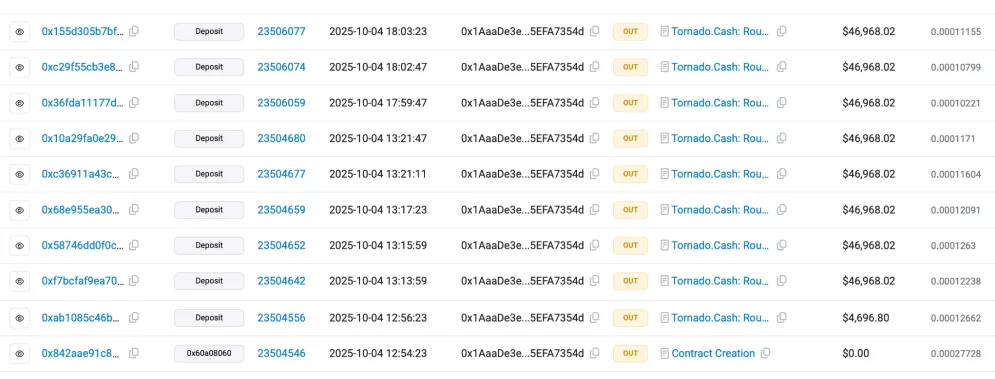
The analysts say the attacker hit six Cauldrons in one go, taking roughly 1.79 million MIM and swapping it for ETH. Attackers exploited vulnerability, and systematically went through six different Cauldrons and drained each one “using the same technique with a dedicated cook function call,” the analysts explained.
Abracadabra $1.8m hack repeats earlier fork flaw, Hacken reveals - 2

After swapping, the attacker routed funds through Tornado Cash, a crypto mixing protocol, mostly 10 ETH each, sending gradually over the following day.

And this isn’t the first time Abracadabra’s CauldronV4 code has been involved in trouble. Other incidents earlier this year used different edge cases in the same family of contracts. What’s interesting now is how fast the forked deployment reacted.

According to the report, a fork called Synnax paused or un-whitelisted its CauldronV4 master on its own DegenBox days before the Abracadabra drain, so basically the fork team pulled the emergency brake after spotting the same weak pattern, suggesting that the risk was visible to teams watching the code, if not fixed.

Piyasa Fırsatı
DeFi Logosu
DeFi Fiyatı(DEFI)
$0.00048
$0.00048$0.00048
0.00%
USD
DeFi (DEFI) Canlı Fiyat Grafiği
Sorumluluk Reddi: Bu sitede yeniden yayınlanan makaleler, halka açık platformlardan alınmıştır ve yalnızca bilgilendirme amaçlıdır. MEXC'nin görüşlerini yansıtmayabilir. Tüm hakları telif sahiplerine aittir. Herhangi bir içeriğin üçüncü taraf haklarını ihlal ettiğini düşünüyorsanız, kaldırılması için lütfen [email protected] ile iletişime geçin. MEXC, içeriğin doğruluğu, eksiksizliği veya güncelliği konusunda hiçbir garanti vermez ve sağlanan bilgilere dayalı olarak alınan herhangi bir eylemden sorumlu değildir. İçerik, finansal, yasal veya diğer profesyonel tavsiye niteliğinde değildir ve MEXC tarafından bir tavsiye veya onay olarak değerlendirilmemelidir.

Ayrıca Şunları da Beğenebilirsiniz

MAXI DOGE Holders Diversify into $GGs for Fast-Growth 2025 Crypto Presale Opportunities

MAXI DOGE Holders Diversify into $GGs for Fast-Growth 2025 Crypto Presale Opportunities

Presale crypto tokens have become some of the most active areas in Web3, offering early access to projects that blend culture, finance, and technology. Investors are constantly searching for the best crypto presale to buy right now, comparing new token presales across different niches. MAXI DOGE has gained attention for its meme-driven energy, but early [...] The post MAXI DOGE Holders Diversify into $GGs for Fast-Growth 2025 Crypto Presale Opportunities appeared first on Blockonomi.
Paylaş
Blockonomi2025/09/18 00:00
Bank of Canada cuts rate to 2.5% as tariffs and weak hiring hit economy

Bank of Canada cuts rate to 2.5% as tariffs and weak hiring hit economy

The Bank of Canada lowered its overnight rate to 2.5% on Wednesday, responding to mounting economic damage from US tariffs and a slowdown in hiring. The quarter-point cut was the first since March and met predictions from markets and economists. Governor Tiff Macklem, speaking in Ottawa, said the decision was unanimous. “With a weaker economy […]
Paylaş
Cryptopolitan2025/09/17 23:09
Edges higher ahead of BoC-Fed policy outcome

Edges higher ahead of BoC-Fed policy outcome

The post Edges higher ahead of BoC-Fed policy outcome appeared on BitcoinEthereumNews.com. USD/CAD gains marginally to near 1.3760 ahead of monetary policy announcements by the Fed and the BoC. Both the Fed and the BoC are expected to lower interest rates. USD/CAD forms a Head and Shoulder chart pattern. The USD/CAD pair ticks up to near 1.3760 during the late European session on Wednesday. The Loonie pair gains marginally ahead of monetary policy outcomes by the Bank of Canada (BoC) and the Federal Reserve (Fed) during New York trading hours. Both the BoC and the Fed are expected to cut interest rates amid mounting labor market conditions in their respective economies. Inflationary pressures in the Canadian economy have cooled down, emerging as another reason behind the BoC’s dovish expectations. However, the Fed is expected to start the monetary-easing campaign despite the United States (US) inflation remaining higher. Investors will closely monitor press conferences from both Fed Chair Jerome Powell and BoC Governor Tiff Macklem to get cues about whether there will be more interest rate cuts in the remainder of the year. According to analysts from Barclays, the Fed’s latest median projections for interest rates are likely to call for three interest rate cuts by 2025. Ahead of the Fed’s monetary policy, the US Dollar Index (DXY), which tracks the Greenback’s value against six major currencies, holds onto Tuesday’s losses near 96.60. USD/CAD forms a Head and Shoulder chart pattern, which indicates a bearish reversal. The neckline of the above-mentioned chart pattern is plotted near 1.3715. The near-term trend of the pair remains bearish as it stays below the 20-day Exponential Moving Average (EMA), which trades around 1.3800. The 14-day Relative Strength Index (RSI) slides to near 40.00. A fresh bearish momentum would emerge if the RSI falls below that level. Going forward, the asset could slide towards the round level of…
Paylaş
BitcoinEthereumNews2025/09/18 01:23