WormHole is a novel algorithm designed for answering multiple shortest path queries efficiently across large-scale social and information networks. It offers sublinear query complexity, rapid setup (up to 100x faster than PLL and MLL), and strong accuracy guarantees. By storing exact paths on a small “core” subset of vertices, WormHole achieves both theoretical soundness and exceptional empirical performance—even on billion-edge graphs—making it a breakthrough in scalable network analysis.WormHole is a novel algorithm designed for answering multiple shortest path queries efficiently across large-scale social and information networks. It offers sublinear query complexity, rapid setup (up to 100x faster than PLL and MLL), and strong accuracy guarantees. By storing exact paths on a small “core” subset of vertices, WormHole achieves both theoretical soundness and exceptional empirical performance—even on billion-edge graphs—making it a breakthrough in scalable network analysis.

How WormHole Speeds Up Pathfinding in Billion-Edge Graphs

Abstract and 1. Introduction

1.1 Our Contribution

1.2 Setting

1.3 The algorithm

  1. Related Work

  2. Algorithm

    3.1 The Structural Decomposition Phase

    3.2 The Routing Phase

    3.3 Variants of WormHole

  3. Theoretical Analysis

    4.1 Preliminaries

    4.2 Sublinearity of Inner Ring

    4.3 Approximation Error

    4.4 Query Complexity

  4. Experimental Results

    5.1 WormHole𝐸, WormHole𝐻 and BiBFS

    5.2 Comparison with index-based methods

    5.3 WormHole as a primitive: WormHole𝑀

References

1.1 Our Contribution

We design a new algorithm, WormHole, that creates a data structure allowing us to answer multiple shortest path inquiries by exploiting the typical structure of many social and information networks. WormHole is simple, easy to implement, and theoretically backed. We provide several variants of it, each suitable for a different setting, showing excellent empirical results on a variety of network datasets. Below are some of its key features:

\ • Performance-accuracy tradeoff. To the best of our knowledge, ours is the first approximate sublinear shortest paths algorithm in large networks. The fact that we allow small additive error, gives rise to a trade-off between preprocessing time/space and per-inquiry time, and allows us to come

\ Figure 2: (a) a comparison of the footprint in terms of disk space for different methods. The indexing based methods did not terminate on graphs larger than these.For WormHole, we consider the sum of Cin and Cout binary files. Note that PLL here is the distance algorithm, solving a weaker problem. The red bar “Input" is the size of the
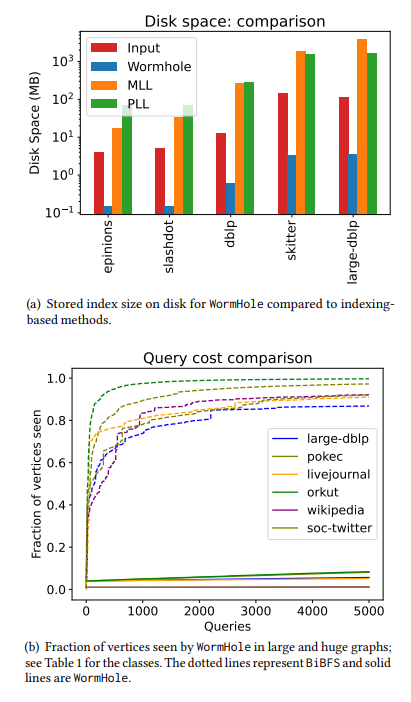
\ up with a solution with efficient preprocessing and fast perinquiry time. Notably, our most accurate (but slowest) variant, WormHole𝐸, has near-perfect accuracy: more than 90% of the inquiries are answered with no additive error, and in all networks, more than 99% of the inquiries are answered with additive error at most 2. See Table 3 for more details.

\ • Extremely rapid setup time. Our longest index construction time was just two minutes even for billion-edged graphs. For context, PLL and MLL timed out on half of the networks that we tested, and for moderately sized graphs where PLL and MLL did finish their runs, WormHole index construction was×100 faster. Namely, WormHole finished in seconds while PLL took hours. See Table 4 and Table 5. This rapid setup time is achieved due to the use of a sublinearly-sized index. For the largest networks we considered, it is sufficient to take an index of about 1% of the nodes to get small mean additive error – see Table 1. For smaller networks, it may be up to 6%.

\ • Fast inquiry time. Compared to BiBFS, the vanilla version WormHole𝐸 (without any index-based optimizations) is ×2 faster for almost all graphs and more than ×4 faster on the three largest graphs that we tested. A simple variant WormHole𝐻 achieves an order of magnitude improvement at some cost to accuracy: consistently 20× faster across almost all graphs, and more than 180× for the largest graph we have. See Table 3 for a full comparison. Indexing based methods typically answer inquiries in microseconds; both of the aforementioned variants are still in the millisecond regime.

\ • Combining WormHole and the state of the art. WormHole works by storing a small subset of vertices on which we compute the exact shortest paths. For arbitrary inquiries, we route our path through this subset, which we call the core. We use this insight to provide a third variant, WormHole𝑀 by implementing the state of the art for shortest paths, MLL, on the core. This achieves inquiry times that are comparable to MLL (with the same accuracy guarantee as WormHole𝐻 ) at a fraction of the setup cost, and runs for massive graphs where MLL does not terminate. We explore this combined approach in §5.3, and provide statistics in Table 6.

\ • Sublinear query complexity. The query complexity refers to the number of vertices queried by the algorithm. In a limited query access model where querying a node reveals its list of neighbors(see §1.2), the query complexity of our algorithm scales very well with the number of distance / shortest path inquiries made. To answer 5000 approximate shortest path inquiries, our algorithm only observes between 1% and 20% of the nodes for most networks. In comparison, BiBFS sees more than 90%of the graph to answer a few hundred shortest path inquiries. See Figure 2 and Figure 5 for a comparison.

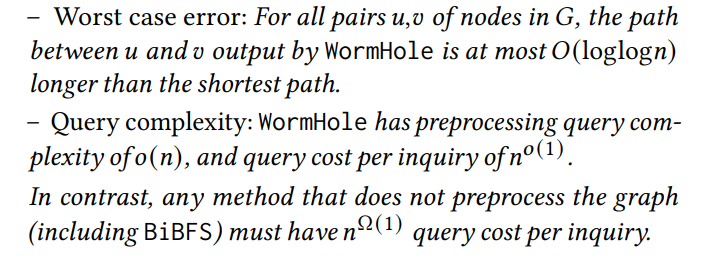
\ • Provable guarantees on error and performance. In §4 we prove a suite of theoretical results complementing and explaining the empirical performance. The results, stated informally below, are proved for the Chung-Lu model of random graphs with a power-law degree distribution [15–17].

\ Theorem 1.1 (Informal). In a Chung-Lu random graph𝐺 with power-law exponent 𝛽 ∈ (2,3) on 𝑛 vertices, WormHole has the following guarantees with high probability:

\
\

:::info Authors:

(1) Talya Eden, Bar-Ilan University ([email protected]);

(2) Omri Ben-Eliezer, MIT ([email protected]);

(3) C. Seshadhri, UC Santa Cruz ([email protected]).

:::


:::info This paper is available on arxiv under CC BY 4.0 license.

:::

\

Piyasa Fırsatı
Edge Logosu
Edge Fiyatı(EDGE)
$0.12862
$0.12862$0.12862
-5.35%
USD
Edge (EDGE) Canlı Fiyat Grafiği
Sorumluluk Reddi: Bu sitede yeniden yayınlanan makaleler, halka açık platformlardan alınmıştır ve yalnızca bilgilendirme amaçlıdır. MEXC'nin görüşlerini yansıtmayabilir. Tüm hakları telif sahiplerine aittir. Herhangi bir içeriğin üçüncü taraf haklarını ihlal ettiğini düşünüyorsanız, kaldırılması için lütfen [email protected] ile iletişime geçin. MEXC, içeriğin doğruluğu, eksiksizliği veya güncelliği konusunda hiçbir garanti vermez ve sağlanan bilgilere dayalı olarak alınan herhangi bir eylemden sorumlu değildir. İçerik, finansal, yasal veya diğer profesyonel tavsiye niteliğinde değildir ve MEXC tarafından bir tavsiye veya onay olarak değerlendirilmemelidir.

Ayrıca Şunları da Beğenebilirsiniz

Ethereum unveils roadmap focusing on scaling, interoperability, and security at Japan Dev Conference

Ethereum unveils roadmap focusing on scaling, interoperability, and security at Japan Dev Conference

The post Ethereum unveils roadmap focusing on scaling, interoperability, and security at Japan Dev Conference appeared on BitcoinEthereumNews.com. Key Takeaways Ethereum’s new roadmap was presented by Vitalik Buterin at the Japan Dev Conference. Short-term priorities include Layer 1 scaling and raising gas limits to enhance transaction throughput. Vitalik Buterin presented Ethereum’s development roadmap at the Japan Dev Conference today, outlining the blockchain platform’s priorities across multiple timeframes. The short-term goals focus on scaling solutions and increasing Layer 1 gas limits to improve transaction capacity. Mid-term objectives target enhanced cross-Layer 2 interoperability and faster network responsiveness to create a more seamless user experience across different scaling solutions. The long-term vision emphasizes building a secure, simple, quantum-resistant, and formally verified minimalist Ethereum network. This approach aims to future-proof the platform against emerging technological threats while maintaining its core functionality. The roadmap presentation comes as Ethereum continues to compete with other blockchain platforms for market share in the smart contract and decentralized application space. Source: https://cryptobriefing.com/ethereum-roadmap-scaling-interoperability-security-japan/
Paylaş
BitcoinEthereumNews2025/09/18 00:25
USD/INR opens flat on hopes of RBI’s follow-through intervention

USD/INR opens flat on hopes of RBI’s follow-through intervention

The post USD/INR opens flat on hopes of RBI’s follow-through intervention appeared on BitcoinEthereumNews.com. The Indian Rupee (INR) opens on a flat note against
Paylaş
BitcoinEthereumNews2025/12/18 13:33
A Netflix ‘KPop Demon Hunters’ Short Film Has Been Rated For Release

A Netflix ‘KPop Demon Hunters’ Short Film Has Been Rated For Release

The post A Netflix ‘KPop Demon Hunters’ Short Film Has Been Rated For Release appeared on BitcoinEthereumNews.com. KPop Demon Hunters Netflix Everyone has wondered what may be the next step for KPop Demon Hunters as an IP, given its record-breaking success on Netflix. Now, the answer may be something exactly no one predicted. According to a new filing with the MPA, something called Debut: A KPop Demon Hunters Story has been rated PG by the ratings body. It’s listed alongside some other films, and this is obviously something that has not been publicly announced. A short film could be well, very short, a few minutes, and likely no more than ten. Even that might be pushing it. Using say, Pixar shorts as a reference, most are between 4 and 8 minutes. The original movie is an hour and 36 minutes. The “Debut” in the title indicates some sort of flashback, perhaps to when HUNTR/X first arrived on the scene before they blew up. Previously, director Maggie Kang has commented about how there were more backstory components that were supposed to be in the film that were cut, but hinted those could be explored in a sequel. But perhaps some may be put into a short here. I very much doubt those scenes were fully produced and simply cut, but perhaps they were finished up for this short film here. When would Debut: KPop Demon Hunters theoretically arrive? I’m not sure the other films on the list are much help. Dead of Winter is out in less than two weeks. Mother Mary does not have a release date. Ne Zha 2 came out earlier this year. I’ve only seen news stories saying The Perfect Gamble was supposed to come out in Q1 2025, but I’ve seen no evidence that it actually has. KPop Demon Hunters Netflix It could be sooner rather than later as Netflix looks to capitalize…
Paylaş
BitcoinEthereumNews2025/09/18 02:23