Pantera Capital founder and CEO Dan Morehead argues the core driver of this cycle remains the same “one trade” uniting macro and crypto: fiat debasement pushing capital into scarce, higher-beta assets. In a wide-ranging conversation with Real Vision’s Raoul Pal, the pair frame the current rally—and what comes next—through the lens of policy error, structural deficits, sticky inflation, and the slow-rolling migration of institutional and sovereign portfolios into digital assets. The Debasement Trade Powers The Crypto Bull Run Morehead’s starting point is blunt: “We have full employment. Inflation is debasing our assets by 3% a year… and they’re cutting rates. Like, it’s crazy.” He calls 2020–2021 “a policy error”—“there was a time where inflation was 8%, and the Fed Funds rate was zero”—and says easing into today’s backdrop “when everything’s booming” undermines the monetary check on “record fiscal deficits.” The consequence, he argues, is that price levels across real assets look high not because they are rallying independently, but because the denominator is falling: “It’s the price of paper money that’s plummeting.” Related Reading: Is The Crypto Bull Run Over? Lekker Capital CIO Warns ‘Don’t Miss The Forest’ Pal extends the frame to a single macro factor. “We use [Global Macro Investor’s] total global liquidity index as our benchmark for debasement. The Nasdaq, since 2012, has a 97.5% correlation, and Bitcoin is about 90%.” In his words, “None of it matters. It’s all one trade.” The implication is a regime where liquidity and debasement overwhelm the usual cross-asset nuance: “It’s the greatest macro trade of all time.” That regime, in Morehead’s view, also explains why adoption keeps broadening. The pair note how the “debasement trade” has migrated from crypto-native circles into bank research. “JP Morgan’s talking about it. And I got an email from Goldman today, the debasement trade,” Morehead says. “I’ve been talking about it for 12 years.” Pal adds that even large banks “openly” talk about currency debasement now, while clients are being offered wider access to crypto exposure. The wedge, they contend, remains institutional under-allocation. “How can you have a bubble nobody owns?” Morehead asks. “The median institutional investor’s exposure to crypto and blockchain ventures is literally 0.0.” Asked where steady-state allocation could land, he points to “8 or 10” percent over time, echoing Pal’s observation that many family offices that start at 2% “end up being 20% really fast” as price action mechanically increases weightings and conviction follows. Morehead also sees policy politics and geopolitics accelerating adoption. He argues the US election reset a regulatory headwind—“we went from… aggressively negative… to being extremely positive”—unlocking public pensions and sovereign funds that “got scared away in 2022” after the FTX/Luna/Celsius cascade and high-profile enforcement cases. He goes further, sketching a sovereign “arms race” for reserve Bitcoin: US holdings via seizures, “roughly the same” in China, and GCC states “aggressively getting into the blockchain space,” with room for acquisitions “tiny compared to balance sheets.” In his phrasing, if multiple blocs each target million-coin stockpiles, supply dynamics could “squeeze up like a watermelon seed.” Why This Crypto Bull Run Extends Into 2026 If liquidity and adoption anchor the bull case, both still respect crypto’s cyclicality. Morehead has modeled four-year dynamics around halvings and says Pantera’s prior cycle targets hit with eerie precision: “We forecast… Bitcoin would hit $118,542 on August 11th, 2025. And it did… one day [early].” He also notes past peaks coincided with celebratory “events”—the 2017 CME futures listing and 2021 Coinbase direct listing—followed by ~85% drawdowns. Yet he argues “this time” may be meaningfully extended by the policy and allocation backdrop: “The regulatory changes in the US, I think just trump everything… I think the next six to 12 months are still a big rally.” Pal, while acknowledging the internet’s penchant for hanging forecasters, concurs: “I think it’s going to extend.” Related Reading: Russia’s New Crypto Framework Could Redefine Global Trade Amid Sanctions Pressure The social dimension of adoption runs through the conversation. Debasement’s distributional effects have made housing and rents the stickiest CPI components—“35% of [core CPI] is shelter,” Morehead says—pushing younger cohorts toward hard assets. Meanwhile, the “virality rate of crypto is like 95%,” he claims: “you get a smart person… to think about it for an hour, they’re all like, ‘Oh yeah, I should buy some crypto.’” Evangelists matter, too: “Michael Saylor has done a great job. He has Messianic following… Tom Lee [on ETH]… We’re gonna endeavor to do that on Solana.” Visibility through ETFs, DATs, and media segments pulls newcomers into the funnel, where small initial slices tend to scale. As Pal puts it, investors who lack exposure feel “like you’re short the upside calls.” I love it when technology, crypto, and macro come together in someone’s journey… and there’s no one better than my dear friend @dan_pantera, an OG in the space! Please enjoy pic.twitter.com/ShZAd2tB3u — Raoul Pal (@RaoulGMI) October 23, 2025 For all the optimism, the macro warning lights stay on in the background: structural US deficits “literally in the best of times,” a monetary-fiscal loop trapped between refinancing needs and price stability, and a demographic drag on productivity that leaves AI-driven gains still ahead of the curve. “Debasing your fiat currency against everybody else’s fiat currency is a race to the bottom,” Morehead cautions. In that world, gold and crypto function as life rafts: “That’s why everything’s at record prices… except for paper money.” Both men close by zooming out. The internet is “53 years old and they’re still doing cool internet companies,” Morehead says; Bitcoin turning 17 means the asset class remains a teenager. The majority of institutions “still have 0.0” exposure. If the “one trade” persists—liquidity up, fiat down, adoption rising—then the path of least resistance, in their telling, still points higher. Or as Morehead compresses the thesis into a single line: “If you hold crypto for four or five years, I think it’s like 90% that you make money… It is that simple.” At press time, the total crypto market cap stood at $3.7 trillion. Featured image created with DALL.E, chart from TradingView.comPantera Capital founder and CEO Dan Morehead argues the core driver of this cycle remains the same “one trade” uniting macro and crypto: fiat debasement pushing capital into scarce, higher-beta assets. In a wide-ranging conversation with Real Vision’s Raoul Pal, the pair frame the current rally—and what comes next—through the lens of policy error, structural deficits, sticky inflation, and the slow-rolling migration of institutional and sovereign portfolios into digital assets. The Debasement Trade Powers The Crypto Bull Run Morehead’s starting point is blunt: “We have full employment. Inflation is debasing our assets by 3% a year… and they’re cutting rates. Like, it’s crazy.” He calls 2020–2021 “a policy error”—“there was a time where inflation was 8%, and the Fed Funds rate was zero”—and says easing into today’s backdrop “when everything’s booming” undermines the monetary check on “record fiscal deficits.” The consequence, he argues, is that price levels across real assets look high not because they are rallying independently, but because the denominator is falling: “It’s the price of paper money that’s plummeting.” Related Reading: Is The Crypto Bull Run Over? Lekker Capital CIO Warns ‘Don’t Miss The Forest’ Pal extends the frame to a single macro factor. “We use [Global Macro Investor’s] total global liquidity index as our benchmark for debasement. The Nasdaq, since 2012, has a 97.5% correlation, and Bitcoin is about 90%.” In his words, “None of it matters. It’s all one trade.” The implication is a regime where liquidity and debasement overwhelm the usual cross-asset nuance: “It’s the greatest macro trade of all time.” That regime, in Morehead’s view, also explains why adoption keeps broadening. The pair note how the “debasement trade” has migrated from crypto-native circles into bank research. “JP Morgan’s talking about it. And I got an email from Goldman today, the debasement trade,” Morehead says. “I’ve been talking about it for 12 years.” Pal adds that even large banks “openly” talk about currency debasement now, while clients are being offered wider access to crypto exposure. The wedge, they contend, remains institutional under-allocation. “How can you have a bubble nobody owns?” Morehead asks. “The median institutional investor’s exposure to crypto and blockchain ventures is literally 0.0.” Asked where steady-state allocation could land, he points to “8 or 10” percent over time, echoing Pal’s observation that many family offices that start at 2% “end up being 20% really fast” as price action mechanically increases weightings and conviction follows. Morehead also sees policy politics and geopolitics accelerating adoption. He argues the US election reset a regulatory headwind—“we went from… aggressively negative… to being extremely positive”—unlocking public pensions and sovereign funds that “got scared away in 2022” after the FTX/Luna/Celsius cascade and high-profile enforcement cases. He goes further, sketching a sovereign “arms race” for reserve Bitcoin: US holdings via seizures, “roughly the same” in China, and GCC states “aggressively getting into the blockchain space,” with room for acquisitions “tiny compared to balance sheets.” In his phrasing, if multiple blocs each target million-coin stockpiles, supply dynamics could “squeeze up like a watermelon seed.” Why This Crypto Bull Run Extends Into 2026 If liquidity and adoption anchor the bull case, both still respect crypto’s cyclicality. Morehead has modeled four-year dynamics around halvings and says Pantera’s prior cycle targets hit with eerie precision: “We forecast… Bitcoin would hit $118,542 on August 11th, 2025. And it did… one day [early].” He also notes past peaks coincided with celebratory “events”—the 2017 CME futures listing and 2021 Coinbase direct listing—followed by ~85% drawdowns. Yet he argues “this time” may be meaningfully extended by the policy and allocation backdrop: “The regulatory changes in the US, I think just trump everything… I think the next six to 12 months are still a big rally.” Pal, while acknowledging the internet’s penchant for hanging forecasters, concurs: “I think it’s going to extend.” Related Reading: Russia’s New Crypto Framework Could Redefine Global Trade Amid Sanctions Pressure The social dimension of adoption runs through the conversation. Debasement’s distributional effects have made housing and rents the stickiest CPI components—“35% of [core CPI] is shelter,” Morehead says—pushing younger cohorts toward hard assets. Meanwhile, the “virality rate of crypto is like 95%,” he claims: “you get a smart person… to think about it for an hour, they’re all like, ‘Oh yeah, I should buy some crypto.’” Evangelists matter, too: “Michael Saylor has done a great job. He has Messianic following… Tom Lee [on ETH]… We’re gonna endeavor to do that on Solana.” Visibility through ETFs, DATs, and media segments pulls newcomers into the funnel, where small initial slices tend to scale. As Pal puts it, investors who lack exposure feel “like you’re short the upside calls.” I love it when technology, crypto, and macro come together in someone’s journey… and there’s no one better than my dear friend @dan_pantera, an OG in the space! Please enjoy pic.twitter.com/ShZAd2tB3u — Raoul Pal (@RaoulGMI) October 23, 2025 For all the optimism, the macro warning lights stay on in the background: structural US deficits “literally in the best of times,” a monetary-fiscal loop trapped between refinancing needs and price stability, and a demographic drag on productivity that leaves AI-driven gains still ahead of the curve. “Debasing your fiat currency against everybody else’s fiat currency is a race to the bottom,” Morehead cautions. In that world, gold and crypto function as life rafts: “That’s why everything’s at record prices… except for paper money.” Both men close by zooming out. The internet is “53 years old and they’re still doing cool internet companies,” Morehead says; Bitcoin turning 17 means the asset class remains a teenager. The majority of institutions “still have 0.0” exposure. If the “one trade” persists—liquidity up, fiat down, adoption rising—then the path of least resistance, in their telling, still points higher. Or as Morehead compresses the thesis into a single line: “If you hold crypto for four or five years, I think it’s like 90% that you make money… It is that simple.” At press time, the total crypto market cap stood at $3.7 trillion. Featured image created with DALL.E, chart from TradingView.com
‘It’s All One Trade’ — Crypto Bull Run Isn’t Done, Says Dan Morehead

2025/10/25 12:00

Pantera Capital founder and CEO Dan Morehead argues the core driver of this cycle remains the same “one trade” uniting macro and crypto: fiat debasement pushing capital into scarce, higher-beta assets. In a wide-ranging conversation with Real Vision’s Raoul Pal, the pair frame the current rally—and what comes next—through the lens of policy error, structural deficits, sticky inflation, and the slow-rolling migration of institutional and sovereign portfolios into digital assets.

The Debasement Trade Powers The Crypto Bull Run

Morehead’s starting point is blunt: “We have full employment. Inflation is debasing our assets by 3% a year… and they’re cutting rates. Like, it’s crazy.” He calls 2020–2021 “a policy error”—“there was a time where inflation was 8%, and the Fed Funds rate was zero”—and says easing into today’s backdrop “when everything’s booming” undermines the monetary check on “record fiscal deficits.” The consequence, he argues, is that price levels across real assets look high not because they are rallying independently, but because the denominator is falling: “It’s the price of paper money that’s plummeting.”

Pal extends the frame to a single macro factor. “We use [Global Macro Investor’s] total global liquidity index as our benchmark for debasement. The Nasdaq, since 2012, has a 97.5% correlation, and Bitcoin is about 90%.” In his words, “None of it matters. It’s all one trade.” The implication is a regime where liquidity and debasement overwhelm the usual cross-asset nuance: “It’s the greatest macro trade of all time.”

That regime, in Morehead’s view, also explains why adoption keeps broadening. The pair note how the “debasement trade” has migrated from crypto-native circles into bank research. “JP Morgan’s talking about it. And I got an email from Goldman today, the debasement trade,” Morehead says. “I’ve been talking about it for 12 years.” Pal adds that even large banks “openly” talk about currency debasement now, while clients are being offered wider access to crypto exposure.

The wedge, they contend, remains institutional under-allocation. “How can you have a bubble nobody owns?” Morehead asks. “The median institutional investor’s exposure to crypto and blockchain ventures is literally 0.0.” Asked where steady-state allocation could land, he points to “8 or 10” percent over time, echoing Pal’s observation that many family offices that start at 2% “end up being 20% really fast” as price action mechanically increases weightings and conviction follows.

Morehead also sees policy politics and geopolitics accelerating adoption. He argues the US election reset a regulatory headwind—“we went from… aggressively negative… to being extremely positive”—unlocking public pensions and sovereign funds that “got scared away in 2022” after the FTX/Luna/Celsius cascade and high-profile enforcement cases.

He goes further, sketching a sovereign “arms race” for reserve Bitcoin: US holdings via seizures, “roughly the same” in China, and GCC states “aggressively getting into the blockchain space,” with room for acquisitions “tiny compared to balance sheets.” In his phrasing, if multiple blocs each target million-coin stockpiles, supply dynamics could “squeeze up like a watermelon seed.”

Why This Crypto Bull Run Extends Into 2026

If liquidity and adoption anchor the bull case, both still respect crypto’s cyclicality. Morehead has modeled four-year dynamics around halvings and says Pantera’s prior cycle targets hit with eerie precision: “We forecast… Bitcoin would hit $118,542 on August 11th, 2025. And it did… one day [early].” He also notes past peaks coincided with celebratory “events”—the 2017 CME futures listing and 2021 Coinbase direct listing—followed by ~85% drawdowns.

Yet he argues “this time” may be meaningfully extended by the policy and allocation backdrop: “The regulatory changes in the US, I think just trump everything… I think the next six to 12 months are still a big rally.” Pal, while acknowledging the internet’s penchant for hanging forecasters, concurs: “I think it’s going to extend.”

The social dimension of adoption runs through the conversation. Debasement’s distributional effects have made housing and rents the stickiest CPI components—“35% of [core CPI] is shelter,” Morehead says—pushing younger cohorts toward hard assets. Meanwhile, the “virality rate of crypto is like 95%,” he claims: “you get a smart person… to think about it for an hour, they’re all like, ‘Oh yeah, I should buy some crypto.’”

Evangelists matter, too: “Michael Saylor has done a great job. He has Messianic following… Tom Lee [on ETH]… We’re gonna endeavor to do that on Solana.” Visibility through ETFs, DATs, and media segments pulls newcomers into the funnel, where small initial slices tend to scale. As Pal puts it, investors who lack exposure feel “like you’re short the upside calls.”

For all the optimism, the macro warning lights stay on in the background: structural US deficits “literally in the best of times,” a monetary-fiscal loop trapped between refinancing needs and price stability, and a demographic drag on productivity that leaves AI-driven gains still ahead of the curve. “Debasing your fiat currency against everybody else’s fiat currency is a race to the bottom,” Morehead cautions. In that world, gold and crypto function as life rafts: “That’s why everything’s at record prices… except for paper money.”

Both men close by zooming out. The internet is “53 years old and they’re still doing cool internet companies,” Morehead says; Bitcoin turning 17 means the asset class remains a teenager. The majority of institutions “still have 0.0” exposure. If the “one trade” persists—liquidity up, fiat down, adoption rising—then the path of least resistance, in their telling, still points higher.

Or as Morehead compresses the thesis into a single line: “If you hold crypto for four or five years, I think it’s like 90% that you make money… It is that simple.”

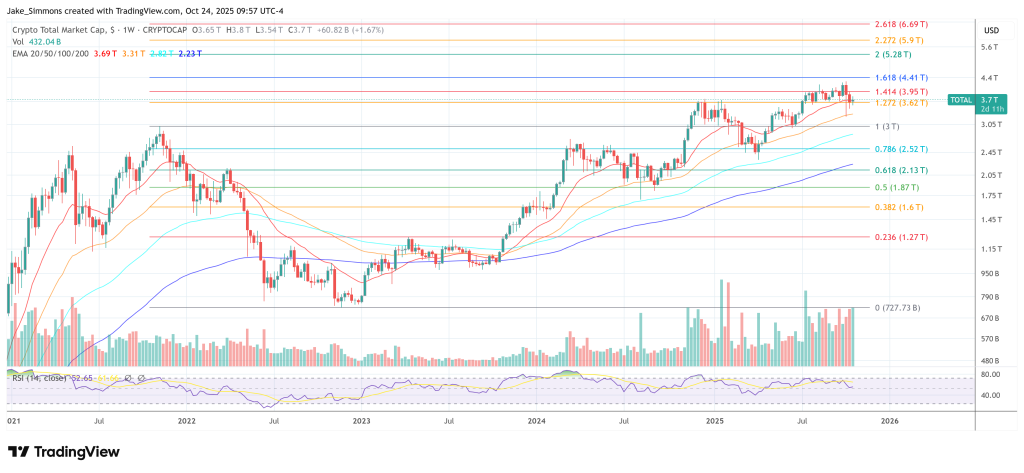
At press time, the total crypto market cap stood at $3.7 trillion.

Total crypto market cap
Piyasa Fırsatı
Polytrade Logosu
Polytrade Fiyatı(TRADE)
$0.07794
$0.07794$0.07794
+13.59%
USD
Polytrade (TRADE) Canlı Fiyat Grafiği
Sorumluluk Reddi: Bu sitede yeniden yayınlanan makaleler, halka açık platformlardan alınmıştır ve yalnızca bilgilendirme amaçlıdır. MEXC'nin görüşlerini yansıtmayabilir. Tüm hakları telif sahiplerine aittir. Herhangi bir içeriğin üçüncü taraf haklarını ihlal ettiğini düşünüyorsanız, kaldırılması için lütfen [email protected] ile iletişime geçin. MEXC, içeriğin doğruluğu, eksiksizliği veya güncelliği konusunda hiçbir garanti vermez ve sağlanan bilgilere dayalı olarak alınan herhangi bir eylemden sorumlu değildir. İçerik, finansal, yasal veya diğer profesyonel tavsiye niteliğinde değildir ve MEXC tarafından bir tavsiye veya onay olarak değerlendirilmemelidir.

Ayrıca Şunları da Beğenebilirsiniz

MoneyGram launches stablecoin-powered app in Colombia

MoneyGram launches stablecoin-powered app in Colombia

The post MoneyGram launches stablecoin-powered app in Colombia appeared on BitcoinEthereumNews.com. MoneyGram has launched a new mobile application in Colombia that uses USD-pegged stablecoins to modernize cross-border remittances. According to an announcement on Wednesday, the app allows customers to receive money instantly into a US dollar balance backed by Circle’s USDC stablecoin, which can be stored, spent, or cashed out through MoneyGram’s global retail network. The rollout is designed to address the volatility of local currencies, particularly the Colombian peso. Built on the Stellar blockchain and supported by wallet infrastructure provider Crossmint, the app marks MoneyGram’s most significant move yet to integrate stablecoins into consumer-facing services. Colombia was selected as the first market due to its heavy reliance on inbound remittances—families in the country receive more than 22 times the amount they send abroad, according to Statista. The announcement said future expansions will target other remittance-heavy markets. MoneyGram, which has nearly 500,000 retail locations globally, has experimented with blockchain rails since partnering with the Stellar Development Foundation in 2021. It has since built cash on and off ramps for stablecoins, developed APIs for crypto integration, and incorporated stablecoins into its internal settlement processes. “This launch is the first step toward a world where every person, everywhere, has access to dollar stablecoins,” CEO Anthony Soohoo stated. The company emphasized compliance, citing decades of regulatory experience, though stablecoin oversight remains fluid. The US Congress passed the GENIUS Act earlier this year, establishing a framework for stablecoin regulation, which MoneyGram has pointed to as providing clearer guardrails. This is a developing story. This article was generated with the assistance of AI and reviewed by editor Jeffrey Albus before publication. Get the news in your inbox. Explore Blockworks newsletters: Source: https://blockworks.co/news/moneygram-stablecoin-app-colombia
Paylaş
BitcoinEthereumNews2025/09/18 07:04
WIF Price Prediction: Targeting $0.48 Recovery Within 2 Weeks as MACD Shows Bullish Divergence

WIF Price Prediction: Targeting $0.48 Recovery Within 2 Weeks as MACD Shows Bullish Divergence

The post WIF Price Prediction: Targeting $0.48 Recovery Within 2 Weeks as MACD Shows Bullish Divergence appeared on BitcoinEthereumNews.com. James Ding Dec 16
Paylaş
BitcoinEthereumNews2025/12/17 17:32
Tokyo’s Metaplanet Launches Miami Subsidiary to Amplify Bitcoin Income

Tokyo’s Metaplanet Launches Miami Subsidiary to Amplify Bitcoin Income

Metaplanet Inc., the Japanese public company known for its bitcoin treasury, is launching a Miami subsidiary to run a dedicated derivatives and income strategy aimed at turning holdings into steady, U.S.-based cash flow. Japanese Bitcoin Treasury Player Metaplanet Opens Miami Outpost The new entity, Metaplanet Income Corp., sits under Metaplanet Holdings, Inc. and is based […]
Paylaş
Coinstats2025/09/18 00:32