Institutional money has changed how crypto trades. Bitcoin and Ethereum now respond to economic news in ways that mirror traditional assets. Reports on the CPI, inflation, and interest rates move prices. This shift means macroeconomic indicators are no longer optional for crypto traders. They are part of the core playbook. This article explains how official data on inflation, central bank rates, and crypto-specific indicators like Bitcoin dominance can help anticipate market trends. The analysis draws on macro releases, crypto charts, and research from large trading desks. The goal is not to predict exact moves but to offer a practical guide to understanding how broader economic trends shape crypto performance. Inflation and Bitcoin: CPI’s Growing Grip on Crypto Inflation started rising sharply in early 2022. The Consumer Price Index , reported by the Bureau of Labor Statistics, reached nine percent year-over-year in June. Bitcoin fell six percent within three days of that release. Investors moved out of risk assets, expecting tighter financial conditions. This pattern continued through 2023 and 2024. When CPI came in lower than forecasts, Bitcoin often rebounded. For example, in November 2022, the month-over-month print was 0.1 percent against a forecast of 0.3 percent. Bitcoin gained nearly four percent within two days. CPI for all items rises 0.1% in May; shelter up #BLSData https://t.co/dJyJeKmvth — BLS-Labor Statistics (@BLS_gov) June 11, 2025 This repeated reaction suggests Bitcoin now trades more like tech stocks. It does not act like a hedge against inflation in the short term. Instead, it follows interest rate expectations. If inflation readings push the Federal Reserve toward cuts, traders often rotate into crypto. If inflation jumps, traders exit fast. CPI for May 2025 showed price growth slowing toward the Federal Reserve’s target. If that trend continues, investors may add risk again. However, if energy costs or wages lift inflation above forecasts, expectations may shift back toward tightening. Traders will likely adjust positions in Bitcoin and Ethereum based on these releases. CPI releases now act as drivers of short-term price direction. Fed Rates and Ethereum: Liquidity Cycles in Action The Federal Reserve began raising interest rates in March 2022. That cycle lasted until mid-2023, with the target range reaching 5.25 to 5.5 percent. Each increase indicated tighter liquidity. Ethereum often fell in the days following these announcements, mirroring declines in growth-focused equities. Ethereum Price 2022 (Source: CoinMarketCap) Ethereum’s sensitivity to rate decisions became clear in several key moments. After the June 2022 hike of 75 basis points, ETH dropped by over eight percent within 48 hours. The same pattern repeated in September. By contrast, when the Fed paused in July 2023, ETH rebounded by nearly five percent over the next three trading sessions. However, one exception came in March 2023. The collapse of Silicon Valley Bank triggered panic in financial markets. The Fed raised rates by 25 basis points but indicated it might stop soon. That shift helped ETH recover as it climbed from under $1,400 to over $1,800 within three weeks. These events show Ethereum’s link to monetary policy. Rate hikes tighten conditions and push ETH down. Pauses or signs of easing often lead to sharp rebounds. Ethereum trades like a proxy for risk appetite in a liquidity-driven market. Bitcoin Dominance: Crypto’s Own Macro Gauge Bitcoin dominance tracks the percentage of total crypto market value held in Bitcoin. When dominance rises, it often reflects a retreat to safety. During periods of macro tightening, investors reduce exposure to smaller tokens and move capital into Bitcoin. This behavior mirrors broader risk-off patterns. U.S. Interest Rate 2015-2025 (Federal Reserve Bank) From late 2021 through 2022, Bitcoin dominance climbed from under 40 percent to nearly 48 percent. That move came during sharp inflation spikes, and a series of Fed rate increases as the market pulled back from speculative assets. Dominance rose again in mid-2023, just before the Fed indicated a pause, and fell shortly after. This pattern supports a familiar cycle. In early risk-on phases, Bitcoin leads. Once it stabilizes, capital rotates into Ethereum, then into altcoins with lower market value. Drops in dominance often mark the beginning of these rotations. The index can act as a sign of changing sentiment within the market. Bitcoin dominance reflects how crypto investors respond to broader economic shifts. It can function like a barometer—trending upward when uncertainty grows and falling when conditions favor higher risk exposure. Institutional Macro Forecasts and the Next 90 Days Institutional research over the past year has increasingly tied macro indicators to digital asset performance. In an October 2024 report, Crypto.com Research stated: “Economic growth may generally indicate a more favourable environment for cryptocurrencies, but the impact will vary depending on other market conditions.” They noted that “increasing correlation between traditional markets and cryptocurrencies means that stock market performance may potentially provide valuable insights into potential crypto trends.” Looking ahead, the next 90 days include several macro events that could affect crypto direction. The July CPI data is due on August 12, with consensus forecasting a YoY increase of 2.8 percent. The next FOMC meeting is on September 17, where markets currently price a 25 basis point cut. The August nonfarm payroll report (due September 6) and Q2 GDP revision (August 29) also stand out as volatility triggers. These dates offer key decision points. A lower CPI print could reinforce Fed easing expectations and push capital into risk assets. On the other hand, a stronger-than-expected payroll may reduce those expectations. ETF-related flows and crypto-native reactions will likely hinge on these cues, reinforcing the case that macro indicators now drive the broader crypto narrative. Conclusion: A Macro-Informed Strategy Macroeconomic indicators now play a measurable role in shaping the crypto market direction. Inflation data, central bank policy , and internal metrics like Bitcoin dominance have shown clear relationships with past price shifts in both Bitcoin and Ethereum. These signs, when aligned, can offer a grounded framework for interpreting future moves. While no model captures every turn, tracking CPI releases, FOMC decisions, and market reactions allows for more informed positioning. Macro data will not replace crypto-native analysis, but it adds a broader context that is becoming harder to ignore. Keeping an economic calendar in view may prove as useful as any technical chart.Institutional money has changed how crypto trades. Bitcoin and Ethereum now respond to economic news in ways that mirror traditional assets. Reports on the CPI, inflation, and interest rates move prices. This shift means macroeconomic indicators are no longer optional for crypto traders. They are part of the core playbook. This article explains how official data on inflation, central bank rates, and crypto-specific indicators like Bitcoin dominance can help anticipate market trends. The analysis draws on macro releases, crypto charts, and research from large trading desks. The goal is not to predict exact moves but to offer a practical guide to understanding how broader economic trends shape crypto performance. Inflation and Bitcoin: CPI’s Growing Grip on Crypto Inflation started rising sharply in early 2022. The Consumer Price Index , reported by the Bureau of Labor Statistics, reached nine percent year-over-year in June. Bitcoin fell six percent within three days of that release. Investors moved out of risk assets, expecting tighter financial conditions. This pattern continued through 2023 and 2024. When CPI came in lower than forecasts, Bitcoin often rebounded. For example, in November 2022, the month-over-month print was 0.1 percent against a forecast of 0.3 percent. Bitcoin gained nearly four percent within two days. CPI for all items rises 0.1% in May; shelter up #BLSData https://t.co/dJyJeKmvth — BLS-Labor Statistics (@BLS_gov) June 11, 2025 This repeated reaction suggests Bitcoin now trades more like tech stocks. It does not act like a hedge against inflation in the short term. Instead, it follows interest rate expectations. If inflation readings push the Federal Reserve toward cuts, traders often rotate into crypto. If inflation jumps, traders exit fast. CPI for May 2025 showed price growth slowing toward the Federal Reserve’s target. If that trend continues, investors may add risk again. However, if energy costs or wages lift inflation above forecasts, expectations may shift back toward tightening. Traders will likely adjust positions in Bitcoin and Ethereum based on these releases. CPI releases now act as drivers of short-term price direction. Fed Rates and Ethereum: Liquidity Cycles in Action The Federal Reserve began raising interest rates in March 2022. That cycle lasted until mid-2023, with the target range reaching 5.25 to 5.5 percent. Each increase indicated tighter liquidity. Ethereum often fell in the days following these announcements, mirroring declines in growth-focused equities. Ethereum Price 2022 (Source: CoinMarketCap) Ethereum’s sensitivity to rate decisions became clear in several key moments. After the June 2022 hike of 75 basis points, ETH dropped by over eight percent within 48 hours. The same pattern repeated in September. By contrast, when the Fed paused in July 2023, ETH rebounded by nearly five percent over the next three trading sessions. However, one exception came in March 2023. The collapse of Silicon Valley Bank triggered panic in financial markets. The Fed raised rates by 25 basis points but indicated it might stop soon. That shift helped ETH recover as it climbed from under $1,400 to over $1,800 within three weeks. These events show Ethereum’s link to monetary policy. Rate hikes tighten conditions and push ETH down. Pauses or signs of easing often lead to sharp rebounds. Ethereum trades like a proxy for risk appetite in a liquidity-driven market. Bitcoin Dominance: Crypto’s Own Macro Gauge Bitcoin dominance tracks the percentage of total crypto market value held in Bitcoin. When dominance rises, it often reflects a retreat to safety. During periods of macro tightening, investors reduce exposure to smaller tokens and move capital into Bitcoin. This behavior mirrors broader risk-off patterns. U.S. Interest Rate 2015-2025 (Federal Reserve Bank) From late 2021 through 2022, Bitcoin dominance climbed from under 40 percent to nearly 48 percent. That move came during sharp inflation spikes, and a series of Fed rate increases as the market pulled back from speculative assets. Dominance rose again in mid-2023, just before the Fed indicated a pause, and fell shortly after. This pattern supports a familiar cycle. In early risk-on phases, Bitcoin leads. Once it stabilizes, capital rotates into Ethereum, then into altcoins with lower market value. Drops in dominance often mark the beginning of these rotations. The index can act as a sign of changing sentiment within the market. Bitcoin dominance reflects how crypto investors respond to broader economic shifts. It can function like a barometer—trending upward when uncertainty grows and falling when conditions favor higher risk exposure. Institutional Macro Forecasts and the Next 90 Days Institutional research over the past year has increasingly tied macro indicators to digital asset performance. In an October 2024 report, Crypto.com Research stated: “Economic growth may generally indicate a more favourable environment for cryptocurrencies, but the impact will vary depending on other market conditions.” They noted that “increasing correlation between traditional markets and cryptocurrencies means that stock market performance may potentially provide valuable insights into potential crypto trends.” Looking ahead, the next 90 days include several macro events that could affect crypto direction. The July CPI data is due on August 12, with consensus forecasting a YoY increase of 2.8 percent. The next FOMC meeting is on September 17, where markets currently price a 25 basis point cut. The August nonfarm payroll report (due September 6) and Q2 GDP revision (August 29) also stand out as volatility triggers. These dates offer key decision points. A lower CPI print could reinforce Fed easing expectations and push capital into risk assets. On the other hand, a stronger-than-expected payroll may reduce those expectations. ETF-related flows and crypto-native reactions will likely hinge on these cues, reinforcing the case that macro indicators now drive the broader crypto narrative. Conclusion: A Macro-Informed Strategy Macroeconomic indicators now play a measurable role in shaping the crypto market direction. Inflation data, central bank policy , and internal metrics like Bitcoin dominance have shown clear relationships with past price shifts in both Bitcoin and Ethereum. These signs, when aligned, can offer a grounded framework for interpreting future moves. While no model captures every turn, tracking CPI releases, FOMC decisions, and market reactions allows for more informed positioning. Macro data will not replace crypto-native analysis, but it adds a broader context that is becoming harder to ignore. Keeping an economic calendar in view may prove as useful as any technical chart.

Macro Meets Crypto: Predicting Prices with CPI, Fed Rates & BTC Dominance

Institutional money has changed how crypto trades. Bitcoin and Ethereum now respond to economic news in ways that mirror traditional assets. Reports on the CPI, inflation, and interest rates move prices. This shift means macroeconomic indicators are no longer optional for crypto traders. They are part of the core playbook.

This article explains how official data on inflation, central bank rates, and crypto-specific indicators like Bitcoin dominance can help anticipate market trends. The analysis draws on macro releases, crypto charts, and research from large trading desks.

The goal is not to predict exact moves but to offer a practical guide to understanding how broader economic trends shape crypto performance.

Inflation and Bitcoin: CPI’s Growing Grip on Crypto

Inflation started rising sharply in early 2022. The Consumer Price Index, reported by the Bureau of Labor Statistics, reached nine percent year-over-year in June. Bitcoin fell six percent within three days of that release. Investors moved out of risk assets, expecting tighter financial conditions.

This pattern continued through 2023 and 2024. When CPI came in lower than forecasts, Bitcoin often rebounded. For example, in November 2022, the month-over-month print was 0.1 percent against a forecast of 0.3 percent. Bitcoin gained nearly four percent within two days.

This repeated reaction suggests Bitcoin now trades more like tech stocks. It does not act like a hedge against inflation in the short term. Instead, it follows interest rate expectations. If inflation readings push the Federal Reserve toward cuts, traders often rotate into crypto. If inflation jumps, traders exit fast.

CPI for May 2025 showed price growth slowing toward the Federal Reserve’s target. If that trend continues, investors may add risk again. However, if energy costs or wages lift inflation above forecasts, expectations may shift back toward tightening.

Traders will likely adjust positions in Bitcoin and Ethereum based on these releases. CPI releases now act as drivers of short-term price direction.

Fed Rates and Ethereum: Liquidity Cycles in Action

The Federal Reserve began raising interest rates in March 2022. That cycle lasted until mid-2023, with the target range reaching 5.25 to 5.5 percent. Each increase indicated tighter liquidity. Ethereum often fell in the days following these announcements, mirroring declines in growth-focused equities.
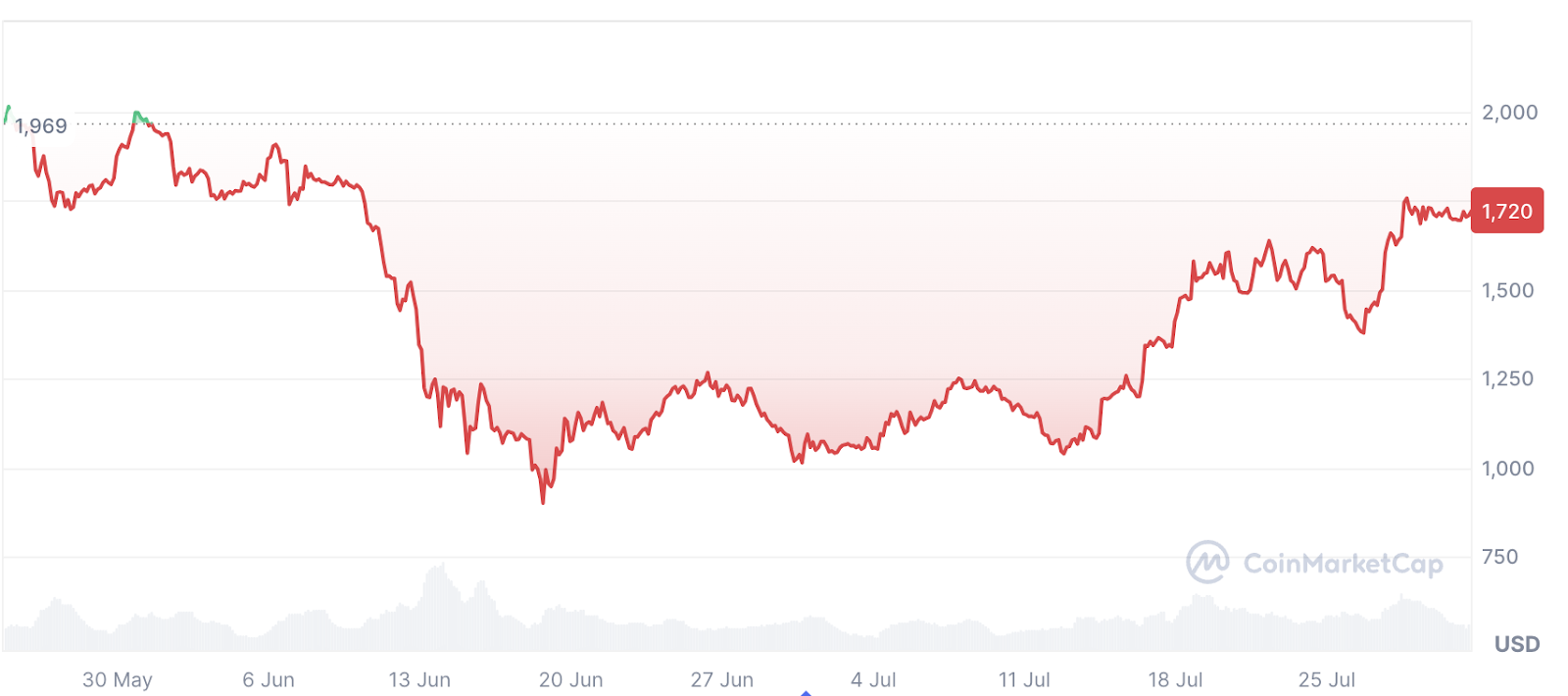
Ethereum Price 2022 (Source: CoinMarketCap)

Ethereum’s sensitivity to rate decisions became clear in several key moments. After the June 2022 hike of 75 basis points, ETH dropped by over eight percent within 48 hours. The same pattern repeated in September. By contrast, when the Fed paused in July 2023, ETH rebounded by nearly five percent over the next three trading sessions.

However, one exception came in March 2023. The collapse of Silicon Valley Bank triggered panic in financial markets. The Fed raised rates by 25 basis points but indicated it might stop soon. That shift helped ETH recover as it climbed from under $1,400 to over $1,800 within three weeks.

These events show Ethereum’s link to monetary policy. Rate hikes tighten conditions and push ETH down. Pauses or signs of easing often lead to sharp rebounds. Ethereum trades like a proxy for risk appetite in a liquidity-driven market.

Bitcoin Dominance: Crypto’s Own Macro Gauge

Bitcoin dominance tracks the percentage of total crypto market value held in Bitcoin. When dominance rises, it often reflects a retreat to safety. During periods of macro tightening, investors reduce exposure to smaller tokens and move capital into Bitcoin. This behavior mirrors broader risk-off patterns.

U.S. Interest Rate 2015-2025 (Federal Reserve Bank)

From late 2021 through 2022, Bitcoin dominance climbed from under 40 percent to nearly 48 percent. That move came during sharp inflation spikes, and a series of Fed rate increases as the market pulled back from speculative assets. Dominance rose again in mid-2023, just before the Fed indicated a pause, and fell shortly after.

This pattern supports a familiar cycle. In early risk-on phases, Bitcoin leads. Once it stabilizes, capital rotates into Ethereum, then into altcoins with lower market value. Drops in dominance often mark the beginning of these rotations. The index can act as a sign of changing sentiment within the market.

Bitcoin dominance reflects how crypto investors respond to broader economic shifts. It can function like a barometer—trending upward when uncertainty grows and falling when conditions favor higher risk exposure.

Institutional Macro Forecasts and the Next 90 Days

Institutional research over the past year has increasingly tied macro indicators to digital asset performance.

In an October 2024 report, Crypto.com Research stated: “Economic growth may generally indicate a more favourable environment for cryptocurrencies, but the impact will vary depending on other market conditions.” They noted that “increasing correlation between traditional markets and cryptocurrencies means that stock market performance may potentially provide valuable insights into potential crypto trends.”

Looking ahead, the next 90 days include several macro events that could affect crypto direction. The July CPI data is due on August 12, with consensus forecasting a YoY increase of 2.8 percent. The next FOMC meeting is on September 17, where markets currently price a 25 basis point cut. The August nonfarm payroll report (due September 6) and Q2 GDP revision (August 29) also stand out as volatility triggers.

These dates offer key decision points. A lower CPI print could reinforce Fed easing expectations and push capital into risk assets. On the other hand, a stronger-than-expected payroll may reduce those expectations. ETF-related flows and crypto-native reactions will likely hinge on these cues, reinforcing the case that macro indicators now drive the broader crypto narrative.

Conclusion: A Macro-Informed Strategy

Macroeconomic indicators now play a measurable role in shaping the crypto market direction. Inflation data, central bank policy, and internal metrics like Bitcoin dominance have shown clear relationships with past price shifts in both Bitcoin and Ethereum. These signs, when aligned, can offer a grounded framework for interpreting future moves.

While no model captures every turn, tracking CPI releases, FOMC decisions, and market reactions allows for more informed positioning. Macro data will not replace crypto-native analysis, but it adds a broader context that is becoming harder to ignore. Keeping an economic calendar in view may prove as useful as any technical chart.

Piyasa Fırsatı
LETSTOP Logosu
LETSTOP Fiyatı(STOP)
$0.01728
$0.01728$0.01728
+0.17%
USD
LETSTOP (STOP) Canlı Fiyat Grafiği
Sorumluluk Reddi: Bu sitede yeniden yayınlanan makaleler, halka açık platformlardan alınmıştır ve yalnızca bilgilendirme amaçlıdır. MEXC'nin görüşlerini yansıtmayabilir. Tüm hakları telif sahiplerine aittir. Herhangi bir içeriğin üçüncü taraf haklarını ihlal ettiğini düşünüyorsanız, kaldırılması için lütfen [email protected] ile iletişime geçin. MEXC, içeriğin doğruluğu, eksiksizliği veya güncelliği konusunda hiçbir garanti vermez ve sağlanan bilgilere dayalı olarak alınan herhangi bir eylemden sorumlu değildir. İçerik, finansal, yasal veya diğer profesyonel tavsiye niteliğinde değildir ve MEXC tarafından bir tavsiye veya onay olarak değerlendirilmemelidir.

Ayrıca Şunları da Beğenebilirsiniz

Thyroid Eye Disease (TED) Treatments Market Nears $4.3 Billion by 2032: Emerging Small Molecule Therapies Targeting Orbital Fibroblasts Drive Revenue Growth – ResearchAndMarkets.com

Thyroid Eye Disease (TED) Treatments Market Nears $4.3 Billion by 2032: Emerging Small Molecule Therapies Targeting Orbital Fibroblasts Drive Revenue Growth – ResearchAndMarkets.com

DUBLIN–(BUSINESS WIRE)–The “Thyroid Eye Disease Treatments Market – Global Forecast 2025-2032” report has been added to ResearchAndMarkets.com’s offering. The thyroid
Paylaş
AI Journal2025/12/20 04:48
Virtus Equity & Convertible Income Fund Announces Special Year-End Distribution and Discloses Sources of Distribution – Section 19(a) Notice

Virtus Equity & Convertible Income Fund Announces Special Year-End Distribution and Discloses Sources of Distribution – Section 19(a) Notice

HARTFORD, Conn.–(BUSINESS WIRE)–Virtus Equity & Convertible Income Fund (NYSE: NIE) today announced the following special year-end distribution to holders of its
Paylaş
AI Journal2025/12/20 05:30
Fed rate decision September 2025

Fed rate decision September 2025

The post Fed rate decision September 2025 appeared on BitcoinEthereumNews.com. WASHINGTON – The Federal Reserve on Wednesday approved a widely anticipated rate cut and signaled that two more are on the way before the end of the year as concerns intensified over the U.S. labor market. In an 11-to-1 vote signaling less dissent than Wall Street had anticipated, the Federal Open Market Committee lowered its benchmark overnight lending rate by a quarter percentage point. The decision puts the overnight funds rate in a range between 4.00%-4.25%. Newly-installed Governor Stephen Miran was the only policymaker voting against the quarter-point move, instead advocating for a half-point cut. Governors Michelle Bowman and Christopher Waller, looked at for possible additional dissents, both voted for the 25-basis point reduction. All were appointed by President Donald Trump, who has badgered the Fed all summer to cut not merely in its traditional quarter-point moves but to lower the fed funds rate quickly and aggressively. In the post-meeting statement, the committee again characterized economic activity as having “moderated” but added language saying that “job gains have slowed” and noted that inflation “has moved up and remains somewhat elevated.” Lower job growth and higher inflation are in conflict with the Fed’s twin goals of stable prices and full employment.  “Uncertainty about the economic outlook remains elevated” the Fed statement said. “The Committee is attentive to the risks to both sides of its dual mandate and judges that downside risks to employment have risen.” Markets showed mixed reaction to the developments, with the Dow Jones Industrial Average up more than 300 points but the S&P 500 and Nasdaq Composite posting losses. Treasury yields were modestly lower. At his post-meeting news conference, Fed Chair Jerome Powell echoed the concerns about the labor market. “The marked slowing in both the supply of and demand for workers is unusual in this less dynamic…
Paylaş
BitcoinEthereumNews2025/09/18 02:44