Traders who made $8m from SOL shift to LILPEPE, eyes 8000% gains. #partnercontentTraders who made $8m from SOL shift to LILPEPE, eyes 8000% gains. #partnercontent

After turning $20k into $8m on Solana, traders shift to crypto projected to jump 8000%

Disclosure: This article does not represent investment advice. The content and materials featured on this page are for educational purposes only.

Traders who made $8m from SOL shift to LILPEPE, eye 8000% gains.

Crypto traders known for turning a $20,000 investment into $8 million during the Solana (SOL) bull run have now shifted focus. 

The trader reportedly exited SOL after reaching exponential returns and has redirected funds into a project with significant upside potential. According to the latest disclosures, the trader expects the new asset to deliver up to 8000% gains within the next four months. 

Market participants have been tracking this movement, aiming to understand which asset carries such momentum and promise. That asset has now been identified as Little Pepe (LILPEPE).

Little Pepe presale stage 5 raises $6.1m

Little Pepe is a utility-driven memecoin built on an Ethereum-compatible Layer 2 blockchain. The project incorporates real technical use cases while preserving its memecoin appeal. Built for speed, security, and low transaction costs, Little Pepe is engineered to scale and it carries a zero-tax policy on trades and integrates sniper bot protection to prevent unfair advantages during token launches.

As of now, the project has raised $6,192,657 out of its $6,575,000 Stage 5 cap. The presale has moved from an initial $0.001 in Stage 1 to $0.0014 in the current stage. The next pricing tier, Stage 6, is set at $0.0015. To date, 4,976,897,438 out of 5.25 billion tokens have been sold in this phase.

Little Pepe’s 100 billion token supply is structured to support staking, liquidity, CEX listings, and ecosystem growth. Allocations include 13.5 billion (13.5%) for staking rewards and 30 billion (30%) for chain reserves. 10 billion each for marketing, CEX reserves, and liquidity.

Built for utility: Meme launchpad, DAO, NFTs and more

LILPEPE provides real use cases across several on-chain applications, which is not like other memecoins. The platform integrates DAO voting, giving token holders governance over protocol decisions. A staking mechanism allows users to earn passive rewards. The upcoming meme launchpad will support new meme-based projects across the network.

Future roadmap features include cross-chain compatibility and NFTs. These utilities position Little Pepe as more than just a speculative memecoin. Instead, it operates as the primary fuel for its own Layer 2 blockchain ecosystem.

The blockchain also supports EVM, allowing Ethereum-based tools and smart contracts to function without modification. Security and speed are core features of the network, as emphasized during its ongoing rollout.

$777,000 giveaway running during presale

Little Pepe has rolled out a promotion of a giveaway of $777,000. There will be ten winners who will equally get $77,000 worth of LILPEPE. All contributors in the presale are allowed to participate, without a minimum amount of $100. The giveaway will stay open until the presale ends.

The event has spurred greater involvement, which is consistent with the increasing volume of wallets joining the network. It has even assisted in sustaining the momentum of trading during the phases. They started presale on June 10, where every phase of the pricing passed within a short time because of the high demand in the community.

Little Pepe is notable because it offers memecoin culture and has actual blockchain application. The roadmap shows plans that go beyond staking rewards and DAO governance as it has a meme launchpad of its own and NFT support in the future. 

The project is in Stage 5 with prices set at $0.0014 with more than 6.1 million raised and presale phases going through at a fast pace. Since it has the full Layer 2 infrastructure and future cross-chain exploration, Little Pepe presents a clear growth play in the meme and DeFi categories. Traders who seek high-upside deals now find that LILPEPE is the next thing to monitor.

For more details about Little PEPE, visit the official website.

Disclosure: This content is provided by a third party. Neither crypto.news nor the author of this article endorses any product mentioned on this page. Users should conduct their own research before taking any action related to the company.

Piyasa Fırsatı
Solana Logosu
Solana Fiyatı(SOL)
$124.99
$124.99$124.99
-0.06%
USD
Solana (SOL) Canlı Fiyat Grafiği
Sorumluluk Reddi: Bu sitede yeniden yayınlanan makaleler, halka açık platformlardan alınmıştır ve yalnızca bilgilendirme amaçlıdır. MEXC'nin görüşlerini yansıtmayabilir. Tüm hakları telif sahiplerine aittir. Herhangi bir içeriğin üçüncü taraf haklarını ihlal ettiğini düşünüyorsanız, kaldırılması için lütfen [email protected] ile iletişime geçin. MEXC, içeriğin doğruluğu, eksiksizliği veya güncelliği konusunda hiçbir garanti vermez ve sağlanan bilgilere dayalı olarak alınan herhangi bir eylemden sorumlu değildir. İçerik, finansal, yasal veya diğer profesyonel tavsiye niteliğinde değildir ve MEXC tarafından bir tavsiye veya onay olarak değerlendirilmemelidir.

Ayrıca Şunları da Beğenebilirsiniz

Building a DEXScreener Clone: A Step-by-Step Guide

Building a DEXScreener Clone: A Step-by-Step Guide

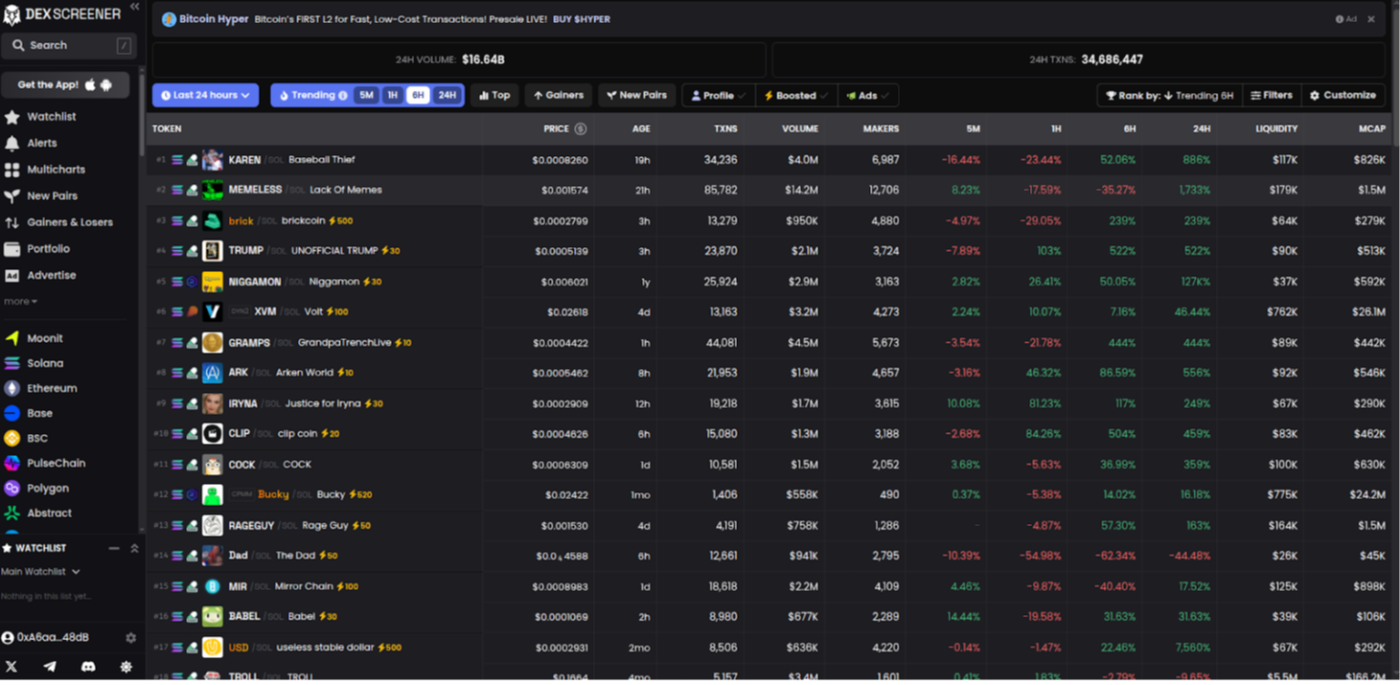
DEX Screener is used by crypto traders who need access to on-chain data like trading volumes, liquidity, and token prices. This information allows them to analyze trends, monitor new listings, and make informed investment decisions. In this tutorial, I will build a DEXScreener clone from scratch, covering everything from the initial design to a functional app. We will use Streamlit, a Python framework for building full-stack apps.
Paylaş
Hackernoon2025/09/18 15:05
Which DOGE? Musk's Cryptic Post Explodes Confusion

Which DOGE? Musk's Cryptic Post Explodes Confusion

A viral chart documenting a sharp decline in U.S. federal employment during President Trump's second term has sparked unexpected confusion in cryptocurrency markets
Paylaş
Coinstats2025/12/20 01:13
Google's AP2 protocol has been released. Does encrypted AI still have a chance?

Google's AP2 protocol has been released. Does encrypted AI still have a chance?

Following the MCP and A2A protocols, the AI Agent market has seen another blockbuster arrival: the Agent Payments Protocol (AP2), developed by Google. This will clearly further enhance AI Agents' autonomous multi-tasking capabilities, but the unfortunate reality is that it has little to do with web3AI. Let's take a closer look: What problem does AP2 solve? Simply put, the MCP protocol is like a universal hook, enabling AI agents to connect to various external tools and data sources; A2A is a team collaboration communication protocol that allows multiple AI agents to cooperate with each other to complete complex tasks; AP2 completes the last piece of the puzzle - payment capability. In other words, MCP opens up connectivity, A2A promotes collaboration efficiency, and AP2 achieves value exchange. The arrival of AP2 truly injects "soul" into the autonomous collaboration and task execution of Multi-Agents. Imagine AI Agents connecting Qunar, Meituan, and Didi to complete the booking of flights, hotels, and car rentals, but then getting stuck at the point of "self-payment." What's the point of all that multitasking? So, remember this: AP2 is an extension of MCP+A2A, solving the last mile problem of AI Agent automated execution. What are the technical highlights of AP2? The core innovation of AP2 is the Mandates mechanism, which is divided into real-time authorization mode and delegated authorization mode. Real-time authorization is easy to understand. The AI Agent finds the product and shows it to you. The operation can only be performed after the user signs. Delegated authorization requires the user to set rules in advance, such as only buying the iPhone 17 when the price drops to 5,000. The AI Agent monitors the trigger conditions and executes automatically. The implementation logic is cryptographically signed using Verifiable Credentials (VCs). Users can set complex commission conditions, including price ranges, time limits, and payment method priorities, forming a tamper-proof digital contract. Once signed, the AI Agent executes according to the conditions, with VCs ensuring auditability and security at every step. Of particular note is the "A2A x402" extension, a technical component developed by Google specifically for crypto payments, developed in collaboration with Coinbase and the Ethereum Foundation. This extension enables AI Agents to seamlessly process stablecoins, ETH, and other blockchain assets, supporting native payment scenarios within the Web3 ecosystem. What kind of imagination space can AP2 bring? After analyzing the technical principles, do you think that's it? Yes, in fact, the AP2 is boring when it is disassembled alone. Its real charm lies in connecting and opening up the "MCP+A2A+AP2" technology stack, completely opening up the complete link of AI Agent's autonomous analysis+execution+payment. From now on, AI Agents can open up many application scenarios. For example, AI Agents for stock investment and financial management can help us monitor the market 24/7 and conduct independent transactions. Enterprise procurement AI Agents can automatically replenish and renew without human intervention. AP2's complementary payment capabilities will further expand the penetration of the Agent-to-Agent economy into more scenarios. Google obviously understands that after the technical framework is established, the ecological implementation must be relied upon, so it has brought in more than 60 partners to develop it, almost covering the entire payment and business ecosystem. Interestingly, it also involves major Crypto players such as Ethereum, Coinbase, MetaMask, and Sui. Combined with the current trend of currency and stock integration, the imagination space has been doubled. Is web3 AI really dead? Not entirely. Google's AP2 looks complete, but it only achieves technical compatibility with Crypto payments. It can only be regarded as an extension of the traditional authorization framework and belongs to the category of automated execution. There is a "paradigm" difference between it and the autonomous asset management pursued by pure Crypto native solutions. The Crypto-native solutions under exploration are taking the "decentralized custody + on-chain verification" route, including AI Agent autonomous asset management, AI Agent autonomous transactions (DeFAI), AI Agent digital identity and on-chain reputation system (ERC-8004...), AI Agent on-chain governance DAO framework, AI Agent NPC and digital avatars, and many other interesting and fun directions. Ultimately, once users get used to AI Agent payments in traditional fields, their acceptance of AI Agents autonomously owning digital assets will also increase. And for those scenarios that AP2 cannot reach, such as anonymous transactions, censorship-resistant payments, and decentralized asset management, there will always be a time for crypto-native solutions to show their strength? The two are more likely to be complementary rather than competitive, but to be honest, the key technological advancements behind AI Agents currently all come from web2AI, and web3AI still needs to keep up the good work!
Paylaş
PANews2025/09/18 07:00