Learn how a Bayesian Network model predicts defective story points in Extreme Programming.Learn how a Bayesian Network model predicts defective story points in Extreme Programming.

The Defected Story Points Model in Extreme Programming

2025/08/27 23:00

Abstract and 1. Introduction

  1. Background and 2.1. Related Work

    2.2. The Impact of XP Practices on Software Productivity and Quality

    2.3. Bayesian Network Modelling

  2. Model Design

    3.1. Model Overview

    3.2. Team Velocity Model

    3.3. Defected Story Points Model

  3. Model Validation

    4.1. Experiments Setup

    4.2. Results and Discussion

  4. Conclusions and References

3.3. Defected Story Points Model

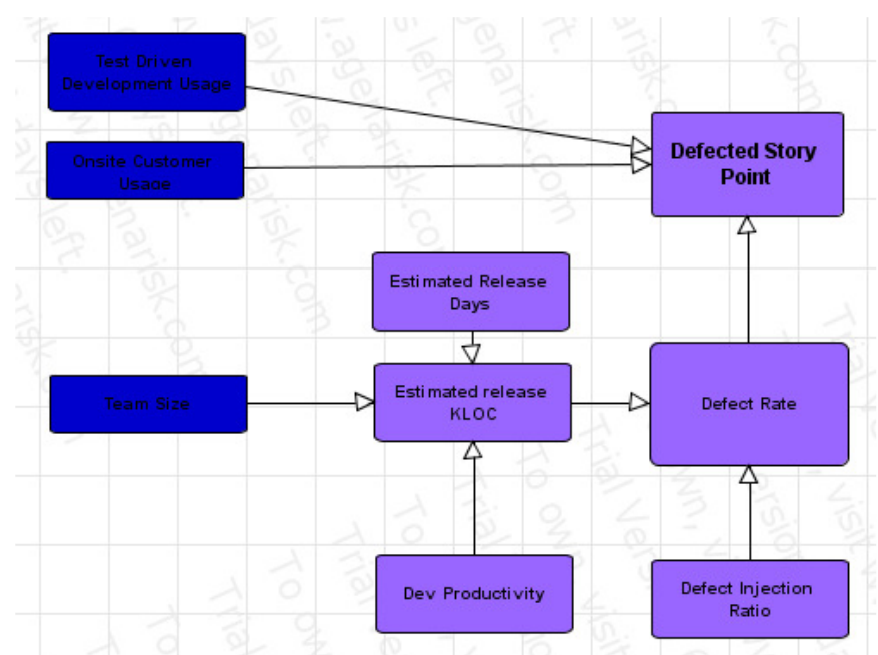
This model calculates an estimate number for the defected story points to be redeveloped in the next release. This number is affected by two XP practices: Test Driven development and Onsite Customer practices. Different components of the model are described as follows:

\

  • Dev. Productivity: The developer productivity measured as the number Line Of Code (LOC) per day. According to the literature [4], a normal distribution with mean 40 and Standard Deviation of 20 represents this value.

    \

  • Estimated Release KLOC: represents the number of KLOC produced from this release. This value is calculated as the product of multiplying Dev. Productivity times Team size times Estimated Release Days.

    \

  • Defect Injection Ratio: represents the number of defects per KLOC. This value was set to a normal distribution with mean 20 and standard deviation 5 [4].

    \

  • Defect Rate: represents the number of defects in this release. It is calculated as the multiplication of the Estimated Release KLOC times Defect Injection Ratio.

    \

  • Defected Story Points: This value represents the number of defected story points to be re-developed in the next release taking into account the impact of two XP practices: Test Driven development and Onsite Customer practices (Equation 3). OSCImpactFactor and TDDImpactFactor represent the impact of the Onsite Customer and Test Driven development practices on reducing the defect rate. According to the literature, there values were set to 0.8 and 0.4 respectively [3],[4]. More details regarding the impact of these practices in the defect rate are available in the Background section.

\ DefectedStoryPoints = DefectRate*(1- OSCImpactFactor * onsitecustomerusage )*(1 TDDImpactFactor *tddusage) Equation (3)

\ Figure 5 Defected Story Points Model
\

:::info Authors:

(1) Mohamed Abouelelam, Software System Engineering, University of Regina, Regina, Canada;

(2) Luigi Benedicenti, Software System Engineering, University of Regina, Regina, Canada.

:::


:::info This paper is available on arxiv under CC BY-NC-ND 4.0 DEED license.

:::

\

Sorumluluk Reddi: Bu sitede yeniden yayınlanan makaleler, halka açık platformlardan alınmıştır ve yalnızca bilgilendirme amaçlıdır. MEXC'nin görüşlerini yansıtmayabilir. Tüm hakları telif sahiplerine aittir. Herhangi bir içeriğin üçüncü taraf haklarını ihlal ettiğini düşünüyorsanız, kaldırılması için lütfen [email protected] ile iletişime geçin. MEXC, içeriğin doğruluğu, eksiksizliği veya güncelliği konusunda hiçbir garanti vermez ve sağlanan bilgilere dayalı olarak alınan herhangi bir eylemden sorumlu değildir. İçerik, finansal, yasal veya diğer profesyonel tavsiye niteliğinde değildir ve MEXC tarafından bir tavsiye veya onay olarak değerlendirilmemelidir.

Ayrıca Şunları da Beğenebilirsiniz

BitGo expands its presence in Europe

BitGo expands its presence in Europe

The post BitGo expands its presence in Europe appeared on BitcoinEthereumNews.com. BitGo, global leader in digital asset infrastructure, announces a significant expansion of its presence in Europe. The company, through its subsidiary BitGo Europe GmbH, has obtained an extension of the license from BaFin (German Federal Financial Supervisory Authority), allowing it to offer regulated cryptocurrency trading services directly from Frankfurt, Germany. This move marks a decisive step for the European digital asset market, offering institutional investors the opportunity to access secure, regulated cryptocurrency trading integrated with advanced custody and management services. A comprehensive offering for European institutional investors With the extension of the license according to the MiCA (Markets in Crypto-Assets) regulation, initially obtained in May 2025, BitGo Europe expands the range of services available for European investors. Now, in addition to custody, staking, and transfer of digital assets, the platform also offers a spot trading service on thousands of cryptocurrencies and stablecoins. Institutional investors can now leverage BitGo’s OTC desk and a high-performance electronic trading platform, designed to ensure fast, secure, and transparent transactions. Aggregated access to numerous liquidity sources, including leading market makers and exchanges, allows for trading at competitive prices and high-quality executions. Security and Regulation at the Core of BitGo’s Strategy According to Brett Reeves, Head of European Sales and Go Network at BitGo, the goal is clear: “We are excited to strengthen our European platform and enable our clients to operate smoothly, competitively, and securely.§By combining our institutional custody solution with high-performance trading execution, clients will be able to access deep liquidity with the peace of mind that their assets will remain in cold storage, under regulated custody and compliant with MiCA.” The security of digital assets is indeed one of the cornerstones of BitGo’s offering. All services are designed to ensure that investors’ assets remain protected in regulated cold storage, minimizing operational and counterparty risks.…
Paylaş
BitcoinEthereumNews2025/09/18 04:28