DeFi protocol Abracadabra lost $1.8 million after an attacker exploited a simple logic mistake in its batch function. Analysts at Hacken say the attacker already laundered funds via Tornado Cash. In early October, Abracadabra, a DeFi lending protocol that lets…DeFi protocol Abracadabra lost $1.8 million after an attacker exploited a simple logic mistake in its batch function. Analysts at Hacken say the attacker already laundered funds via Tornado Cash. In early October, Abracadabra, a DeFi lending protocol that lets…

Abracadabra $1.8m hack repeats earlier fork flaw, Hacken reveals

DeFi protocol Abracadabra lost $1.8 million after an attacker exploited a simple logic mistake in its batch function. Analysts at Hacken say the attacker already laundered funds via Tornado Cash.

Summary
  • Abracadabra lost almost $2 million after an attacker exploited a simple logic mistake in its batch function, similar to an attack on a forked project days earlier.
  • The attacker bypassed a safety flag meant to check if borrowers had enough collateral and drained six Cauldrons in one go before swapping the stolen MIM for ETH and routing it through Tornado Cash.
  • This isn’t the first time Abracadabra’s code has been targeted, but the incident highlights how a small unimplemented function can let hackers take advantage, even when the same flaw was visible in a fork.

In early October, Abracadabra, a DeFi lending protocol that lets people borrow its stablecoin MIM using deposited tokens as collateral and suffered multiple hacker attacks before, this time once again lost about $1.8 million after an attacker used a simple logic mistake in the protocol’s batch function to borrow without putting up any collateral, in the same way a forked project had been hit just days before, analysts at blockchain security firm Hacken said in a research note shared with crypto.news.

Abracadabra launched as a way for people to use interest-bearing tokens as collateral and borrow a U.S. dollar-pegged token called Magic Internet Money, or MIM. The system is built around two pieces: Cauldrons, which handle the borrowing rules, and DegenBox, the shared vault that actually holds tokens. In short: you put up collateral in a Cauldron, and the DegenBox keeps track of the money behind the scenes.

The short version of what went wrong is this: a safety flag that’s supposed to force a final check on whether a borrower actually has collateral got turned off inside a single transaction. As Hacken’s report lays out, the attacker “exploited a logic flaw in Abracadabra’s cook() function where they could borrow MIM tokens and then immediately reset the validation flag that was supposed to check if they had enough collateral.” That allowed a one-shot, uncollateralized borrow across multiple Cauldrons.

Under the microscope

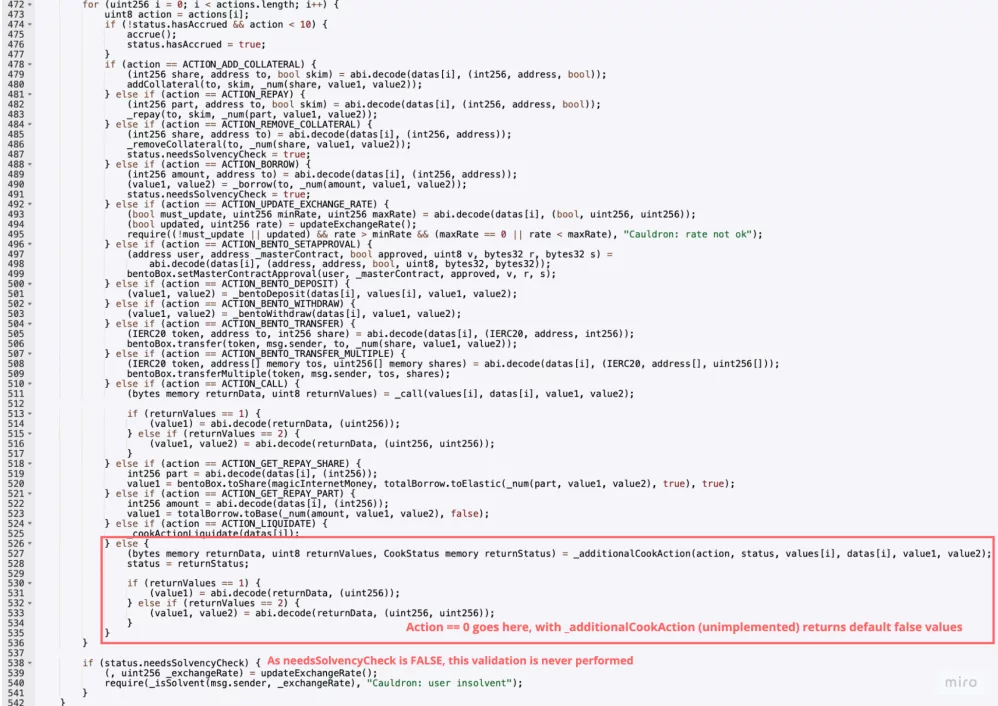
Here’s how the flow worked, in plain terms. Abracadabra uses a batched function called cook() so users can do several actions in one transaction. Say, deposit collateral and borrow in the same click. One of those actions, like the “borrow” step, sets a flag named needsSolvencyCheck to true, meaning “at the end of this transaction, check that the borrower is safe.”
Abracadabra $1.8m hack repeats earlier fork flaw, Hacken reveals - 1

But another action that can be run inside the same batch calls “_additionalCookAction(…).” As Hacken points out, that function was declared as “virtual” and never was implemented, so by default it returned an empty object where everything was set to false, including that needsSolvencyCheck flag.

As a result, the attacker called the borrow action, then called the default action that reset the flag, and at the end, the protocol never checked solvency.

The analysts say the attacker hit six Cauldrons in one go, taking roughly 1.79 million MIM and swapping it for ETH. Attackers exploited vulnerability, and systematically went through six different Cauldrons and drained each one “using the same technique with a dedicated cook function call,” the analysts explained.
Abracadabra $1.8m hack repeats earlier fork flaw, Hacken reveals - 2

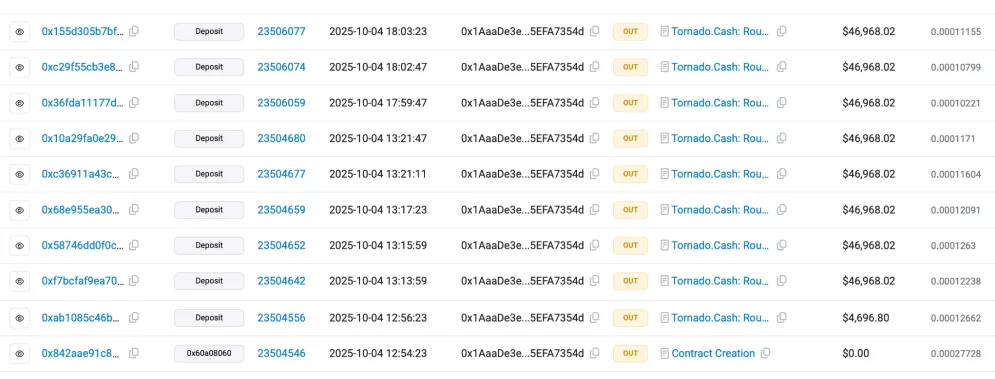
After swapping, the attacker routed funds through Tornado Cash, a crypto mixing protocol, mostly 10 ETH each, sending gradually over the following day.

And this isn’t the first time Abracadabra’s CauldronV4 code has been involved in trouble. Other incidents earlier this year used different edge cases in the same family of contracts. What’s interesting now is how fast the forked deployment reacted.

According to the report, a fork called Synnax paused or un-whitelisted its CauldronV4 master on its own DegenBox days before the Abracadabra drain, so basically the fork team pulled the emergency brake after spotting the same weak pattern, suggesting that the risk was visible to teams watching the code, if not fixed.

Piyasa Fırsatı
DeFi Logosu
DeFi Fiyatı(DEFI)
$0.000478
$0.000478$0.000478
-0.41%
USD
DeFi (DEFI) Canlı Fiyat Grafiği
Sorumluluk Reddi: Bu sitede yeniden yayınlanan makaleler, halka açık platformlardan alınmıştır ve yalnızca bilgilendirme amaçlıdır. MEXC'nin görüşlerini yansıtmayabilir. Tüm hakları telif sahiplerine aittir. Herhangi bir içeriğin üçüncü taraf haklarını ihlal ettiğini düşünüyorsanız, kaldırılması için lütfen [email protected] ile iletişime geçin. MEXC, içeriğin doğruluğu, eksiksizliği veya güncelliği konusunda hiçbir garanti vermez ve sağlanan bilgilere dayalı olarak alınan herhangi bir eylemden sorumlu değildir. İçerik, finansal, yasal veya diğer profesyonel tavsiye niteliğinde değildir ve MEXC tarafından bir tavsiye veya onay olarak değerlendirilmemelidir.

Ayrıca Şunları da Beğenebilirsiniz

U.S. Court Finds Pastor Found Guilty in $3M Crypto Scam

U.S. Court Finds Pastor Found Guilty in $3M Crypto Scam

The post U.S. Court Finds Pastor Found Guilty in $3M Crypto Scam appeared on BitcoinEthereumNews.com. Crime 18 September 2025 | 04:05 A Colorado judge has brought closure to one of the state’s most unusual cryptocurrency scandals, declaring INDXcoin to be a fraudulent operation and ordering its founders, Denver pastor Eli Regalado and his wife Kaitlyn, to repay $3.34 million. The ruling, issued by District Court Judge Heidi L. Kutcher, came nearly two years after the couple persuaded hundreds of people to invest in their token, promising safety and abundance through a Christian-branded platform called the Kingdom Wealth Exchange. The scheme ran between June 2022 and April 2023 and drew in more than 300 participants, many of them members of local church networks. Marketing materials portrayed INDXcoin as a low-risk gateway to prosperity, yet the project unraveled almost immediately. The exchange itself collapsed within 24 hours of launch, wiping out investors’ money. Despite this failure—and despite an auditor’s damning review that gave the system a “0 out of 10” for security—the Regalados kept presenting it as a solid opportunity. Colorado regulators argued that the couple’s faith-based appeal was central to the fraud. Securities Commissioner Tung Chan said the Regalados “dressed an old scam in new technology” and used their standing within the Christian community to convince people who had little knowledge of crypto. For him, the case illustrates how modern digital assets can be exploited to replicate classic Ponzi-style tactics under a different name. Court filings revealed where much of the money ended up: luxury goods, vacations, jewelry, a Range Rover, high-end clothing, and even dental procedures. In a video that drew worldwide attention earlier this year, Eli Regalado admitted the funds had been spent, explaining that a portion went to taxes while the remainder was used for a home renovation he claimed was divinely inspired. The judgment not only confirms that INDXcoin qualifies as a…
Paylaş
BitcoinEthereumNews2025/09/18 09:14
ZKP’s Proof Generation Edge: The $100M Privacy Layer DOGE and XRP Don’t Have

ZKP’s Proof Generation Edge: The $100M Privacy Layer DOGE and XRP Don’t Have

Dogecoin, XRP, and ZKP represent three very different bets for the next cycle,  and the market is already separating speculation from structure. The Dogecoin price
Paylaş
Blockonomi2026/01/22 01:00
MAXI DOGE Holders Diversify into $GGs for Fast-Growth 2025 Crypto Presale Opportunities

MAXI DOGE Holders Diversify into $GGs for Fast-Growth 2025 Crypto Presale Opportunities

Presale crypto tokens have become some of the most active areas in Web3, offering early access to projects that blend culture, finance, and technology. Investors are constantly searching for the best crypto presale to buy right now, comparing new token presales across different niches. MAXI DOGE has gained attention for its meme-driven energy, but early [...] The post MAXI DOGE Holders Diversify into $GGs for Fast-Growth 2025 Crypto Presale Opportunities appeared first on Blockonomi.
Paylaş
Blockonomi2025/09/18 00:00