US President Donald Trump has called on the House of Representatives to swiftly pass the GENIUS Act without making any amendments, urging lawmakers to deliver the bill to his desk “ASAP.” In a post on Truth Social Thursday, Trump celebrated the Senate’s approval of the bill and warned against any attempts to delay or tweak it. “The Senate just passed an incredible Bill that is going to make America the UNDISPUTED Leader in Digital Assets,” he wrote. “Get it to my desk, ASAP — NO DELAYS, NO ADD ONS.” The push comes a day after the Senate passed the GENIUS Act in a 68 to 30 vote , with 18 Democrats joining most Republicans in support. Formally known as the Guiding and Establishing National Innovation for US Stablecoins Act, the bill represents Congress’s first major attempt to regulate stablecoins, which are crypto tokens pegged to the US dollar. Source: Truth Social/@realDonaldTrump GENIUS Act Faces Scrutiny Over Trump’s Crypto Gains Ahead of House Debate Next, the House is expected to take up the measure, with Republicans holding a narrow majority. While GOP leadership is likely to support the bill, partisan tensions remain. The GENIUS Act failed its initial Senate vote in May. This was largely due to concerns about Trump’s ties to the crypto industry. Sen. Elizabeth Warren, one of the bill’s strongest critics, raised serious objections. She accused the president and his family of standing to make “hundreds of millions” if the bill becomes law. Trump’s USD1 stablecoin reportedly brought in $57m last year. Despite the controversy, several Democrats say the need to regulate the growing stablecoin sector is urgent. Sen. Mark Warner, who also raised concerns about Trump’s crypto ventures, argued that the US cannot afford to remain on the sidelines while other countries move forward with digital asset policy. With Backing from Industry, Stablecoin Bill Moves Ahead Despite Regulatory Gaps If the House passes the GENIUS Act, it would create a federal licensing system for stablecoin issuers. Each token would be required to maintain full 1:1 backing with US dollars. In addition, the bill would restrict how reserves are used, limiting them to redemptions and low-risk investments such as Treasury repos. It also mandates anti-money laundering checks and basic consumer protections. Once cleared by the House, the bill would head to President Trump for his final signature. Large crypto firms have largely welcomed the legislation. Many have spent millions lobbying in Washington to shape digital asset rules. However, critics say the bill leaves important gaps. While it prohibits members of Congress and their families from profiting off stablecoins, it does not apply the same rule to the president or first family. As a result, Trump could continue issuing stablecoins even as he signs the regulations governing them into law. Other provisions in the bill have also drawn criticism. It prohibits yield-bearing stablecoins, a move some say protects traditional banks but stifles innovation. Additionally, the bill’s strict compliance rules could increase costs. This may push out smaller issuers and concentrate power among a few large players. Even so, momentum appears to favor the bill. Trump’s allies see his urgency as a strategy to lock in digital asset policy. They hope to avoid delays from drawn-out Congressional negotiations or the risk of the bill being bundled with more contentious crypto legislation.US President Donald Trump has called on the House of Representatives to swiftly pass the GENIUS Act without making any amendments, urging lawmakers to deliver the bill to his desk “ASAP.” In a post on Truth Social Thursday, Trump celebrated the Senate’s approval of the bill and warned against any attempts to delay or tweak it. “The Senate just passed an incredible Bill that is going to make America the UNDISPUTED Leader in Digital Assets,” he wrote. “Get it to my desk, ASAP — NO DELAYS, NO ADD ONS.” The push comes a day after the Senate passed the GENIUS Act in a 68 to 30 vote , with 18 Democrats joining most Republicans in support. Formally known as the Guiding and Establishing National Innovation for US Stablecoins Act, the bill represents Congress’s first major attempt to regulate stablecoins, which are crypto tokens pegged to the US dollar. Source: Truth Social/@realDonaldTrump GENIUS Act Faces Scrutiny Over Trump’s Crypto Gains Ahead of House Debate Next, the House is expected to take up the measure, with Republicans holding a narrow majority. While GOP leadership is likely to support the bill, partisan tensions remain. The GENIUS Act failed its initial Senate vote in May. This was largely due to concerns about Trump’s ties to the crypto industry. Sen. Elizabeth Warren, one of the bill’s strongest critics, raised serious objections. She accused the president and his family of standing to make “hundreds of millions” if the bill becomes law. Trump’s USD1 stablecoin reportedly brought in $57m last year. Despite the controversy, several Democrats say the need to regulate the growing stablecoin sector is urgent. Sen. Mark Warner, who also raised concerns about Trump’s crypto ventures, argued that the US cannot afford to remain on the sidelines while other countries move forward with digital asset policy. With Backing from Industry, Stablecoin Bill Moves Ahead Despite Regulatory Gaps If the House passes the GENIUS Act, it would create a federal licensing system for stablecoin issuers. Each token would be required to maintain full 1:1 backing with US dollars. In addition, the bill would restrict how reserves are used, limiting them to redemptions and low-risk investments such as Treasury repos. It also mandates anti-money laundering checks and basic consumer protections. Once cleared by the House, the bill would head to President Trump for his final signature. Large crypto firms have largely welcomed the legislation. Many have spent millions lobbying in Washington to shape digital asset rules. However, critics say the bill leaves important gaps. While it prohibits members of Congress and their families from profiting off stablecoins, it does not apply the same rule to the president or first family. As a result, Trump could continue issuing stablecoins even as he signs the regulations governing them into law. Other provisions in the bill have also drawn criticism. It prohibits yield-bearing stablecoins, a move some say protects traditional banks but stifles innovation. Additionally, the bill’s strict compliance rules could increase costs. This may push out smaller issuers and concentrate power among a few large players. Even so, momentum appears to favor the bill. Trump’s allies see his urgency as a strategy to lock in digital asset policy. They hope to avoid delays from drawn-out Congressional negotiations or the risk of the bill being bundled with more contentious crypto legislation.

Trump Wants GENIUS Bill Sent Straight to His Desk, Without Congressional Tweaks

US President Donald Trump has called on the House of Representatives to swiftly pass the GENIUS Act without making any amendments, urging lawmakers to deliver the bill to his desk “ASAP.”

In a post on Truth Social Thursday, Trump celebrated the Senate’s approval of the bill and warned against any attempts to delay or tweak it.

“The Senate just passed an incredible Bill that is going to make America the UNDISPUTED Leader in Digital Assets,” he wrote. “Get it to my desk, ASAP — NO DELAYS, NO ADD ONS.”

The push comes a day after the Senate passed the GENIUS Act in a 68 to 30 vote, with 18 Democrats joining most Republicans in support.

Formally known as the Guiding and Establishing National Innovation for US Stablecoins Act, the bill represents Congress’s first major attempt to regulate stablecoins, which are crypto tokens pegged to the US dollar.
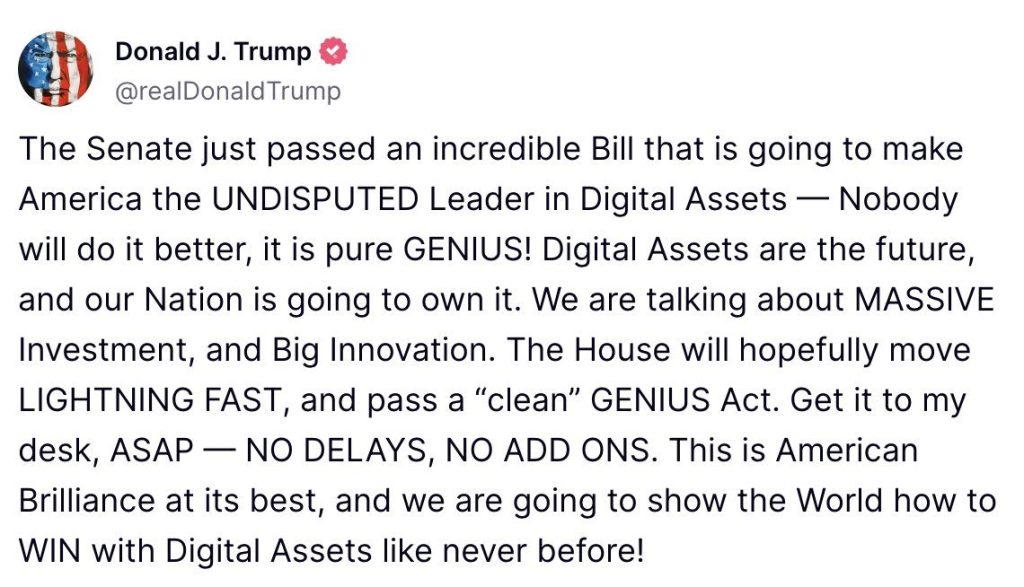
Source: Truth Social/@realDonaldTrump

GENIUS Act Faces Scrutiny Over Trump’s Crypto Gains Ahead of House Debate

Next, the House is expected to take up the measure, with Republicans holding a narrow majority. While GOP leadership is likely to support the bill, partisan tensions remain.

The GENIUS Act failed its initial Senate vote in May. This was largely due to concerns about Trump’s ties to the crypto industry. Sen. Elizabeth Warren, one of the bill’s strongest critics, raised serious objections. She accused the president and his family of standing to make “hundreds of millions” if the bill becomes law.

Trump’s USD1 stablecoin reportedly brought in $57m last year. Despite the controversy, several Democrats say the need to regulate the growing stablecoin sector is urgent. Sen. Mark Warner, who also raised concerns about Trump’s crypto ventures, argued that the US cannot afford to remain on the sidelines while other countries move forward with digital asset policy.

With Backing from Industry, Stablecoin Bill Moves Ahead Despite Regulatory Gaps

If the House passes the GENIUS Act, it would create a federal licensing system for stablecoin issuers. Each token would be required to maintain full 1:1 backing with US dollars.

In addition, the bill would restrict how reserves are used, limiting them to redemptions and low-risk investments such as Treasury repos. It also mandates anti-money laundering checks and basic consumer protections.

Once cleared by the House, the bill would head to President Trump for his final signature.

Large crypto firms have largely welcomed the legislation. Many have spent millions lobbying in Washington to shape digital asset rules. However, critics say the bill leaves important gaps.

While it prohibits members of Congress and their families from profiting off stablecoins, it does not apply the same rule to the president or first family. As a result, Trump could continue issuing stablecoins even as he signs the regulations governing them into law.

Other provisions in the bill have also drawn criticism. It prohibits yield-bearing stablecoins, a move some say protects traditional banks but stifles innovation. Additionally, the bill’s strict compliance rules could increase costs. This may push out smaller issuers and concentrate power among a few large players.

Even so, momentum appears to favor the bill. Trump’s allies see his urgency as a strategy to lock in digital asset policy. They hope to avoid delays from drawn-out Congressional negotiations or the risk of the bill being bundled with more contentious crypto legislation.

Piyasa Fırsatı
Sentio Protocol Logosu
Sentio Protocol Fiyatı(SEN)
$0.004125
$0.004125$0.004125
-4.33%
USD
Sentio Protocol (SEN) Canlı Fiyat Grafiği
Sorumluluk Reddi: Bu sitede yeniden yayınlanan makaleler, halka açık platformlardan alınmıştır ve yalnızca bilgilendirme amaçlıdır. MEXC'nin görüşlerini yansıtmayabilir. Tüm hakları telif sahiplerine aittir. Herhangi bir içeriğin üçüncü taraf haklarını ihlal ettiğini düşünüyorsanız, kaldırılması için lütfen [email protected] ile iletişime geçin. MEXC, içeriğin doğruluğu, eksiksizliği veya güncelliği konusunda hiçbir garanti vermez ve sağlanan bilgilere dayalı olarak alınan herhangi bir eylemden sorumlu değildir. İçerik, finansal, yasal veya diğer profesyonel tavsiye niteliğinde değildir ve MEXC tarafından bir tavsiye veya onay olarak değerlendirilmemelidir.

Ayrıca Şunları da Beğenebilirsiniz

American Bitcoin’s $5B Nasdaq Debut Puts Trump-Backed Miner in Crypto Spotlight

American Bitcoin’s $5B Nasdaq Debut Puts Trump-Backed Miner in Crypto Spotlight

The post American Bitcoin’s $5B Nasdaq Debut Puts Trump-Backed Miner in Crypto Spotlight appeared on BitcoinEthereumNews.com. Key Takeaways: American Bitcoin (ABTC) surged nearly 85% on its Nasdaq debut, briefly reaching a $5B valuation. The Trump family, alongside Hut 8 Mining, controls 98% of the newly merged crypto-mining entity. Eric Trump called Bitcoin “modern-day gold,” predicting it could reach $1 million per coin. American Bitcoin, a fast-rising crypto mining firm with strong political and institutional backing, has officially entered Wall Street. After merging with Gryphon Digital Mining, the company made its Nasdaq debut under the ticker ABTC, instantly drawing global attention to both its stock performance and its bold vision for Bitcoin’s future. Read More: Trump-Backed Crypto Firm Eyes Asia for Bold Bitcoin Expansion Nasdaq Debut: An Explosive First Day ABTC’s first day of trading proved as dramatic as expected. Shares surged almost 85% at the open, touching a peak of $14 before settling at lower levels by the close. That initial spike valued the company around $5 billion, positioning it as one of 2025’s most-watched listings. At the last session, ABTC has been trading at $7.28 per share, which is a small positive 2.97% per day. Although the price has decelerated since opening highs, analysts note that the company has been off to a strong start and early investor activity is a hard-to-find feat in a newly-launched crypto mining business. According to market watchers, the listing comes at a time of new momentum in the digital asset markets. With Bitcoin trading above $110,000 this quarter, American Bitcoin’s entry comes at a time when both institutional investors and retail traders are showing heightened interest in exposure to Bitcoin-linked equities. Ownership Structure: Trump Family and Hut 8 at the Helm Its management and ownership set up has increased the visibility of the company. The Trump family and the Canadian mining giant Hut 8 Mining jointly own 98 percent…
Paylaş
BitcoinEthereumNews2025/09/18 01:33
Current Week Is the Third Worst Week Historically for BTC

Current Week Is the Third Worst Week Historically for BTC

The post Current Week Is the Third Worst Week Historically for BTC appeared on BitcoinEthereumNews.com. The 38th week of the year is historically the third-worst performing week for bitcoin, averaging a return of -2.25%. Only week 28 (-2.78%) and week 14 (-3.91%) have been weaker historically, according to Coinglass data. This week, bitcoin is already down nearly 2%, trading around $113,000, with September’s monthly options expiry pointing to a max pain level at $110,000, according to Deribit, this could imply further downside. Max pain refers to the strike price at which the largest number of options contracts (calls and puts) expire worthless, effectively maximizing losses for option buyers. In addition, market enthusiasm has faded. Perpetual funding rates for bitcoin, which measure the ongoing cost of holding leveraged long or short positions in perpetual futures contracts, have dropped to 4%, one of their lowest levels in a month. A low positive funding rate suggests reduced demand for leveraged long exposure, often signaling that speculative froth in the market has cooled. While, implied volatility (IV), which reflects market expectations for future price swings, is also near historic lows at 37. Despite the weekly dip, bitcoin remains 4% higher in September and up 6% for the quarter. With roughly 14 weeks left in the year and most of those weeks historically producing positive returns, this may represent calm before potential volatility. Meanwhile, gold has continued its impressive rally, climbing another 1% on Tuesday and now more than 42% higher year to date, which continues to take the sting out of bitcoin. Another factor weighing on bitcoin sentiment is the massive gains in artificial intelligence and high-performance computing stocks, for example IREN (IREN), which may have taken some shine away from bitcoin in the short term. Source: https://www.coindesk.com/markets/2025/09/23/bitcoin-stumbles-in-week-38-its-third-worst-week-on-average
Paylaş
BitcoinEthereumNews2025/09/23 21:04
“Major US bank blows up from Silver trade” headlines hide the $675M margin shock currently hitting traders

“Major US bank blows up from Silver trade” headlines hide the $675M margin shock currently hitting traders

This week started with a sensational screenshot shared across hundreds of breathless posts on X, and a claim designed to hit every financial nerve ending at once
Paylaş
CryptoSlate2025/12/30 05:25