Stablecoin Liquidity Is Shifting Networks, Not Leaving Crypto/
A decline in ERC-20 stablecoin supply is often interpreted as liquidity exiting the cryptocurrency market.
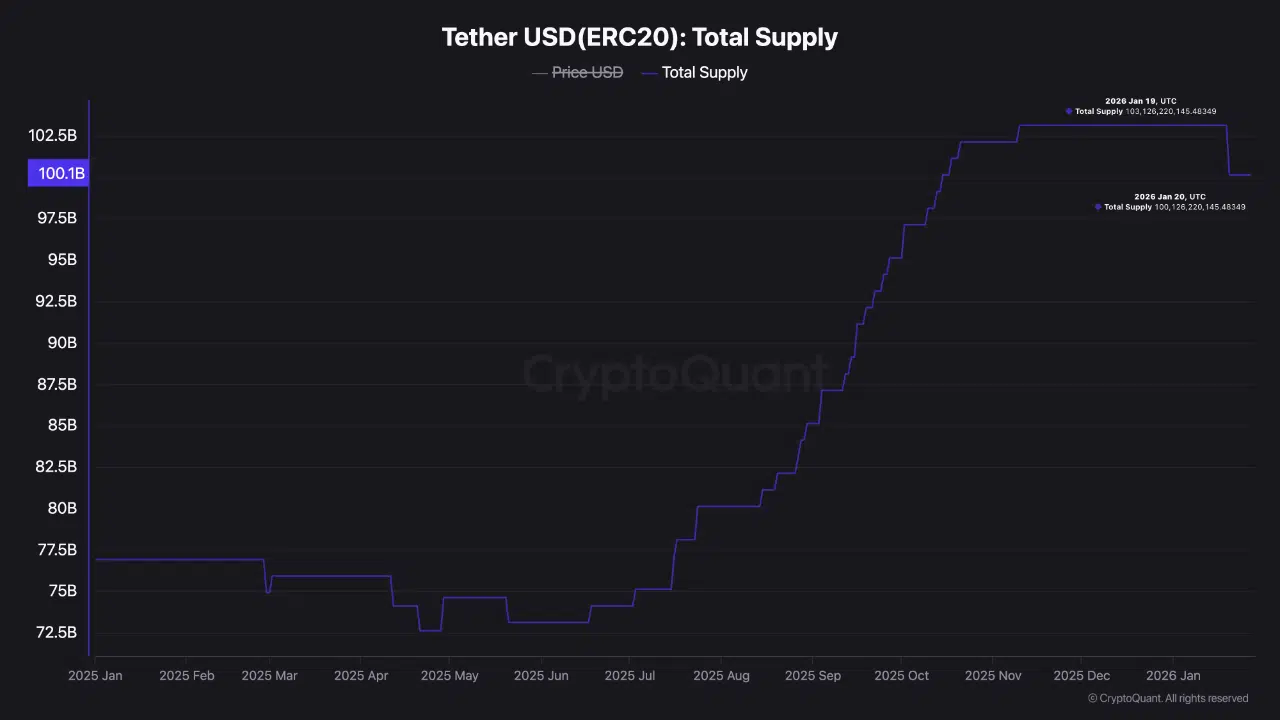
However, on-chain data from CryptoQuant shows a different dynamic unfolding in January 2026. Rather than leaving the system, stablecoin liquidity appears to be rotating across blockchain networks.
Stablecoin Supply Moves: January 19–20, 2026
On January 19 and 20, a clear divergence emerged between Ethereum and Tron stablecoin supplies.
 On the Tron network, USDT supply increased sharply. Total TRC-20 USDT rose from 82,434,679,540 on January 19 to 83,434,679,540 on January 20, marking a net increase of $1 billion in a single day. This expansion was driven by a direct mint on Tron.
At the same time, Ethereum experienced a notable contraction in stablecoin balances. ERC-20 USDT supply declined by approximately $3.0 billion, while ERC-20 USDC fell by around $3.55 billion. Combined, this represents roughly $6.5 billion in stablecoins removed from Ethereum-based circulation.
The timing is critical. The increase in TRC-20 USDT followed immediately after the contraction on Ethereum, suggesting a coordinated liquidity shift rather than an isolated redemption event.
What the Flow Data Indicates
This pattern does not resemble a broad exit from crypto into fiat. Instead, it reflects a redistribution of liquidity across networks and use cases.
USDT is primarily used for derivatives trading, OTC settlement, and short-term tactical positioning. Because of this role, it frequently migrates to lower-cost networks where transaction efficiency is higher. Tron has increasingly served as a preferred rail for these functions.
USDC, by contrast, is more closely tied to spot market activity and on-chain settlement. As a result, changes in ERC-20 USDC supply tend to act as a clearer signal for spot demand conditions, particularly on Ethereum.
When both USDT and USDC decline on Ethereum while USDT simultaneously expands on Tron, the most straightforward interpretation is that liquidity is changing rails, not disappearing.
Market Implications
The data suggests that liquidity remains inside the crypto ecosystem, but its positioning has become more defensive. Demand for Ethereum-based settlement appears to be softening, while capital preference shifts toward derivatives-oriented and parked liquidity environments.
From a market perspective, falling ERC-20 stablecoin supply carries specific implications. It is bearish for Ethereum on-chain activity, neutral to bearish for spot-driven risk appetite, and not evidence of capital exiting crypto entirely.
Rather than signaling capitulation, the stablecoin flows point to structural reallocation, a rotation within crypto infrastructure driven by cost efficiency and evolving use cases.
The post Stablecoin Liquidity Is Shifting Networks, Not Leaving Crypto appeared first on ETHNews.
/Anda Mungkin Juga Suka

'Stunning': Pakar undang-undang terpegun dengan amaran 'luar biasa' oleh hakim terhadap Trump berhubung ICE/

Strive Muncul sebagai Raksasa Harta Bitcoin dengan Pegangan Sebanyak $1.17 Bilion Selepas Pengambilalihan Strategik/