The WormHole algorithm demonstrates that efficient routing in large graphs can be achieved with minimal error and limited queries. By maintaining a sublinear “inner ring” that still contains the Chung–Lu core, WormHole ensures routing paths deviate by at most O(log log n) from the true shortest path, even in worst-case scenarios. The paper further bounds its query complexity under the node query model, proving that high-accuracy results can be obtained with a fraction of the exploration cost.The WormHole algorithm demonstrates that efficient routing in large graphs can be achieved with minimal error and limited queries. By maintaining a sublinear “inner ring” that still contains the Chung–Lu core, WormHole ensures routing paths deviate by at most O(log log n) from the true shortest path, even in worst-case scenarios. The paper further bounds its query complexity under the node query model, proving that high-accuracy results can be obtained with a fraction of the exploration cost.

Understanding Approximation Error and Query Complexity in WormHole Routing

2025/10/16 20:00

Abstract and 1. Introduction

1.1 Our Contribution

1.2 Setting

1.3 The algorithm

  1. Related Work

  2. Algorithm

    3.1 The Structural Decomposition Phase

    3.2 The Routing Phase

    3.3 Variants of WormHole

  3. Theoretical Analysis

    4.1 Preliminaries

    4.2 Sublinearity of Inner Ring

    4.3 Approximation Error

    4.4 Query Complexity

  4. Experimental Results

    5.1 WormHole𝐸, WormHole𝐻 and BiBFS

    5.2 Comparison with index-based methods

    5.3 WormHole as a primitive: WormHole𝑀

References

4.3 Approximation Error

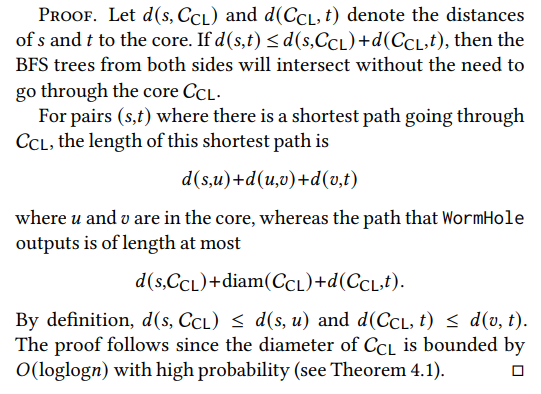
Now that we have a sublinear inner ring that contains the Chung-Lu core, we must show that routing paths through it incurs only a small penalty. Intuitively, the larger the inner ring, the easier this is to satisfy: if the inner ring is the whole graph, the statement holds trivially. Therefore the challenge lies in showing that we can achieve a strong guarantee in terms of accuracy even with a sublinear inner ring. We prove that WormHole incurs an additive error at most 𝑂(loglog𝑛) for all pairs, which is much smaller than the diameter Θ(log𝑛).

\

\ The above result holds with high probability even in the worst case. Namely, for all pairs (𝑠,𝑡) of vertices in the graph, the length of the path returned by WormHole is at most𝑂(loglog𝑛) higher than the actual distance between 𝑠 and 𝑡. This trivially implies that the average additive error of WormHole is, with high probability, bounded by the same amount.

\
\

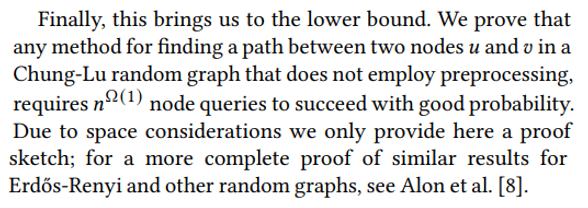
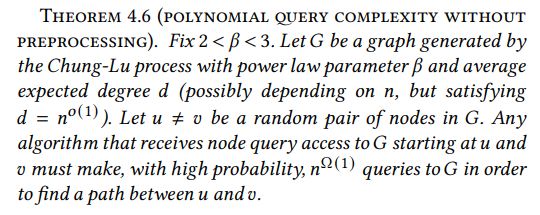
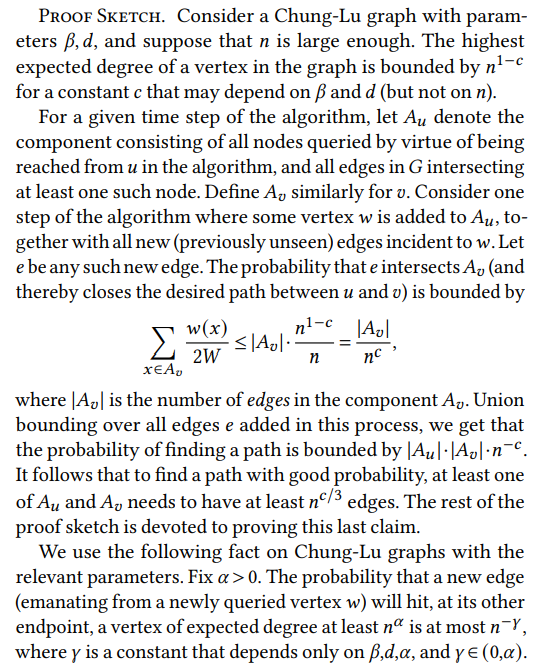
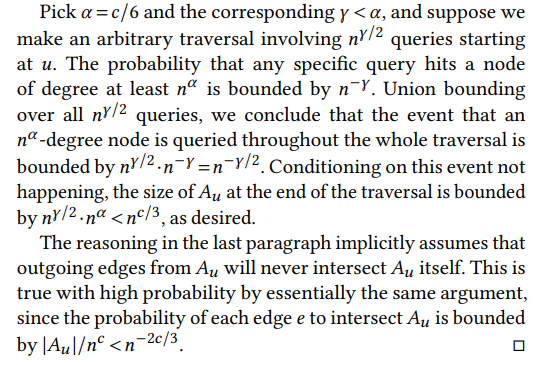
4.4 Query Complexity

Recall the node query model in this paper (see §1.2): starting from a single node, we are allowed to iteratively make queries, where each query retrieves the neighbor list of a node 𝑣 of our choice. We are interested in the query complexity, i.e., the number of queries required to conduct certain operations.

\ \
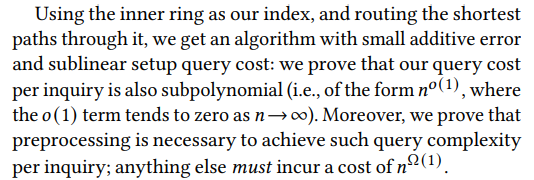
\ \ The first result is the upper bound on our performance.

\ \
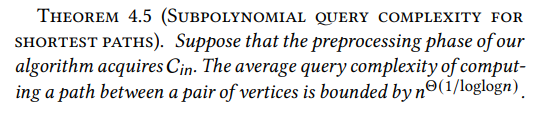
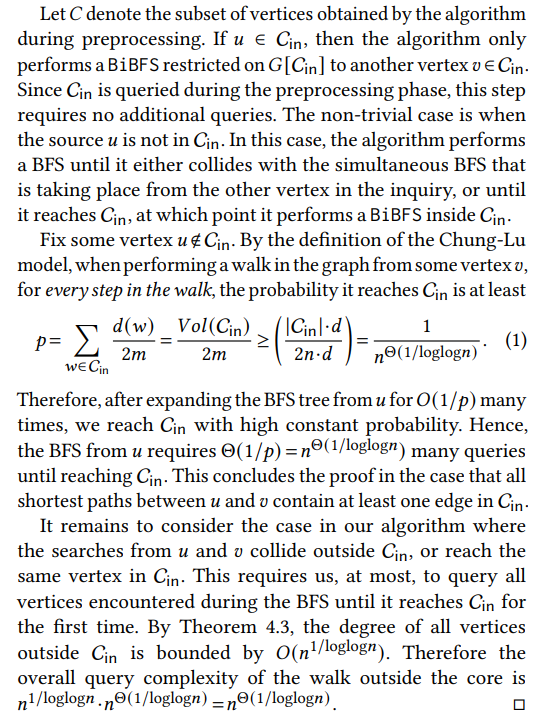
\ \ Proof Sketch. For a given inquiry SP(𝑢, 𝑣), we give an upper bound on the query complexity of the BFS that starts at 𝑢, and similarly for𝑣; the total query complexity is the sum of these two quantities.

\ \
\ \ \
\ \ \
\ \ \
\ \ \
\ \

:::info Authors:

(1) Talya Eden, Bar-Ilan University ([email protected]);

(2) Omri Ben-Eliezer, MIT ([email protected]);

(3) C. Seshadhri, UC Santa Cruz ([email protected]).

:::


:::info This paper is available on arxiv under CC BY 4.0 license.

:::

\

Sorumluluk Reddi: Bu sitede yeniden yayınlanan makaleler, halka açık platformlardan alınmıştır ve yalnızca bilgilendirme amaçlıdır. MEXC'nin görüşlerini yansıtmayabilir. Tüm hakları telif sahiplerine aittir. Herhangi bir içeriğin üçüncü taraf haklarını ihlal ettiğini düşünüyorsanız, kaldırılması için lütfen [email protected] ile iletişime geçin. MEXC, içeriğin doğruluğu, eksiksizliği veya güncelliği konusunda hiçbir garanti vermez ve sağlanan bilgilere dayalı olarak alınan herhangi bir eylemden sorumlu değildir. İçerik, finansal, yasal veya diğer profesyonel tavsiye niteliğinde değildir ve MEXC tarafından bir tavsiye veya onay olarak değerlendirilmemelidir.

Ayrıca Şunları da Beğenebilirsiniz

‘Already seen the low?’ – Inside Cathie Wood’s bet on a new Bitcoin cycle
‘Already seen the low?’ – Inside Cathie Wood’s bet on a new Bitcoin cycle

The post ‘Already seen the low?’ – Inside Cathie Wood’s bet on a new Bitcoin cycle appeared on BitcoinEthereumNews.com. Bitcoin has rarely looked more fragile, and many analysts are already referring to this as the worst fourth quarter on record, marked by a massive leverage wipeout and a steep drop from its all-time highs. For over a decade, Bitcoin [BTC] has followed a harsh, predictable pattern: a Halving event, a commendable rally to new highs, and then a brutal 75–90% crash that resets the entire market. This cycle shaped the crypto world and created the “crypto winter” mentality that traders have come to expect. Cathie Wood challenges the four-year cycle But according to Cathie Wood, CEO and CIO of ARK Invest, those old rules no longer apply. Speaking with Fox Business, Wood made a profound declaration: institutional adoption is actively “disrupting” the traditional Bitcoin cycle. Wood noted that growing participation in U.S. Spot Bitcoin ETFs had started to change how BTC absorbed volatility. She pointed to a steady decline in its two-year volatility trend over the past five years, adding fuel to the idea of a maturing asset. Why Bitcoin’s old pattern may be fading Wood’s view challenges over a decade of beliefs built around Bitcoin’s strict, predictable four-year cycle. The evidence for this cycle is compelling.  For instance, the 2012 Halving saw Bitcoin surge from under $10 to a peak of roughly $1,100; the 2016 Halving fueled a climb from $400 to nearly $20,000; and the 2020 Halving propelled the asset from $8,500 to a record high of around $69,000. Each of these explosive rallies was followed by a painful, defining drawdown of 70% to 85%, resetting the stage for the next run. This predictable pattern, last triggered by the 20th April 2024, Halving, has historically been the sole script for investors. Yet, this time, the narrative feels disjointed and disruptive. What is Wood so concerned about? Wood…
Paylaş
BitcoinEthereumNews2025/12/11 19:15
