

Power banks to buy in Nigeria 2025 (tested & reviewed)
Do you really need a power bank in 2025? To be honest, smartphones now come with durable batteries that last the whole day. But realistically, power outages in Nigeria are unpredictable and can last for hours or days. Additionally, if you live in a busy city like Lagos, you may spend time in traffic jams, far from any charging outlets. So, the answer is yes. You need a power bank.
The Nigerian market is a dumping ground for all sorts of power banks, making it hard for buyers to tell the difference between fakes and originals. I have been in that position many times and suffered from the menace of fake power banks. This is why I have decided to test and review power banks to ease your decision-making process. If you want to save money and avoid buying something that will gather dust, this guide is for you. Let’s move to the main findings and see what actually works.
Benchmarks used to select the five (5) best power banks in Nigeria 2025
Before shortlisting, during testing, and when selecting the final 5 power banks, I focused on key factors to ensure my recommendations are practical and align with Nigerian realities. Here’s a breakdown of the benchmarks I used:
Battery capacity (27,000mAh–55,000mAh): how many full charges you’ll get
Battery capacity is the major selling point of any power bank. For this review, I tested mid-range and high-end power banks. High-end power banks offer 6-11 charges, depending on the phone’s battery size, while mid-range power banks can last 2-4 charges before needing to be recharged.
For context, a 27,000 mAh power bank can charge an iPhone 11 roughly 4 times, and a 55,000 mAh power bank can do the same up to 12 times.
Charging speed (input vs output): how fast each power bank performs
For this benchmark, I looked at two things: how quickly each power bank can charge a phone (output) and how quickly the power bank itself recharges when plugged in (input). I focused especially on how long it takes to recharge using a fast charger. This matters a lot in Nigeria, where electricity supply can be unreliable and every minute of charging time counts.
Build quality: weight, size, and portability for everyday use
Most power bank reviews omit how uncomfortable it can be to move around with one. The physical design matters a lot for everyday use and mobility.
Input and output ports: USB-A and USB-C compatibility
I paid attention to the number of ports. Most models come
with USB-A and USB-C ports. Where possible, I tested how well the ports handle charging multiple devices, including phones, EarPods, and smartwatches.
Price and availability across Nigerian retailers
Lastly, I took into consideration the price of each power bank in Nigerian Naira (₦) across local retailers.
Top 5 power banks in Nigeria (tested and recommended)
Here are the top 5 power banks I’m recommending after my review:
New Age Turbo Ultra 5 (55,000 mAh)
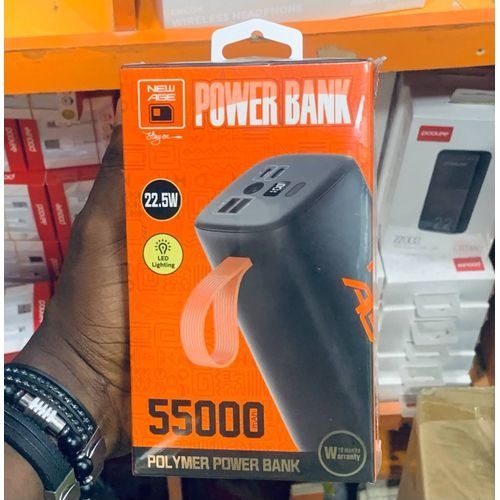
Photo credit: Jumia
New Age gadgets are well-known for their reliability and durability. The Turbo Ultra 5 didn’t fall below expectations during testing.
To measure charging speed, I drained my iPhone 13 Pro Max to 10%, set a stopwatch, and plugged it in with a Type-C fast-charging cable. My phone went from 10% to 80% in 36 minutes. I also charged my AirPods Pro and Apple Watch Series 7, and they each reached full charge within an hour.
The power bank provided 10 full charges for my iPhone 13 Pro Max, and multiple charging sessions for my Apple Watch and EarPods.
Recharging the power bank itself took a bit of time; a full charge using the Type-C port took over 11 hours.
Specifications
Pros
- A big 55,000 mAh capacity is strong enough for multiple charges for smartphones, tablets, and other gadgets.
- Built-in torch for emergencies.
- The LED display shows accurate battery percentage.
- Durable, built to withstand travel and heavy use.
Cons
- A bit too heavy at 2kg and uncomfortable to move around.
- Its large size requires a bag for transport.
- It takes a long time to recharge (over 11 hours).
Price
- New age website: ₦52,800.00 ($36.38)
- Konga: ₦55,000.00 ($37.89)
- Jumia: ₦55,455.00 ($38.21)
Poole Blaze (50,000 mAh)
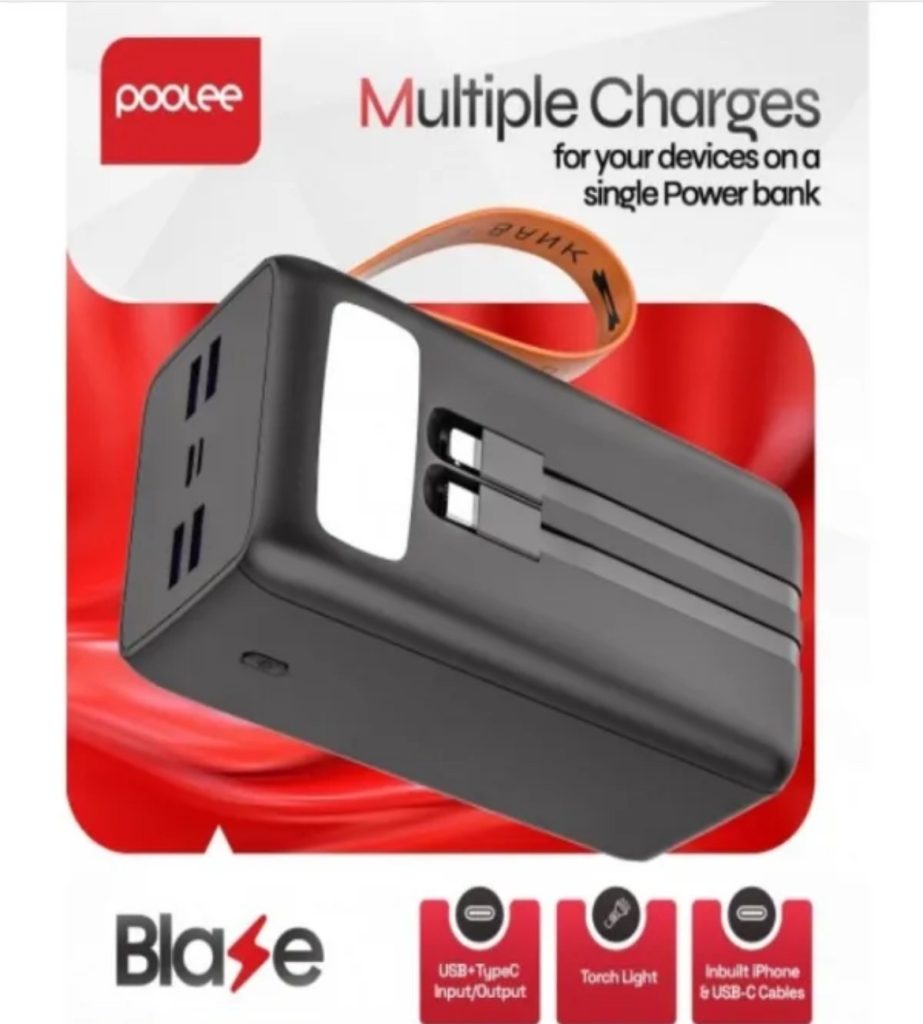
Photo credit: Chomart
I decided to add the Poole Blaze to my list of recommendations because of its large capacity, lightning-fast PD22.5W charging, built-in cables, and four USB ports.
My iPhone charged from 10% to 80% using the PD22.5W in 37 minutes; my Watch and AirPods also charged in under an hour.
The power bank charged the iPhone 13 Pro Max 9 times and charged the Apple Watch and EarPods multiple times.
Recharging the power bank took a bit of time. It charged for over 11 hours using the Type-C port.
Specifications
Pros
- The battery lasts for multiple charges.
- The LED display shows an accurate battery percentage.
- It comes with integrated cables, solving extra cable issues.
- Built-in lamp that provides illumination during emergencies.
Cons
- It takes a long time to charge (over 11 hours).
- Requires a bag for mobility.
- Couldn’t find a specific warranty period for the product.
Price
- Poole store: ₦49,200.00 ($33.90)
- Jumia: ₦55,700.00 ($38.38)
- Konga: ₦55,000.00 ($37.89)
Romoss Sense 8PF (30,000 mAh)
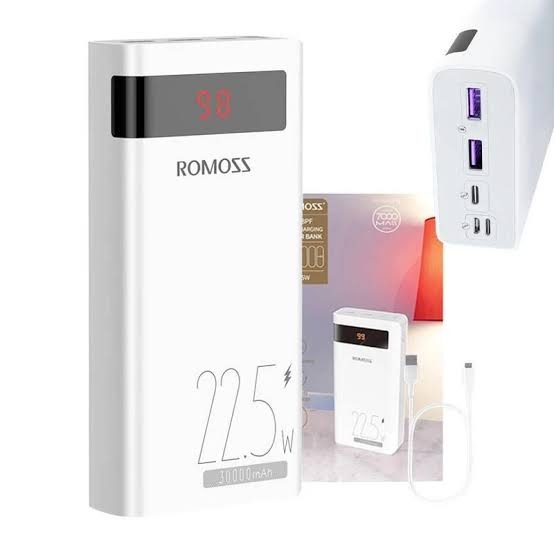
Photo credit: MyTrendyPhone
The Romoss Sense 8PF 30,000 mAh is a good bet for extensive use. It also supports multiple fast-charging protocols, such as Power Delivery (PD), Fast Charge Protocol (FCP), and Quick Charge (QC), which are highly efficient for charging.
During the charging test, the power bank charged my 13 Pro Max from 10% to 80% in 39 minutes via the USB-C port with PD fast charging. My AirPods and Apple Watch charged in an hour.
My phone charged fully four times, and my gadgets multiple times thereafter.
Recharging the power bank took over 9 hours and could stretch to 12 hours depending on the charger’s quality.
Specifications
Pros
- The battery will sufficiently handle multiple charges.
- Supports fast charging.
- Equipped with three output ports, thereby supporting multiple devices simultaneously.
- The digital LED display shows battery percentage, charging current, and voltage.
Cons
- 671 grams is still a lot of weight, making it uncomfortable to carry around.
- A full recharge might take up to 12 hours, making it difficult to charge.
- Although it’s a good option for phones, it is inefficient for laptops.
Price
- Jumia: ₦42,750.00 ($29.45)
- Konga: ₦43,000.00 ($29.63)
Itel Powerpulse 1 (30,000 mAh)
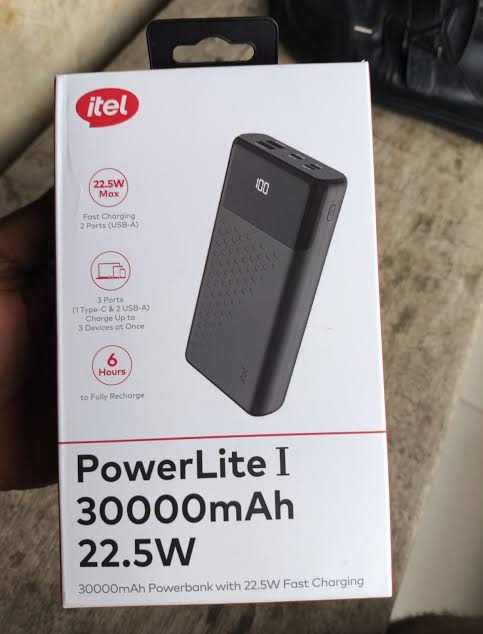
Photo credit: Jumia
Itel gadgets are gaining a foothold in Nigeria, thanks to their durability. I bought the Itel Powerpulse 1 power bank to satisfy my curiosity about the product.
Keeping to my testing schedule, I drained my iPhone 13 Pro Max to 10% before plugging it in with a Type-C fast-charging cable. The phone charged to 80% in 38 minutes, while my Watch and AirPods were fully charged within an hour.
My phone charged fully 4 times, and my gadgets charged multiple times.
Using a fast charger, recharging the power bank took up to 7 hours, which was decent for a power bank with a 30,000 mAh battery capacity.
Specifications
Pros
- Its battery capacity provides multiple charges for smartphones and other devices.
- Features an anti-slip 3D texture surface that resists stains and scratches.
- Display battery percentage for proper management
- Compatible with a good range of devices, including iPhones, iPads, Android phones, tablets, watches, and other gadgets.
Cons
- While the recharging time (7 hours) is faster than others, it still requires overnight charging.
- At 600g, it is bulky for the pocket and uncomfortable to move around.
Price
- Jiji: ₦29,500.00 ($20.32)
- Jumia: ₦28,500.00 ($19.64)
- Konga: ₦30,000.00 ($20.67)
Oraimo Traveler 3 Lit (27,000 mAh)
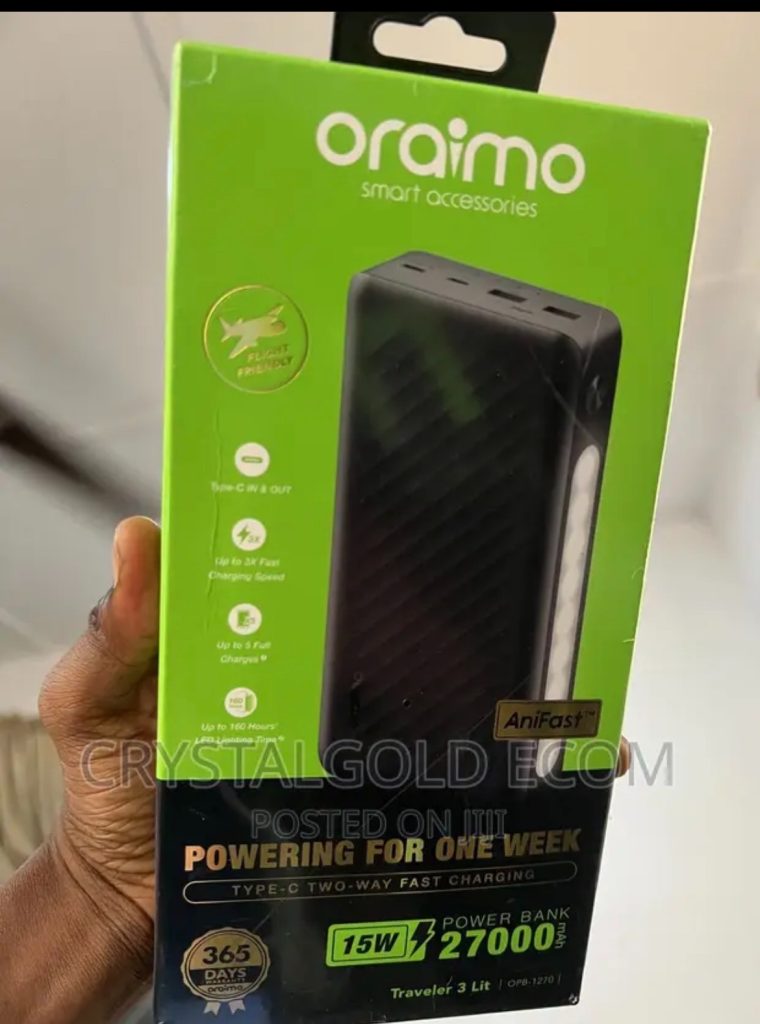
Photo credit: Jiji
Oraimo is also a major player in the Nigerian market, offering a wide range of products and gadgets. I decided to add the Oraimo Traveler 3 Lit 27,000 mAh to test how mid-range power banks work.
With the power bank, it took over an hour for my phone to charge from 10% to 80%, my Watch and AirPods charged for nearly 2 hours. With a maximum output power of 15W, I wasn’t surprised with the charging speed.
The power bank did well charging my phone 3 times. My gadgets were also charged multiple times without draining half of the power.
Recharging the power bank took roughly 10 hours using the Type-C charger.
Specifications
Why you should buy
- The 27,000 mAh capacity provides multiple full charges for smartphones and other devices.
- The built-in LED flashlight comes in handy during an emergency.
- The Lithium polymer battery has international certification, ensuring safety and stable voltage.
- The LED battery percentage indicator provides information on remaining power.
Why you should not buy
- At 15W, the charging speed is decent but slower than the competition’s.
- It takes up to 10 hours to charge.
- Not ideal for fast charging due to output limitations.
Price
- Jumia: ₦23,870.00 ($16.45)
- Konga: ₦24,500.00 ($16.88)
Comparison table: key specs, capacity, and prices of the five (5) best power banks in Nigeria
After a proper review of the power banks, let’s take a look at how they compare side by side:
How to choose the right power bank for your needs (based on my 5 recommendations)
Each power bank I tested is best for a specific purpose or moment:
Conclusion
The power banks listed above have been tested for reliability under Nigerian conditions. Selection depends on user priorities for capacity, portability, and price range. For users who need maximum capacity and don’t mind the weight, the New Age Turbo Ultra 5 is an absolute workhorse. However, for the best balance of portability, price, and performance, the Itel Powerpulse 1 is the clear winner for everyday Nigerian use.
Ayrıca Şunları da Beğenebilirsiniz

And the Big Day Has Arrived: The Anticipated News for XRP and Dogecoin Tomorrow

Luxembourg adds Bitcoin to its wealth fund, but what does that mean for Europe?

