XRP community researcher SMQKE recently shared an analysis outlining how Ripple Payments and XRP can interact with SWIFT without any formal partnership. According to him, instead of direct integration, the connection is possible through third-party vendors and API bridges developed by firms such as SAP, Temenos, and CGI. These intermediaries enable RippleNet to receive SWIFT’s MT103 payment messages via HTTPS APIs, creating an indirect but functional pathway between the two networks. How the Flow Works When a payment is initiated on SWIFT GPI, the message is transmitted through the traditional banking system. RippleNet receives the same MT103 message through vendor-managed APIs. From there, RippleNet can route the transaction through exchanges and leverage XRP as a liquidity tool within its settlement layer. This setup allows banks connected to RippleNet to settle transactions that originated on the SWIFT network, without SWIFT and Ripple working together directly. Does This Actually Work? Ripple Dev Responds SMQKE’s recent revelation about how Ripple, XRP, and the SWIFT system could work together raised eyebrows across the crypto community, including among influential voices in the XRP space. Many have questioned the legitimacy of the document he presented. One of the most vocal critics was XRP-focused YouTuber Crypto Eri. She publicly called on Neil Hartner, a software engineer at Ripple specializing in Ripple Payments, to weigh in on the document and clarify whether the proposed workflow is technically viable, especially since SMQKE did not cite a source. In response, Hartner described the scenario as “plausible”. He added that, from a technical view, the flow could indeed be implemented. He noted that, theoretically, a bank could send the MT103 message to the Ripple Payments (formerly RippleNet) API using the additional_info field. However, Hartner also stated that he could not comment on specific vendor names, cautioning: “Don’t read too much into my answer.” https://twitter.com/illneil/status/1956357863393358148 ISO 20022 at Work A crucial factor behind this interoperability is ISO 20022, the global standard for financial messaging. Ripple is one of the foremost payment institutions to adopt this standard. By aligning with ISO 20022, RippleNet ensures compatibility with traditional networks like SWIFT and newer blockchain-based systems. This reduces fragmentation and paves the way for APIs and distributed ledger technology to support real-time settlement and improved cross-border efficiency. XRP Ledger to Capture Part of SWIFT Volume While Ripple and SWIFT have no formal partnership, members of the XRP community continue to hold out hope for either a future partnership or for a scenario in which Ripple ultimately replaces SWIFT. At the 2025 XRPL Apex event, Ripple CEO Brad Garlinghouse stated that the XRP Ledger (XRPL) could manage up to 14% of SWIFT’s transaction volume by 2030. According to Forbes, SWIFT processes approximately $150 trillion in annual transaction volume. If XRPL were to capture 14% of that, it would amount to roughly $21 trillion flowing through XRPL each year. Based on this projection, an analysis estimated that if XRP were to turn over 30 times per year, a liquidity pool of around $700 billion would be required. With XRP’s circulating supply, this would imply a token price in the range of approximately $11 to $24. However, it’s important to note that these projections are purely speculative.XRP community researcher SMQKE recently shared an analysis outlining how Ripple Payments and XRP can interact with SWIFT without any formal partnership. According to him, instead of direct integration, the connection is possible through third-party vendors and API bridges developed by firms such as SAP, Temenos, and CGI. These intermediaries enable RippleNet to receive SWIFT’s MT103 payment messages via HTTPS APIs, creating an indirect but functional pathway between the two networks. How the Flow Works When a payment is initiated on SWIFT GPI, the message is transmitted through the traditional banking system. RippleNet receives the same MT103 message through vendor-managed APIs. From there, RippleNet can route the transaction through exchanges and leverage XRP as a liquidity tool within its settlement layer. This setup allows banks connected to RippleNet to settle transactions that originated on the SWIFT network, without SWIFT and Ripple working together directly. Does This Actually Work? Ripple Dev Responds SMQKE’s recent revelation about how Ripple, XRP, and the SWIFT system could work together raised eyebrows across the crypto community, including among influential voices in the XRP space. Many have questioned the legitimacy of the document he presented. One of the most vocal critics was XRP-focused YouTuber Crypto Eri. She publicly called on Neil Hartner, a software engineer at Ripple specializing in Ripple Payments, to weigh in on the document and clarify whether the proposed workflow is technically viable, especially since SMQKE did not cite a source. In response, Hartner described the scenario as “plausible”. He added that, from a technical view, the flow could indeed be implemented. He noted that, theoretically, a bank could send the MT103 message to the Ripple Payments (formerly RippleNet) API using the additional_info field. However, Hartner also stated that he could not comment on specific vendor names, cautioning: “Don’t read too much into my answer.” https://twitter.com/illneil/status/1956357863393358148 ISO 20022 at Work A crucial factor behind this interoperability is ISO 20022, the global standard for financial messaging. Ripple is one of the foremost payment institutions to adopt this standard. By aligning with ISO 20022, RippleNet ensures compatibility with traditional networks like SWIFT and newer blockchain-based systems. This reduces fragmentation and paves the way for APIs and distributed ledger technology to support real-time settlement and improved cross-border efficiency. XRP Ledger to Capture Part of SWIFT Volume While Ripple and SWIFT have no formal partnership, members of the XRP community continue to hold out hope for either a future partnership or for a scenario in which Ripple ultimately replaces SWIFT. At the 2025 XRPL Apex event, Ripple CEO Brad Garlinghouse stated that the XRP Ledger (XRPL) could manage up to 14% of SWIFT’s transaction volume by 2030. According to Forbes, SWIFT processes approximately $150 trillion in annual transaction volume. If XRPL were to capture 14% of that, it would amount to roughly $21 trillion flowing through XRPL each year. Based on this projection, an analysis estimated that if XRP were to turn over 30 times per year, a liquidity pool of around $700 billion would be required. With XRP’s circulating supply, this would imply a token price in the range of approximately $11 to $24. However, it’s important to note that these projections are purely speculative.
Here’s How SWIFT Taps XRP Without a Direct SWIFT-Ripple Link

2025/08/22 18:14

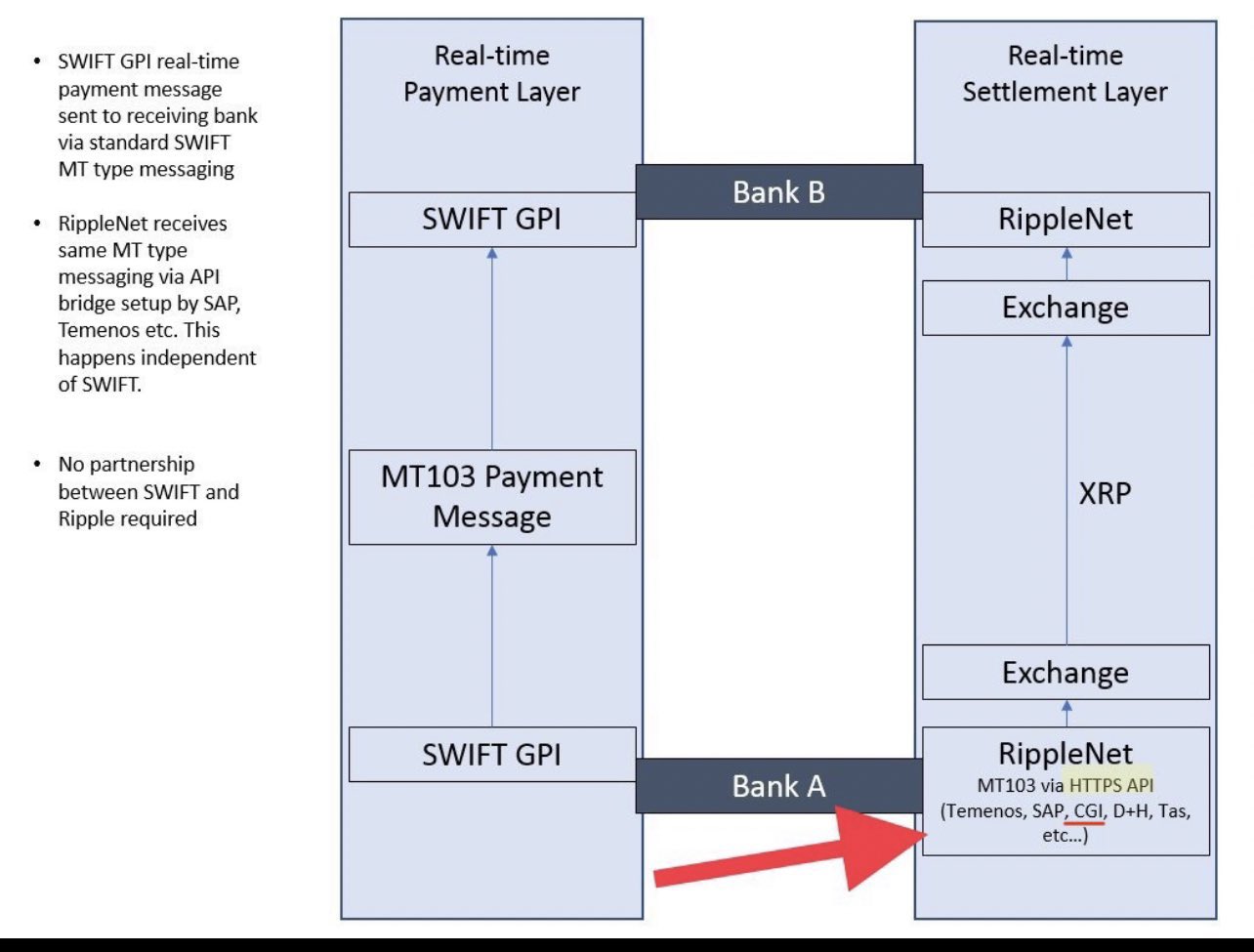
XRP community researcher SMQKE recently shared an analysis outlining how Ripple Payments and XRP can interact with SWIFT without any formal partnership. According to him, instead of direct integration, the connection is possible through third-party vendors and API bridges developed by firms such as SAP, Temenos, and CGI. These intermediaries enable RippleNet to receive SWIFT’s MT103 payment messages via HTTPS APIs, creating an indirect but functional pathway between the two networks. How the Flow Works When a payment is initiated on SWIFT GPI, the message is transmitted through the traditional banking system. RippleNet receives the same MT103 message through vendor-managed APIs. From there, RippleNet can route the transaction through exchanges and leverage XRP as a liquidity tool within its settlement layer. This setup allows banks connected to RippleNet to settle transactions that originated on the SWIFT network, without SWIFT and Ripple working together directly. Image Does This Actually Work? Ripple Dev Responds SMQKE’s recent revelation about how Ripple, XRP, and the SWIFT system could work together raised eyebrows across the crypto community, including among influential voices in the XRP space. Many have questioned the legitimacy of the document he presented. One of the most vocal critics was XRP-focused YouTuber Crypto Eri. She publicly called on Neil Hartner, a software engineer at Ripple specializing in Ripple Payments, to weigh in on the document and clarify whether the proposed workflow is technically viable, especially since SMQKE did not cite a source. In response, Hartner described the scenario as “plausible”. He added that, from a technical view, the flow could indeed be implemented. He noted that, theoretically, a bank could send the MT103 message to the Ripple Payments (formerly RippleNet) API using the additional_info field. However, Hartner also stated that he could not comment on specific vendor names, cautioning: “Don’t read too much into my answer.” https://twitter.com/illneil/status/1956357863393358148 ISO 20022 at Work A crucial factor behind this interoperability is ISO 20022, the global standard for financial messaging. Ripple is one of the foremost payment institutions to adopt this standard. By aligning with ISO 20022, RippleNet ensures compatibility with traditional networks like SWIFT and newer blockchain-based systems. This reduces fragmentation and paves the way for APIs and distributed ledger technology to support real-time settlement and improved cross-border efficiency. XRP Ledger to Capture Part of SWIFT Volume While Ripple and SWIFT have no formal partnership, members of the XRP community continue to hold out hope for either a future partnership or for a scenario in which Ripple ultimately replaces SWIFT. At the 2025 XRPL Apex event, Ripple CEO Brad Garlinghouse stated that the XRP Ledger (XRPL) could manage up to 14% of SWIFT’s transaction volume by 2030. According to Forbes, SWIFT processes approximately $150 trillion in annual transaction volume. If XRPL were to capture 14% of that, it would amount to roughly $21 trillion flowing through XRPL each year. Based on this projection, an analysis estimated that if XRP were to turn over 30 times per year, a liquidity pool of around $700 billion would be required. With XRP’s circulating supply, this would imply a token price in the range of approximately $11 to $24. However, it’s important to note that these projections are purely speculative.

Piyasa Fırsatı
Threshold Logosu
Threshold Fiyatı(T)
$0.00938
$0.00938$0.00938
-3.39%
USD
Threshold (T) Canlı Fiyat Grafiği
Sorumluluk Reddi: Bu sitede yeniden yayınlanan makaleler, halka açık platformlardan alınmıştır ve yalnızca bilgilendirme amaçlıdır. MEXC'nin görüşlerini yansıtmayabilir. Tüm hakları telif sahiplerine aittir. Herhangi bir içeriğin üçüncü taraf haklarını ihlal ettiğini düşünüyorsanız, kaldırılması için lütfen [email protected] ile iletişime geçin. MEXC, içeriğin doğruluğu, eksiksizliği veya güncelliği konusunda hiçbir garanti vermez ve sağlanan bilgilere dayalı olarak alınan herhangi bir eylemden sorumlu değildir. İçerik, finansal, yasal veya diğer profesyonel tavsiye niteliğinde değildir ve MEXC tarafından bir tavsiye veya onay olarak değerlendirilmemelidir.

Ayrıca Şunları da Beğenebilirsiniz

XRP Price Prediction: Can Ripple Rally Past $2 Before the End of 2025?

XRP Price Prediction: Can Ripple Rally Past $2 Before the End of 2025?

The post XRP Price Prediction: Can Ripple Rally Past $2 Before the End of 2025? appeared first on Coinpedia Fintech News The XRP price has come under enormous pressure
Paylaş
CoinPedia2025/12/16 19:22
DMCC and Crypto.com Partner to Explore Blockchain Infrastructure for Physical Commodities

DMCC and Crypto.com Partner to Explore Blockchain Infrastructure for Physical Commodities

The Dubai Multi Commodities Centre and Crypto.com have announced a partnership to explore on-chain infrastructure for physical commodities including gold, energy, and agricultural products. The collaboration brings together one of the world's leading free trade zones with a global cryptocurrency exchange, signaling serious institutional interest in commodity tokenization.
Paylaş
MEXC NEWS2025/12/16 20:46
Why The Green Bay Packers Must Take The Cleveland Browns Seriously — As Hard As That Might Be

Why The Green Bay Packers Must Take The Cleveland Browns Seriously — As Hard As That Might Be

The post Why The Green Bay Packers Must Take The Cleveland Browns Seriously — As Hard As That Might Be appeared on BitcoinEthereumNews.com. Jordan Love and the Green Bay Packers are off to a 2-0 start. Getty Images The Green Bay Packers are, once again, one of the NFL’s better teams. The Cleveland Browns are, once again, one of the league’s doormats. It’s why unbeaten Green Bay (2-0) is a 8-point favorite at winless Cleveland (0-2) Sunday according to betmgm.com. The money line is also Green Bay -500. Most expect this to be a Packers’ rout, and it very well could be. But Green Bay knows taking anyone in this league for granted can prove costly. “I think if you look at their roster, the paper, who they have on that team, what they can do, they got a lot of talent and things can turn around quickly for them,” Packers safety Xavier McKinney said. “We just got to kind of keep that in mind and know we not just walking into something and they just going to lay down. That’s not what they going to do.” The Browns certainly haven’t laid down on defense. Far from. Cleveland is allowing an NFL-best 191.5 yards per game. The Browns gave up 141 yards to Cincinnati in Week 1, including just seven in the second half, but still lost, 17-16. Cleveland has given up an NFL-best 45.5 rushing yards per game and just 2.1 rushing yards per attempt. “The biggest thing is our defensive line is much, much improved over last year and I think we’ve got back to our personality,” defensive coordinator Jim Schwartz said recently. “When we play our best, our D-line leads us there as our engine.” The Browns rank third in the league in passing defense, allowing just 146.0 yards per game. Cleveland has also gone 30 straight games without allowing a 300-yard passer, the longest active streak in the NFL.…
Paylaş
BitcoinEthereumNews2025/09/18 00:41