Key takeaways
The SEC proposed a comprehensive rewrite of its transfer agent rules in Release No. 34-106246, File No. S7-2026-30, the first significant update in roughly four decades, with Commissioner Mark Uyeda noting that distributed ledger technology and tokenization were barely on the horizon when the Commission last examined these rules in 2015. The proposal would let registered transfer agents use distributed ledger technology as the official master securityholder file, though the Commission had already permitted this through staff guidance, and firms including Securitize have operated on that basis for years. The legally decisive point runs the other way from most coverage, because a master securityholder file can only be maintained by the recordkeeping transfer agent, and under UCC § 8-301, cited in the release, delivery of an uncertificated security occurs when the issuer or its agent registers the purchaser as the new owner on its books. Proposed additions to Form TA-2 would require agents to report how many issues keep their master file on a distributed ledger and to separate tokenized issues into issuer-sponsored and third-party-sponsored categories, a distinction tied to a January 2026 staff statement.

Overview
Transfer agents are the least discussed and most structurally important firms in securities markets, because they maintain the master securityholder file, the authoritative list of who owns a given security. The rules governing them have not been significantly updated in roughly forty years, and Commissioner Mark Uyeda observed that when the Commission last examined the area in 2015, distributed ledger technology and tokenization were barely on the horizon. They are now reshaping how transfer agents perform their core functions.
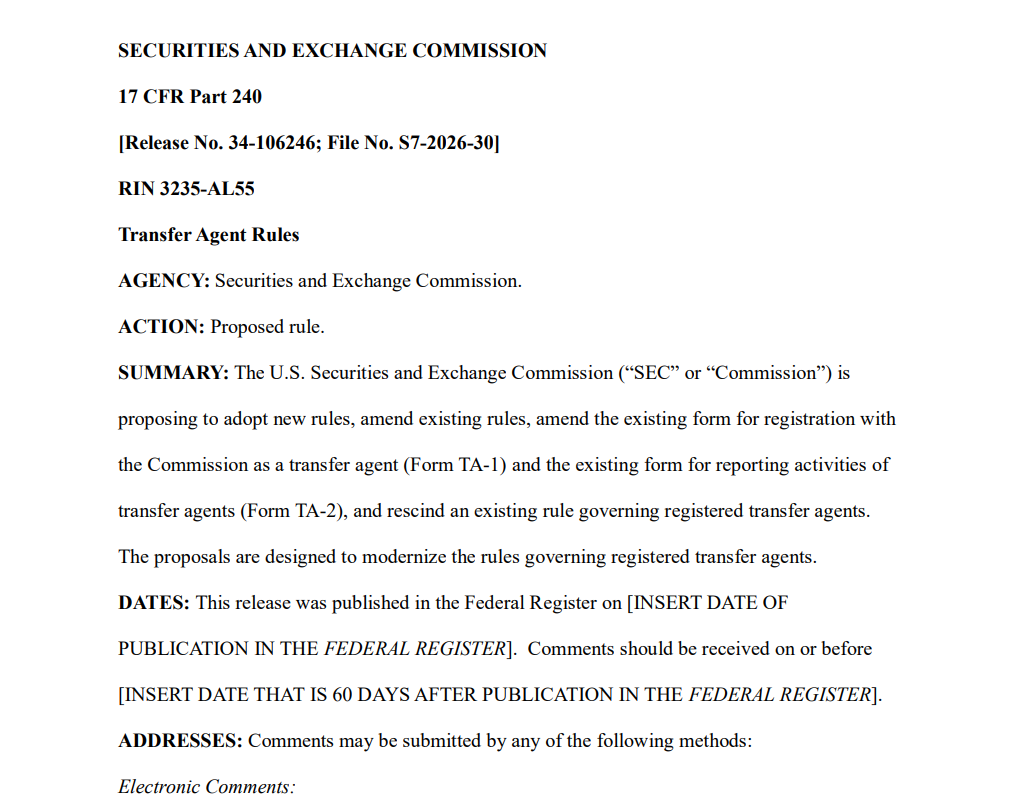
The SEC's response arrived in Release No. 34-106246, a proposal to amend the rules and forms governing recordkeeping, communications, transfer services, reporting and related activities, rescinding one rule and adding several requirements. Chairman Paul Atkins framed it as reflecting agents' use of electronic communications and blockchain technology, and Jamie Selway, director of the Division of Trading and Markets, described it as part of a broader effort to revisit legacy rules as technology changes. For anyone building or holding tokenized securities, the consequences run in two directions at once
1. What the Proposal Covers
The release runs across recordkeeping, communications, transfer services, reporting and other transfer agent activities, amending existing rules and forms while rescinding one rule outright. The framing throughout reflects a shift away from assumptions embedded in a paper-based era, and Uyeda noted that most securities transactions now occur electronically rather than through physical exchange of certificates, settling at T+1 or faster.
Market participants are actively seeking to bring blockchain-native transfer agents into the US market, with firms building models for blockchain-based recordkeeping, tokenized fund administration and cross-chain interoperability that would require agents to keep securityholder records on distributed ledgers and to run smart-contract-driven processes. Securitize, in an earlier submission to the SEC's Crypto Task Force, argued that transfer agent rules need modernising to leverage tokenized securities, including the use of a public blockchain as augmented by the transfer agent.
The proposal also arrives alongside other movement on market structure. The Commission separately announced the agenda for a September 17 roundtable on 24-hour trading, with panelists drawn from Robinhood, Nasdaq, DTCC and the overnight venues Blue Ocean and 24X, while the New York Stock Exchange and Securitize have been working together on a tokenized platform.
2. Blockchain as the Master File, and What Was Already Permitted
The SEC had already said that a registered transfer agent may use distributed ledger technology as its official master securityholder file, provided it complies with applicable federal securities laws around recordkeeping, prompt and accurate transfer, reporting, examination, security and accessibility. Staff guidance further noted that an agent may keep personally identifying information off-chain while recording blockchain transaction details on-chain, so long as records remain auditable and accessible. Securitize has stated in its own filings that it acts as SEC-registered transfer agent for the majority of its customers and uses a public blockchain as the master securityholder file, storing wallet addresses, asset balances, share counts, purchase dates, transaction identifiers and non-identifying details such as KYC status and investor type. What the proposal does is incorporate that existing reality more directly into the transfer agent framework, and it asks whether specific requirements should apply when blockchain is used as the master file or as a component of one. That is a request for input on how to regulate a practice already underway rather than a grant of new permission. The master securityholder file remains the authoritative record of registered owners, and the blockchain does not receive legal status on its own by virtue of holding that record. The ledger is a technology the file may be kept on, not a substitute for the file.
3. One File, One Keeper
The release states that a master securityholder file establishes the list of an issue's current registered owners and can only be maintained by the recordkeeping transfer agent. One issue, one file, one keeper. Stack that against UCC § 8-301, cited in the release's footnotes, under which delivery of an uncertificated security occurs when the issuer or its agent registers the purchaser as the new owner on its books. The books are the file, and the file has a single keeper.
The implication for tokenized securities is significant, because a token transfer that does not register on the master securityholder file has not effected a legal transfer of the underlying security. The January 28, 2026 staff statement from the Divisions of Corporation Finance, Investment Management and Trading and Markets set out the test directly, describing issuer-sponsored tokenization as an arrangement where the issuer or its agent integrates distributed ledger technology into the systems recording owners of the security, such that a transfer of the crypto asset on the network effects the transfer. This is the reason token architecture matters legally rather than aesthetically. A design where the registered agent controls the recordkeeping layer produces transfers that carry legal effect. A freely circulating token on a permissionless network, with no agent recording ownership changes on the master file, may move without transferring the security it represents. The distinction is not the SEC endorsing permissioned tokens over open ones as a policy preference, but the mechanics of what makes a transfer legally real under existing securities and commercial law.
4. Reporting and Risk Requirements
The proposal raises visibility into how transfer agents operate, and the additions to Form TA-2 are the most tokenization-specific requirements in the release. Agents would be required to report how many issues have their master securityholder file on a distributed ledger, and to split tokenized issues into issuer-sponsored and third-party-sponsored categories, a distinction the Commission ties to the differing investor risks identified in its January 2026 staff statement. Tokenization agents and distributed ledger platforms would join banks and printers on the service-provider checklist agents must complete. Reporting updates would also cover the handling of funds and securities and turnaround performance.
On the operational side, the proposal would rescind an exemption rule, establish a single retention period for most records, and reframe the safeguarding rule as a risk-management requirement covering cybersecurity and business continuity rather than as a narrower custody obligation. That reframing matters for firms running distributed ledger infrastructure, because business continuity for an agent operating nodes and smart contracts involves failure modes that the existing rule was never written to address.
5. Who This Affects
Securitize is the clearest case, since it operates as a registered transfer agent using a public blockchain as its master securityholder file and has been arguing for exactly this modernisation in submissions to the SEC's Crypto Task Force. tZERO occupies similar territory as a registered entity building on-chain securities infrastructure. Both have been running businesses under rules written for an era of physical certificates and mailed proxy statements.
The broader category is blockchain-native transfer agents seeking entry to the US market, along with firms building tokenized fund administration and cross-chain interoperability. For those firms the proposal offers something more useful than approval, which is a defined set of requirements to build against. Regulatory uncertainty has been a heavier cost than regulatory burden for this category, because a firm can design for a rule it dislikes but cannot design for a rule that does not exist.
For issuers and investors, the practical effect runs through the risk-management and reporting requirements rather than through the recordkeeping permission. An agent maintaining tokenized securities under an explicit cybersecurity and business continuity framework, reporting its distributed ledger usage on Form TA-2, is a different counterparty risk proposition from one operating under rules that predate the technology entirely.
6. What Happens Next
The comment period runs for 60 days following publication in the Federal Register, and the Commission has asked for input on all aspects of the proposal, including the specific question of whether particular requirements should apply when distributed ledger technology serves as the master securityholder file or part of one. That question is the one worth watching, because the answer determines how much of the tokenization industry's current practice survives contact with a finalised rule. The Commission could adopt a light framework that codifies what firms already do, or it could attach conditions around control, auditability and recovery that reshape how tokenized securities are structured. Both outcomes are consistent with what has been proposed so far.
The larger point the release settles is one of posture. By writing distributed ledger technology into the transfer agent framework rather than building a separate regime beside it, the SEC is treating tokenization as an evolution of regulated securities infrastructure instead of an alternative to it.
Frequently Asked Questions
What is the SEC transfer agent proposal?
It is Release No. 34-106246, File No. S7-2026-30, a proposal to comprehensively amend the rules and forms governing transfer agents, covering recordkeeping, communications, transfer services and reporting. Commissioner Mark Uyeda described it as the first significant update in roughly forty years, noting that when the Commission last examined the area in 2015, distributed ledger technology and tokenization were barely on the horizon.
Does this newly allow blockchains to be used as ownership records?
The SEC had already said a registered transfer agent may use distributed ledger technology as its official master securityholder file, provided it meets requirements around recordkeeping, prompt and accurate transfer, reporting, examination, security and accessibility. Securitize has operated on that basis for years. The proposal incorporates that reality more directly into the framework and asks whether specific additional requirements should apply.
Does a blockchain become the legal ownership record?
The master securityholder file remains the authoritative record of registered owners, and the blockchain does not acquire legal status on its own by holding that record. The release states the file can only be maintained by the recordkeeping transfer agent, and under UCC § 8-301, delivery of an uncertificated security occurs when the issuer or its agent registers the purchaser as the new owner on its books.
Why does token architecture matter under these rules?
Because a token transfer that does not register on the master securityholder file has not legally transferred the underlying security. The statement described issuer-sponsored tokenization as an arrangement where the issuer or its agent integrates distributed ledger technology into its ownership recording systems, so that a transfer of the crypto asset effects the transfer.
What new reporting would transfer agents face?
Proposed additions to Form TA-2 would require agents to report how many issues keep their master securityholder file on a distributed ledger and to separate tokenized issues into issuer-sponsored and third-party-sponsored categories. Tokenization agents and distributed ledger platforms would join banks and printers on the service-provider checklist, and reporting would also cover handling of funds and securities and turnaround performance.
When does this take effect?
Nothing takes effect yet. The comment period runs 60 days after publication in the Federal Register, after which the Commission would need to adopt a final rule, which may differ from what has been proposed. The SEC has specifically requested input on whether particular requirements should apply when distributed ledger technology is used as the master securityholder file.
Disclaimer: This article is for informational purposes only and does not constitute financial, investment, legal, or trading advice. Digital assets and securities are subject to risk. Conduct your own research before making any decision.