Burniske: ‘I Have A Zcash Stash I’ll Never Sell, Just Like Bitcoin’
Placeholder co-founder Chris Burniske said in a Nov. 20 interview with Real Vision’s Raoul Pal that he holds a core Zcash position he “will never sell,” explicitly likening it to his long-term Bitcoin stash, even as he cautioned that ZEC’s current rally is not yet a proven structural breakout.
Pal opened by questioning whether Zcash’s surge is “just a rotational circle jerk within crypto again or is this something meaningful?” Burniske responded by foregrounding his conflict of interest: “I’ve been deeply involved within the Zcash community, so I have some bias here.” He cited personal ties and formal work with the ecosystem — “I’m friends with Zoko [Wilcox] […] I sat on […] a grants board” — and recalled that in 2016 Zcash was “the most anticipated coin” and initially traded as “a better Bitcoin,” a narrative he said “is coming back now.”
Burniske HODL’s ZCash And Bitcoin
On market structure, Burniske stressed that ZEC is not moving alone. “ZEC is ripping, but so is Dash and so is Monero […] a lot of these OG privacy coins.” While noting Zcash “has done the best,” he relayed industry chatter for why privacy assets often run late in cycles: “apparently […] some Bitcoin whales will use some of these coins to […] anonymize their profits, end of cycle, um juice a bit more return.” He emphasized this was not a firm claim: “I don’t have the hard data on this […] there’s kind of that explanation.”
For Burniske, the real signal won’t come from the current leg higher but from how ZEC behaves when liquidity compresses. “We are not going to know until or if we get a bear market and we see where these assets bottom.” His test is relative resilience versus peers: if “Dash and Monero […] go back to the bottom of their ranges but ZEC holds materially higher […] that is very strong signal to me.”
Despite that uncertainty, Burniske described a non-negotiable core holding. “I have an amount of Zcash […] that I will never sell. And I kind of treat it like an amount of Bitcoin that I will never sell.” He tied the reasoning to Bitcoin’s historical payoff curve: “The only way people did phenomenally well from Bitcoin […] is basically just being like never sell, right? The hodl mentality.” In his framing, that “portion of ZEC” is held outside cyclical trading logic.
At the same time, he separated that conviction from short-term price chasing. “Even if it keeps going parabolic, you know, I don’t trust that parabolic move. I wouldn’t chase that parabolic move.” He said he has avoided hyping the rally publicly because ZEC’s market narrative is still “unproven,” and he doesn’t want to be responsible for others buying into euphoria and later blaming him.
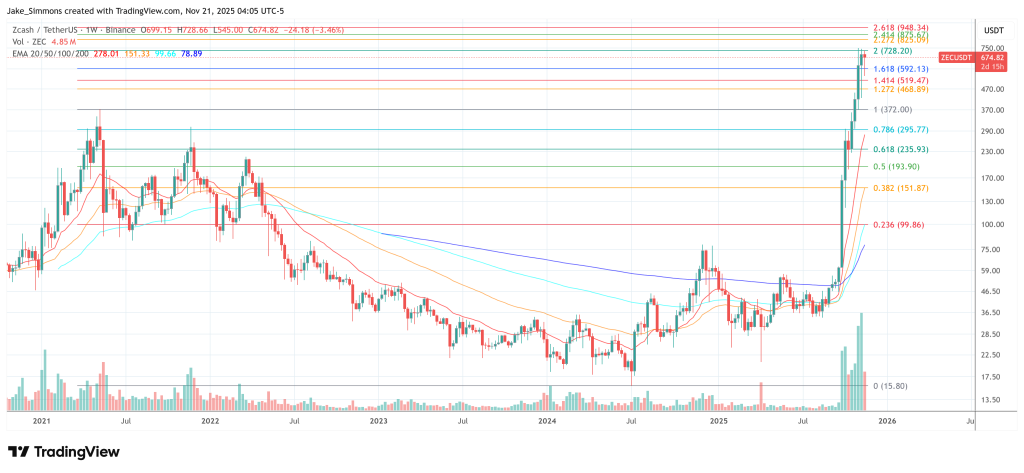
Burniske pointed to ZEC’s long-term chart improvement as a positive development, though not a verdict. “I love that it’s cleared its 2021 highs and it had a monthly close higher than anything it had in 2021,” calling that “a point in the right direction.”
But he also noted the asset is “basically back at its 2017 highs,” underscoring how much of Zcash’s history has been spent in violent ranges. “It’s been this wildly volatile ranging asset,” he said, describing ZEC as a “problem child” in a market where “most crypto assets are value destructive” and only a small minority are “value creative.” For now, ZEC is “kind of a Schrödinger asset.”
Fundamentally, Burniske anchored his long-term thesis in Zcash’s cryptographic pedigree. “Zoko and his team are as hardcore cypherpunks as you could come by,” he said, adding that their “contributions to zero knowledge technology are above anyone else in the industry.” Those attributes, in his view, make ZEC a credible candidate for a rising privacy premium over time, but only if markets eventually validate that premise through sustained higher lows.
In short, Burniske’s stance is two-layered: an untouchable core aligned with Bitcoin-style hoarding — “I will never sell” — and a refusal to treat the present parabolic move as confirmation. The decisive evidence, he argued, will be whether ZEC can keep its footing when the cycle turns and the privacy complex retests its real support.
Notably, Burniske highlighted ZEC relative strength in a X post on Nov. 17: “In the dying breaths of this cycle it doesn’t so much matter what ZEC goes to in USD terms from here; enough good work has already been done there. It does matter, however, at the next bottom where ZECBTC & ZECUSD consolidates. Over the last couple months, the work it’s done in ZECBTC terms is most notable to me.”
He added that Zcash’s performance is especially notable in BTC terms. “Put another way, this late cycle price action from ZEC is not all that unique in USD terms, but it is unique in BTC terms. At the same time, you have to always respect that, for now, BTC sets the entire mood of the cryptoasset market on a medium-to-long term time frame,” he concluded.
At press time, ZEC traded at $674.82.
Ayrıca Şunları da Beğenebilirsiniz

SOL Faces Pressure, DOT Climbs 2.3%, While BullZilla Presale Rockets Past $460K as the Top New Crypto to Join Now

Ripple Completes Rail Acquisition, Leading Stablecoin Innovation