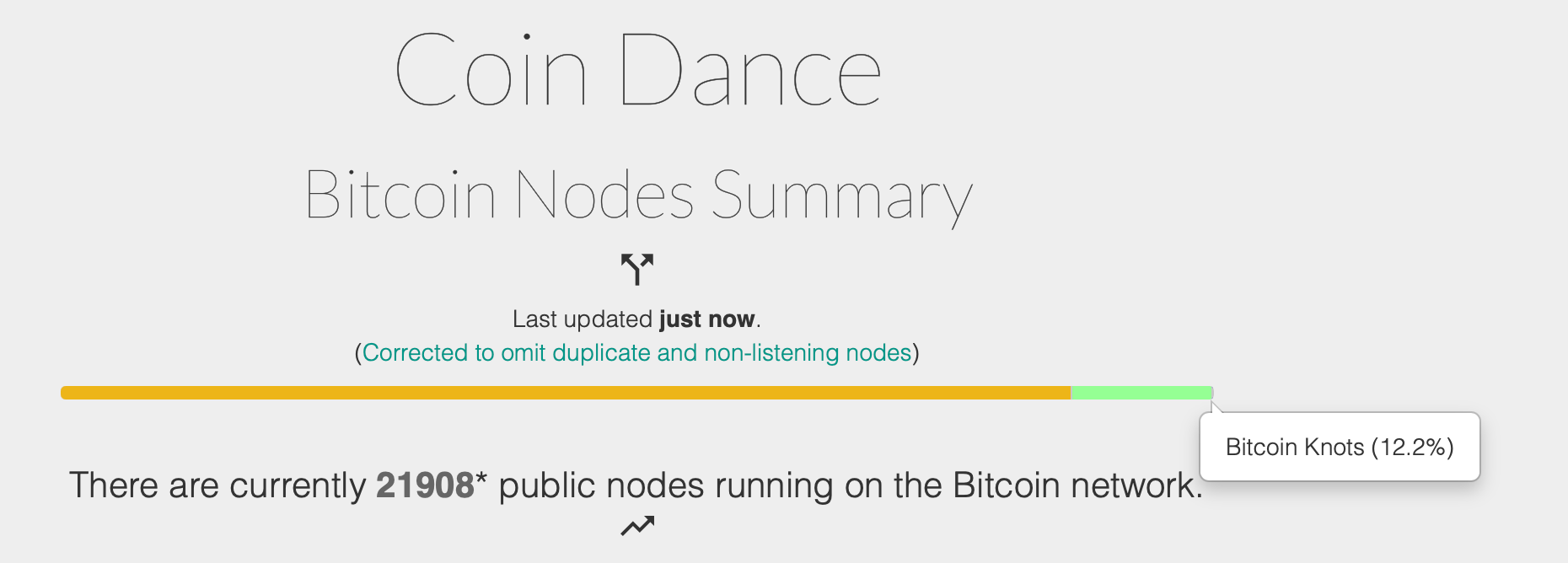
Recent data shows that Bitcoin Knots now powers more than 12% of the 21,908 public Bitcoin nodes. The growing preference for Knots stems largely from debates surrounding Bitcoin Core’s development, particularly proposed adjustments to the OP_RETURN function and its data capacity. 12% and Climbing Data from Coin Dance shows a steady rise in Bitcoin Knots […]Recent data shows that Bitcoin Knots now powers more than 12% of the 21,908 public Bitcoin nodes. The growing preference for Knots stems largely from debates surrounding Bitcoin Core’s development, particularly proposed adjustments to the OP_RETURN function and its data capacity. 12% and Climbing Data from Coin Dance shows a steady rise in Bitcoin Knots […]

Bitcoin Knots Now Powers 12% of the Network in Defiant Push Against Core

2025/06/17 06:05

Recent data shows that Bitcoin Knots now powers more than 12% of the 21,908 public Bitcoin nodes. The growing preference for Knots stems largely from debates surrounding Bitcoin Core’s development, particularly proposed adjustments to the OP_RETURN function and its data capacity.

12% and Climbing

Data from Coin Dance shows a steady rise in Bitcoin Knots adoption, with 2,673 public nodes now running the software. The shift follows Bitcoin Core’s decision to eliminate the 80-byte limit on OP_RETURN transactions. The 80-byte limit refers to the maximum amount of non-payment data—like messages or metadata—that could be included in an OP_RETURN transaction output.
Bitcoin Knots Now Powers 12% of the Network in Defiant Push Against Core

Bitcoin Knots takes a more cautious approach, keeping OP_RETURN transactions limited to 42 bytes while giving users tools to block spam or low-value transactions. Its growing adoption pointedly reflects disagreement with Bitcoin Core’s move to eliminate the 80-byte limit—a controversial change now merged in Core’s code repository on Github and expected in its October 2025 release.

By the end of 2024, approximately 410 Bitcoin Knots nodes were operational, translating to roughly 12.5 new nodes coming online each day over 181 days. With Bitcoin Core currently maintaining 19,186 nodes, Knots would need 554 days at its current growth rate to reach half that figure – far exceeding the 107 days remaining until October 2025.

While 12% may sound significant, even if Bitcoin Knots climbs to 50% node adoption, larger OP_RETURN transactions can still be relayed and confirmed—as long as enough Bitcoin Core nodes transmit them and miners include them in blocks. Relay policies vary by implementation, but consensus rules permit these transactions to be mined and deemed valid across the network.

Right now plenty see the uptick as more than technical—to node runners it’s a symbolic protest in code, a signal of pushback against Bitcoin Core’s policy shifts. Node variety doubles as a quiet form of decentralized defiance. Knots nodes can’t stop transactions from getting mined, but they can clog the propagation lanes for heavier data within their own relay circles—especially if their numbers keep climbing.

Sorumluluk Reddi: Bu sitede yeniden yayınlanan makaleler, halka açık platformlardan alınmıştır ve yalnızca bilgilendirme amaçlıdır. MEXC'nin görüşlerini yansıtmayabilir. Tüm hakları telif sahiplerine aittir. Herhangi bir içeriğin üçüncü taraf haklarını ihlal ettiğini düşünüyorsanız, kaldırılması için lütfen [email protected] ile iletişime geçin. MEXC, içeriğin doğruluğu, eksiksizliği veya güncelliği konusunda hiçbir garanti vermez ve sağlanan bilgilere dayalı olarak alınan herhangi bir eylemden sorumlu değildir. İçerik, finansal, yasal veya diğer profesyonel tavsiye niteliğinde değildir ve MEXC tarafından bir tavsiye veya onay olarak değerlendirilmemelidir.

Ayrıca Şunları da Beğenebilirsiniz

Aave CEO Breaks Silence on Game-changing Upgrade in Q4: Details

Aave CEO Breaks Silence on Game-changing Upgrade in Q4: Details

The post Aave CEO Breaks Silence on Game-changing Upgrade in Q4: Details appeared on BitcoinEthereumNews.com. Aave CEO and founder Stani Kulechov has broken his silence on a major upgrade coming to Aave in Q4, 2025. The Aave v4 upgrade is anticipated to be one of the major events in DeFi in 2025, including features such as a Hub-and-Spoke architecture, reinvestment module and others, boosting Aave liquidity and saving gas. The upgrade will also include UX improvements and a new liquidation engine. The Reinvestment Module would help Aave earn more from unused capital, utilizing idle liquidity. On Sept. 15, the Aave founder informed the crypto community of the Aave v4 upgrade roadmap, which highlights where the project is currently at in its development. Aave CEO reacts The Aave founder commented in reaction to a tweet highlighting the features of Aave V4, “very nice overview of the Aave V4 feature,” adding that the Reinvestment Module was not part of the initial design. Very nice overview of the Aave V4 features. Interestingly, the Reinvestment Module wasn’t part of our original design a couple of years ago when we laid down the protocol architecture. It actually emerged later as an unexpected, but exciting, “last-minute” addition. The… https://t.co/Zkp3bmrCAZ — Stani.eth (@StaniKulechov) September 17, 2025 “Interestingly, the Reinvestment Module wasn’t part of our original design a couple of years ago when we laid down the protocol architecture. It actually emerged later as an unexpected, but exciting, last-minute addition,” Kulechov added. The Aave CEO explained the reinvestment feature further as one that allows the protocol to deploy pool float into low-risk, highly liquid yield strategies, creating additional efficiency for LPs. The feature is somewhat inspired by Ethena’s rebalance to USDtb but applied natively within Aave. The Aave team shared the launch roadmap for the Aave upgrade on Sept. 15, revealing a recent V4 Development Update. Source: https://u.today/aave-ceo-breaks-silence-on-game-changing-upgrade-in-q4-details
Paylaş
BitcoinEthereumNews2025/09/18 16:57