A new research brief published by DNSFilter indicates a rising threat to cryptocurrency users from fake CAPTCHA pages, which use deceptive “I’m not a robot” prompts to deliver malware targeting crypto wallets. According to DNSFilter, the malicious activity was first identified by one of its managed service provider (MSP) customers. What initially appeared to be a routine CAPTCHA verification was, in fact, an attempt to deploy Lumma Stealer, a fileless malware strain capable of exfiltrating browser-stored credentials and wallet information. While DNSFilter’s content filtering successfully blocked the attack, its researchers traced the infrastructure to reveal broader patterns of coordinated phishing efforts. Fake CAPTCHA Scam Targets Greek Bank Users, Delivers Lumma Stealer via PowerShell Trick The incident began when users encountered a CAPTCHA overlay on a Greek banking site. The page mimicked a legitimate CAPTCHA but displayed a message claiming a DNS “network error,” instructing users to press Windows + R, paste a command from the clipboard, and hit Enter. Following these steps would silently execute the Lumma Stealer payload via PowerShell outside the browser while performing a DNS lookup. Source: DNSFilter DNSFilter linked the campaign to two other domains: human-verify-7u.pages.dev, a Cloudflare Pages site that returns an error after the user clicks the button, and recaptcha-manual.shop, which executes commands outside the browser after users follow the prompts. Further investigation, detailed in DNSFilter’s case study , revealed that the campaign was a sophisticated blend of phishing and malware delivery. Attackers relied on fileless execution techniques, using legitimate browser processes to deliver payloads without writing to disk. DNSFilter deployed its content filtering and domain-blocking controls across the MSP’s network, preventing infections before any credentials or wallet data were compromised. Alerts and blocking policies were updated in real time, and the MSP conducted end-user education sessions to reinforce the dangers of interacting with suspicious CAPTCHA. “The malware in this event was Lumma Stealer, delivered through a fake CAPTCHA in a deceptive malvertising chain. Had the analyst’s device been infected, the PowerShell payload could have disabled Windows AMSI and loaded Lumma DLL,” the report explains. “The stealer immediately sweeps the system for anything it can monetize—browser-stored passwords and cookies, saved 2FA tokens, cryptocurrency-wallet data, remote-access credentials, and even password-manager vaults.” Analysis showed that the fake CAPTCHA was accessed 23 times across the DNSFilter network in just three days. More troubling, 17% of users who encountered the page followed its copy‑and‑paste instructions, triggering the malware payload attempt. While DNSFilter prevented successful infections in this case, researchers noted the potential scale if left unchecked. Rapid Laundering Leaves Scam Victims Powerless to Recover Stolen Crypto Reports have revealed that cybercriminals are laundering stolen cryptocurrency at unprecedented speeds. At these rates, victims of fake CAPTCHA schemes are left with virtually no chance of recovering their funds. As per the previous report, crypto hackers can now transfer stolen digital assets through laundering networks in under three minutes. 🚨 Hackers are stealing more crypto and moving it faster. One laundering process took only 2 minutes 57 seconds. Can the industry cope? #CryptoSecurity #Web3 #Blockchain #DeFi https://t.co/lGwutYsT6Q — Cryptonews.com (@cryptonews) August 12, 2025 Elliptic’s data shows that by using automated laundering tools and decentralized exchanges (DEXs), hackers are executing the entire laundering process in a matter of minutes. Source: Elliptic “This new speed makes real-time intervention nearly impossible,” the report warned. Cybersecurity experts warn that the fake CAPTCHA scams are not just a concern for big firms but also for regular users, as they are often disguised as part of login portals or app installations and target ordinary internet users who may not suspect foul play until their wallets are drained. “Bad actors take advantage of both the highs and lows of life,” said Ken Carnesi , CEO and co-founder of DNSFilter. “Any person at any organization has the same chance of encountering a malicious link. The standard cyber hygiene tips apply: use unique passwords, verify who you are ‘talking’ to before handing over credentials, and think before you click.” The rapid laundering process worsens the impact. Victims often discover the theft too late. Law enforcement agencies find it hard to trace the stolen funds across multiple blockchains. Experts note, however, that when cybersecurity firms intervene promptly, all or some of the stolen funds can still be recovered. “Speed is critical. Funds often can be recovered in whole or part if proper actions are taken within 24 to 72 hours,” Cameron G. Shilling, a cybersecurity expert, said in a publication . As hackers continue to shorten laundering times, the risks for victims are expected to grow. “The arms race between cybercriminals and defenders is accelerating,” Elliptic concluded. “Speed is now the hackers’ greatest weapon.”A new research brief published by DNSFilter indicates a rising threat to cryptocurrency users from fake CAPTCHA pages, which use deceptive “I’m not a robot” prompts to deliver malware targeting crypto wallets. According to DNSFilter, the malicious activity was first identified by one of its managed service provider (MSP) customers. What initially appeared to be a routine CAPTCHA verification was, in fact, an attempt to deploy Lumma Stealer, a fileless malware strain capable of exfiltrating browser-stored credentials and wallet information. While DNSFilter’s content filtering successfully blocked the attack, its researchers traced the infrastructure to reveal broader patterns of coordinated phishing efforts. Fake CAPTCHA Scam Targets Greek Bank Users, Delivers Lumma Stealer via PowerShell Trick The incident began when users encountered a CAPTCHA overlay on a Greek banking site. The page mimicked a legitimate CAPTCHA but displayed a message claiming a DNS “network error,” instructing users to press Windows + R, paste a command from the clipboard, and hit Enter. Following these steps would silently execute the Lumma Stealer payload via PowerShell outside the browser while performing a DNS lookup. Source: DNSFilter DNSFilter linked the campaign to two other domains: human-verify-7u.pages.dev, a Cloudflare Pages site that returns an error after the user clicks the button, and recaptcha-manual.shop, which executes commands outside the browser after users follow the prompts. Further investigation, detailed in DNSFilter’s case study , revealed that the campaign was a sophisticated blend of phishing and malware delivery. Attackers relied on fileless execution techniques, using legitimate browser processes to deliver payloads without writing to disk. DNSFilter deployed its content filtering and domain-blocking controls across the MSP’s network, preventing infections before any credentials or wallet data were compromised. Alerts and blocking policies were updated in real time, and the MSP conducted end-user education sessions to reinforce the dangers of interacting with suspicious CAPTCHA. “The malware in this event was Lumma Stealer, delivered through a fake CAPTCHA in a deceptive malvertising chain. Had the analyst’s device been infected, the PowerShell payload could have disabled Windows AMSI and loaded Lumma DLL,” the report explains. “The stealer immediately sweeps the system for anything it can monetize—browser-stored passwords and cookies, saved 2FA tokens, cryptocurrency-wallet data, remote-access credentials, and even password-manager vaults.” Analysis showed that the fake CAPTCHA was accessed 23 times across the DNSFilter network in just three days. More troubling, 17% of users who encountered the page followed its copy‑and‑paste instructions, triggering the malware payload attempt. While DNSFilter prevented successful infections in this case, researchers noted the potential scale if left unchecked. Rapid Laundering Leaves Scam Victims Powerless to Recover Stolen Crypto Reports have revealed that cybercriminals are laundering stolen cryptocurrency at unprecedented speeds. At these rates, victims of fake CAPTCHA schemes are left with virtually no chance of recovering their funds. As per the previous report, crypto hackers can now transfer stolen digital assets through laundering networks in under three minutes. 🚨 Hackers are stealing more crypto and moving it faster. One laundering process took only 2 minutes 57 seconds. Can the industry cope? #CryptoSecurity #Web3 #Blockchain #DeFi https://t.co/lGwutYsT6Q — Cryptonews.com (@cryptonews) August 12, 2025 Elliptic’s data shows that by using automated laundering tools and decentralized exchanges (DEXs), hackers are executing the entire laundering process in a matter of minutes. Source: Elliptic “This new speed makes real-time intervention nearly impossible,” the report warned. Cybersecurity experts warn that the fake CAPTCHA scams are not just a concern for big firms but also for regular users, as they are often disguised as part of login portals or app installations and target ordinary internet users who may not suspect foul play until their wallets are drained. “Bad actors take advantage of both the highs and lows of life,” said Ken Carnesi , CEO and co-founder of DNSFilter. “Any person at any organization has the same chance of encountering a malicious link. The standard cyber hygiene tips apply: use unique passwords, verify who you are ‘talking’ to before handing over credentials, and think before you click.” The rapid laundering process worsens the impact. Victims often discover the theft too late. Law enforcement agencies find it hard to trace the stolen funds across multiple blockchains. Experts note, however, that when cybersecurity firms intervene promptly, all or some of the stolen funds can still be recovered. “Speed is critical. Funds often can be recovered in whole or part if proper actions are taken within 24 to 72 hours,” Cameron G. Shilling, a cybersecurity expert, said in a publication . As hackers continue to shorten laundering times, the risks for victims are expected to grow. “The arms race between cybercriminals and defenders is accelerating,” Elliptic concluded. “Speed is now the hackers’ greatest weapon.”

Hackers Unleash Devious Malware That Steals Crypto Wallet Data Via Fake Captcha: Report

A new research brief published by DNSFilter indicates a rising threat to cryptocurrency users from fake CAPTCHA pages, which use deceptive “I’m not a robot” prompts to deliver malware targeting crypto wallets.

According to DNSFilter, the malicious activity was first identified by one of its managed service provider (MSP) customers. What initially appeared to be a routine CAPTCHA verification was, in fact, an attempt to deploy Lumma Stealer, a fileless malware strain capable of exfiltrating browser-stored credentials and wallet information.

While DNSFilter’s content filtering successfully blocked the attack, its researchers traced the infrastructure to reveal broader patterns of coordinated phishing efforts.

Fake CAPTCHA Scam Targets Greek Bank Users, Delivers Lumma Stealer via PowerShell Trick

The incident began when users encountered a CAPTCHA overlay on a Greek banking site. The page mimicked a legitimate CAPTCHA but displayed a message claiming a DNS “network error,” instructing users to press Windows + R, paste a command from the clipboard, and hit Enter.

Following these steps would silently execute the Lumma Stealer payload via PowerShell outside the browser while performing a DNS lookup.
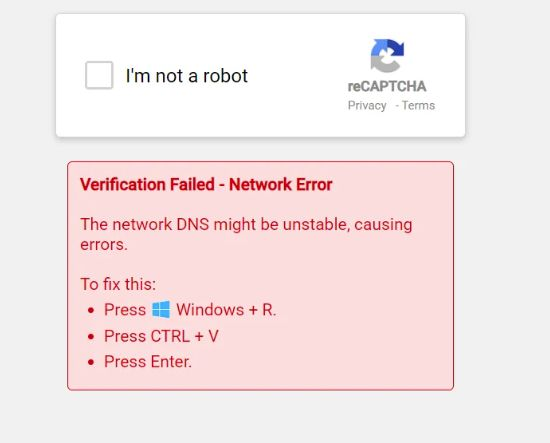
Source: DNSFilter

DNSFilter linked the campaign to two other domains: human-verify-7u.pages.dev, a Cloudflare Pages site that returns an error after the user clicks the button, and recaptcha-manual.shop, which executes commands outside the browser after users follow the prompts.

Further investigation, detailed in DNSFilter’s case study, revealed that the campaign was a sophisticated blend of phishing and malware delivery. Attackers relied on fileless execution techniques, using legitimate browser processes to deliver payloads without writing to disk.

DNSFilter deployed its content filtering and domain-blocking controls across the MSP’s network, preventing infections before any credentials or wallet data were compromised. Alerts and blocking policies were updated in real time, and the MSP conducted end-user education sessions to reinforce the dangers of interacting with suspicious CAPTCHA.

“The malware in this event was Lumma Stealer, delivered through a fake CAPTCHA in a deceptive malvertising chain. Had the analyst’s device been infected, the PowerShell payload could have disabled Windows AMSI and loaded Lumma DLL,” the report explains.

“The stealer immediately sweeps the system for anything it can monetize—browser-stored passwords and cookies, saved 2FA tokens, cryptocurrency-wallet data, remote-access credentials, and even password-manager vaults.”

Analysis showed that the fake CAPTCHA was accessed 23 times across the DNSFilter network in just three days. More troubling, 17% of users who encountered the page followed its copy‑and‑paste instructions, triggering the malware payload attempt. While DNSFilter prevented successful infections in this case, researchers noted the potential scale if left unchecked.

Rapid Laundering Leaves Scam Victims Powerless to Recover Stolen Crypto

Reports have revealed that cybercriminals are laundering stolen cryptocurrency at unprecedented speeds. At these rates, victims of fake CAPTCHA schemes are left with virtually no chance of recovering their funds.

As per the previous report, crypto hackers can now transfer stolen digital assets through laundering networks in under three minutes.

Elliptic’s data shows that by using automated laundering tools and decentralized exchanges (DEXs), hackers are executing the entire laundering process in a matter of minutes.

Source: Elliptic

“This new speed makes real-time intervention nearly impossible,” the report warned.

Cybersecurity experts warn that the fake CAPTCHA scams are not just a concern for big firms but also for regular users, as they are often disguised as part of login portals or app installations and target ordinary internet users who may not suspect foul play until their wallets are drained.

“Bad actors take advantage of both the highs and lows of life,” said Ken Carnesi, CEO and co-founder of DNSFilter. “Any person at any organization has the same chance of encountering a malicious link. The standard cyber hygiene tips apply: use unique passwords, verify who you are ‘talking’ to before handing over credentials, and think before you click.”

The rapid laundering process worsens the impact. Victims often discover the theft too late. Law enforcement agencies find it hard to trace the stolen funds across multiple blockchains. Experts note, however, that when cybersecurity firms intervene promptly, all or some of the stolen funds can still be recovered.

“Speed is critical. Funds often can be recovered in whole or part if proper actions are taken within 24 to 72 hours,” Cameron G. Shilling, a cybersecurity expert, said in a publication.

As hackers continue to shorten laundering times, the risks for victims are expected to grow. “The arms race between cybercriminals and defenders is accelerating,” Elliptic concluded. “Speed is now the hackers’ greatest weapon.”

Piyasa Fırsatı
Gravity Logosu
Gravity Fiyatı(G)
$0.004534
$0.004534$0.004534
+2.48%
USD
Gravity (G) Canlı Fiyat Grafiği
Sorumluluk Reddi: Bu sitede yeniden yayınlanan makaleler, halka açık platformlardan alınmıştır ve yalnızca bilgilendirme amaçlıdır. MEXC'nin görüşlerini yansıtmayabilir. Tüm hakları telif sahiplerine aittir. Herhangi bir içeriğin üçüncü taraf haklarını ihlal ettiğini düşünüyorsanız, kaldırılması için lütfen [email protected] ile iletişime geçin. MEXC, içeriğin doğruluğu, eksiksizliği veya güncelliği konusunda hiçbir garanti vermez ve sağlanan bilgilere dayalı olarak alınan herhangi bir eylemden sorumlu değildir. İçerik, finansal, yasal veya diğer profesyonel tavsiye niteliğinde değildir ve MEXC tarafından bir tavsiye veya onay olarak değerlendirilmemelidir.

Ayrıca Şunları da Beğenebilirsiniz

Santander’s Openbank Sparks Crypto Frenzy in Germany

Santander’s Openbank Sparks Crypto Frenzy in Germany

 In Germany, the digital bank Santander Openbank introduces trading in crypto, which offers BTC, ETH, LTC, POL, and ADA in the MiCA framework of the EU. Santander, the largest bank in Spain, has officially introduced cryptocurrency trading to its clients in Germany, using its digital division, Openbank.  With this new service, users can purchase, sell, […] The post Santander’s Openbank Sparks Crypto Frenzy in Germany appeared first on Live Bitcoin News.
Paylaş
LiveBitcoinNews2025/09/18 04:30
UK and US Seal $42 Billion Tech Pact Driving AI and Energy Future

UK and US Seal $42 Billion Tech Pact Driving AI and Energy Future

The post UK and US Seal $42 Billion Tech Pact Driving AI and Energy Future appeared on BitcoinEthereumNews.com. Key Highlights Microsoft and Google pledge billions as part of UK US tech partnership Nvidia to deploy 120,000 GPUs with British firm Nscale in Project Stargate Deal positions UK as an innovation hub rivaling global tech powers UK and US Seal $42 Billion Tech Pact Driving AI and Energy Future The UK and the US have signed a “Technological Prosperity Agreement” that paves the way for joint projects in artificial intelligence, quantum computing, and nuclear energy, according to Reuters. Donald Trump and King Charles review the guard of honour at Windsor Castle, 17 September 2025. Image: Kirsty Wigglesworth/Reuters The agreement was unveiled ahead of U.S. President Donald Trump’s second state visit to the UK, marking a historic moment in transatlantic technology cooperation. Billions Flow Into the UK Tech Sector As part of the deal, major American corporations pledged to invest $42 billion in the UK. Microsoft leads with a $30 billion investment to expand cloud and AI infrastructure, including the construction of a new supercomputer in Loughton. Nvidia will deploy 120,000 GPUs, including up to 60,000 Grace Blackwell Ultra chips—in partnership with the British company Nscale as part of Project Stargate. Google is contributing $6.8 billion to build a data center in Waltham Cross and expand DeepMind research. Other companies are joining as well. CoreWeave announced a $3.4 billion investment in data centers, while Salesforce, Scale AI, BlackRock, Oracle, and AWS confirmed additional investments ranging from hundreds of millions to several billion dollars. UK Positions Itself as a Global Innovation Hub British Prime Minister Keir Starmer said the deal could impact millions of lives across the Atlantic. He stressed that the UK aims to position itself as an investment hub with lighter regulations than the European Union. Nvidia spokesman David Hogan noted the significance of the agreement, saying it would…
Paylaş
BitcoinEthereumNews2025/09/18 02:22
DOGE ETF Hype Fades as Whales Sell and Traders Await Decline

DOGE ETF Hype Fades as Whales Sell and Traders Await Decline

The post DOGE ETF Hype Fades as Whales Sell and Traders Await Decline appeared on BitcoinEthereumNews.com. Leading meme coin Dogecoin (DOGE) has struggled to gain momentum despite excitement surrounding the anticipated launch of a US-listed Dogecoin ETF this week. On-chain data reveals a decline in whale participation and a general uptick in coin selloffs across exchanges, hinting at the possibility of a deeper price pullback in the coming days. Sponsored Sponsored DOGE Faces Decline as Whales Hold Back, Traders Sell The market is anticipating the launch of Rex-Osprey’s Dogecoin ETF (DOJE) tomorrow, which is expected to give traditional investors direct exposure to Dogecoin’s price movements.  However, DOGE’s price performance has remained muted ahead of the milestone, signaling a lack of enthusiasm from traders. According to on-chain analytics platform Nansen, whale accumulation has slowed notably over the past week. Large investors, with wallets containing DOGE coins worth more than $1 million, appear unconvinced by the ETF narrative and have reduced their holdings by over 4% in the past week.  For token TA and market updates: Want more token insights like this? Sign up for Editor Harsh Notariya’s Daily Crypto Newsletter here. Dogecoin Whale Activity. Source: Nansen When large holders reduce their accumulation, it signals a bearish shift in market sentiment. This reduced DOGE demand from significant players can lead to decreased buying pressure, potentially resulting in price stagnation or declines in the near term. Sponsored Sponsored Furthermore, DOGE’s exchange reserve has risen steadily in the past week, suggesting that more traders are transferring DOGE to exchanges with the intent to sell. As of this writing, the altcoin’s exchange balance sits at 28 billion DOGE, climbing by 12% in the past seven days. DOGE Balance on Exchanges. Source: Glassnode A rising exchange balance indicates that holders are moving their assets to trading platforms to sell rather than to hold. This influx of coins onto exchanges increases the available supply in…
Paylaş
BitcoinEthereumNews2025/09/18 05:07