When most people hear the name Tether, they immediately think of USDT, the world’s largest stablecoin. However, the company has been expanding far beyond digital dollars. Its latest move into Saudi Arabia shows that Tether wants to become a major player in one of blockchain’s fastest-growing sectors: real-world asset (RWA) tokenization.
Rather than launching a new cryptocurrency, Tether is bringing blockchain technology to traditional assets such as real estate. The initiative marks another step toward connecting conventional finance with digital assets and could help accelerate blockchain adoption in one of the Middle East’s fastest-growing economies.
So, what exactly is Tether doing in Saudi Arabia, and why does it matter for the future of crypto? Let’s break it down in simple terms.
1.Key Takeaways
i) Tether is expanding into Saudi Arabia through its Hadron tokenization platform.
ii) The initial focus is on institutional real estate tokenization.
iii) Tokenization converts ownership of real-world assets into blockchain-based digital tokens.
iV) Saudi Arabia’s Vision 2030 supports blockchain and financial innovation.
V) The move strengthens the growing real-world asset (RWA) sector and highlights blockchain’s expanding role beyond cryptocurrencies.
2.What Is Tokenization?
Before understanding Tether’s latest expansion, it’s important to know what tokenization means.
Tokenization is the process of converting ownership of a real-world asset into a digital token on a blockchain. These assets can include real estate, stocks, bonds, commodities, artwork, or even infrastructure projects.
Think of a building worth $20 million. Traditionally, buying part of that building would be difficult and require significant paperwork and legal processes. With tokenization, the building can be divided into thousands of digital tokens, allowing investors to purchase only a small portion instead of the entire property.
Blockchain records every ownership transfer, making transactions faster, more transparent, and easier to manage.
3.Tether’s Expansion Into Saudi Arabia
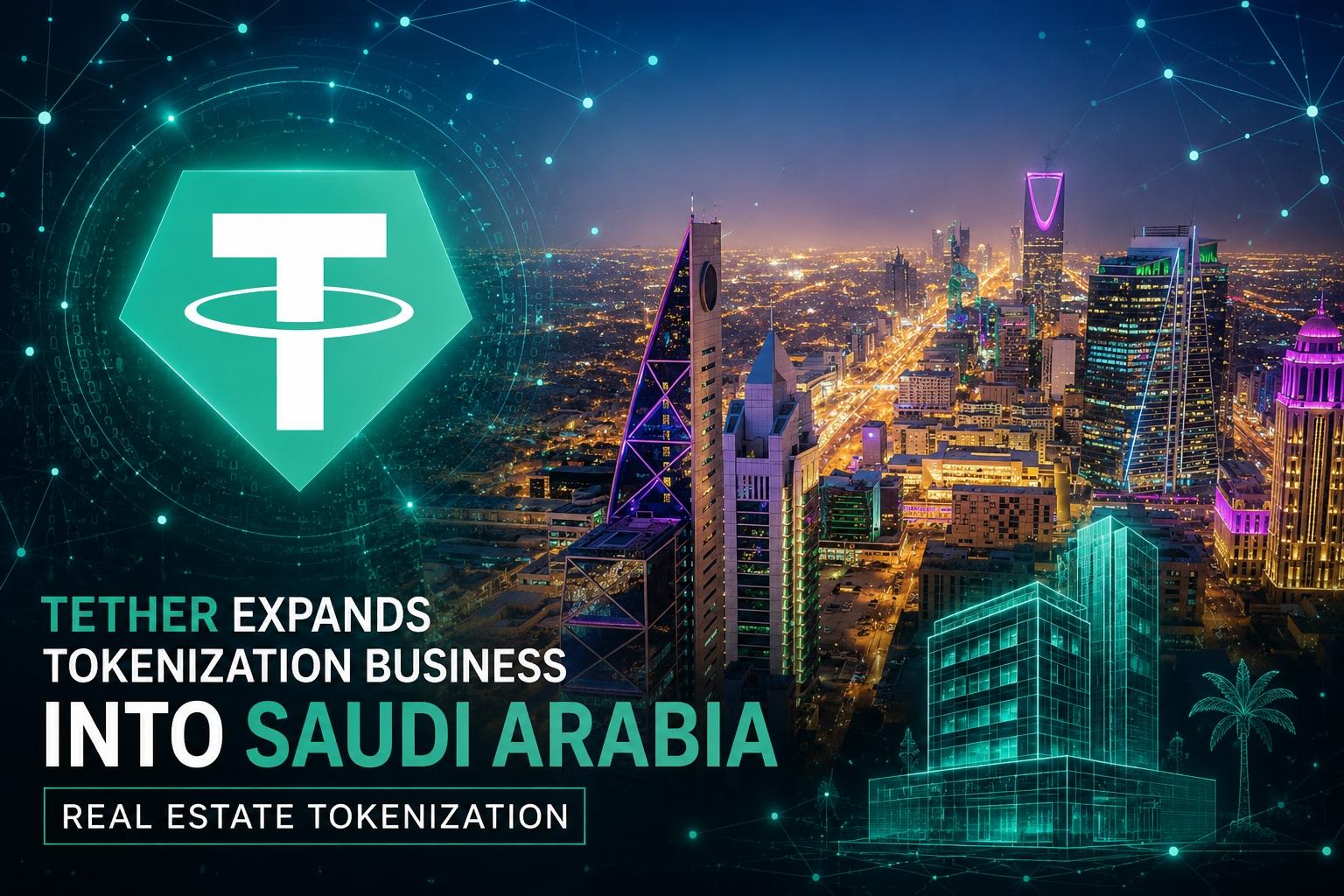
Tether is entering Saudi Arabia through its institutional tokenization platform, Hadron, which is designed to help businesses tokenize real-world assets.
The company is working with local partners to introduce blockchain-powered real estate tokenization for institutional use. Instead of focusing on everyday retail investors, the first phase targets businesses and financial institutions looking to digitize property ownership and investment.
This expansion reflects Tether’s broader strategy of becoming a technology provider for digital assets rather than being known only for issuing the USDT stablecoin.
4.Why Saudi Arabia?
Saudi Arabia has been investing heavily in technology and digital transformation through its Vision 2030 initiative. The country aims to diversify its economy by encouraging innovation in industries such as artificial intelligence, fintech, blockchain, and digital infrastructure.
Real estate is one of Saudi Arabia’s largest and fastest-growing sectors, supported by major development projects and increasing foreign investment.
By bringing tokenization to this market, Tether hopes to modernize how real estate investments are issued, managed, and traded while making financial markets more efficient.
5.How Real Estate Tokenization Works
Imagine an office tower valued at $50 million.Instead of selling the entire building to one buyer, the owner can tokenize it into 50 million digital tokens, with each token representing a tiny ownership share.
An investor could purchase a small number of these tokens and gain exposure to the property’s value without buying the entire building.
If the property’s value increases or it generates rental income, token holders may benefit according to the structure of the investment.
Because ownership exists on a blockchain, transfers can happen much faster than traditional real estate transactions, which often require lengthy paperwork and multiple intermediaries.
6.Why This Matters for Crypto
This announcement is important because it highlights that blockchain technology has uses far beyond cryptocurrencies.
For years, crypto has largely been associated with trading coins like Bitcoin and Ethereum. Today, many companies are focusing on using blockchain to improve traditional financial markets.
Real-world asset tokenization has become one of the fastest-growing areas in the blockchain industry because it allows physical assets to exist digitally while maintaining transparent ownership records.
Tether’s move shows that established crypto companies are increasingly building infrastructure that financial institutions can use in everyday business.
7.Benefits of Tokenization
If adopted on a large scale, tokenization could offer several advantages:
i) Faster settlement compared to traditional property transactions.
ii) Easier access to investment opportunities through fractional ownership.
iii) Improved transparency because blockchain records ownership changes.
iV) Greater liquidity for assets that are usually difficult to buy or sell quickly.
V) Reduced reliance on paperwork and multiple intermediaries.
These benefits could make real estate investing more efficient for institutions and, over time, potentially more accessible to a broader range of investors.
8.Challenges Still Remain
Although tokenization has enormous potential, it is still an emerging industry.
Different countries have different regulations governing digital assets and property ownership. Legal frameworks, investor protection, compliance requirements, and custody solutions will continue to play a major role in determining how quickly tokenized assets become mainstream.
In addition, institutional adoption often takes time because financial organizations must ensure that new technology meets strict security and regulatory standards.
For these reasons, tokenization is expected to grow gradually rather than replacing traditional financial systems overnight.
9.Conclusion
Tether’s move into Saudi Arabia is about much more than expanding its business. It represents another milestone in bringing blockchain technology into traditional finance.
Instead of focusing solely on cryptocurrencies, the company is helping create digital infrastructure for real-world assets, beginning with institutional real estate. While tokenization is still in its early stages, initiatives like this demonstrate how blockchain can solve practical problems beyond digital payments and speculative trading.
If adoption continues to grow and regulatory frameworks mature, tokenized assets could become a common part of global financial markets. Tether’s latest expansion suggests that the future of blockchain may be just as much about modernizing traditional industries as it is about powering cryptocurrencies.
Disclaimer:This content is for educational and reference purposes only and does not constitute any investment advice. Digital asset investments carry high risk. Please evaluate carefully and assume full responsibility for your own decisions.