Beli Kripto
Pasar
Spot
Futures OILBTC
Tabungan
Pusat Acara
Hub Hadiah
Lainnya
P2P Risk Awareness: Triangle Scams and How to Reduce Your RiskP2P Risk Awareness: Triangle Scams and How to Reduce Your Risk
Daftar Kategori
Batalkan

P2P Risk Awareness: Triangle Scams and How to Reduce Your Risk

1. What is Triangle Scam?


A triangle scam occurs when a scammer tricks a buyer into sending payment to a different merchant's order on the platform. The payment is intentionally redirected so that the scammer can receive crypto from another completed order without paying the original seller.

2. Common Triangle Scams Scenarios
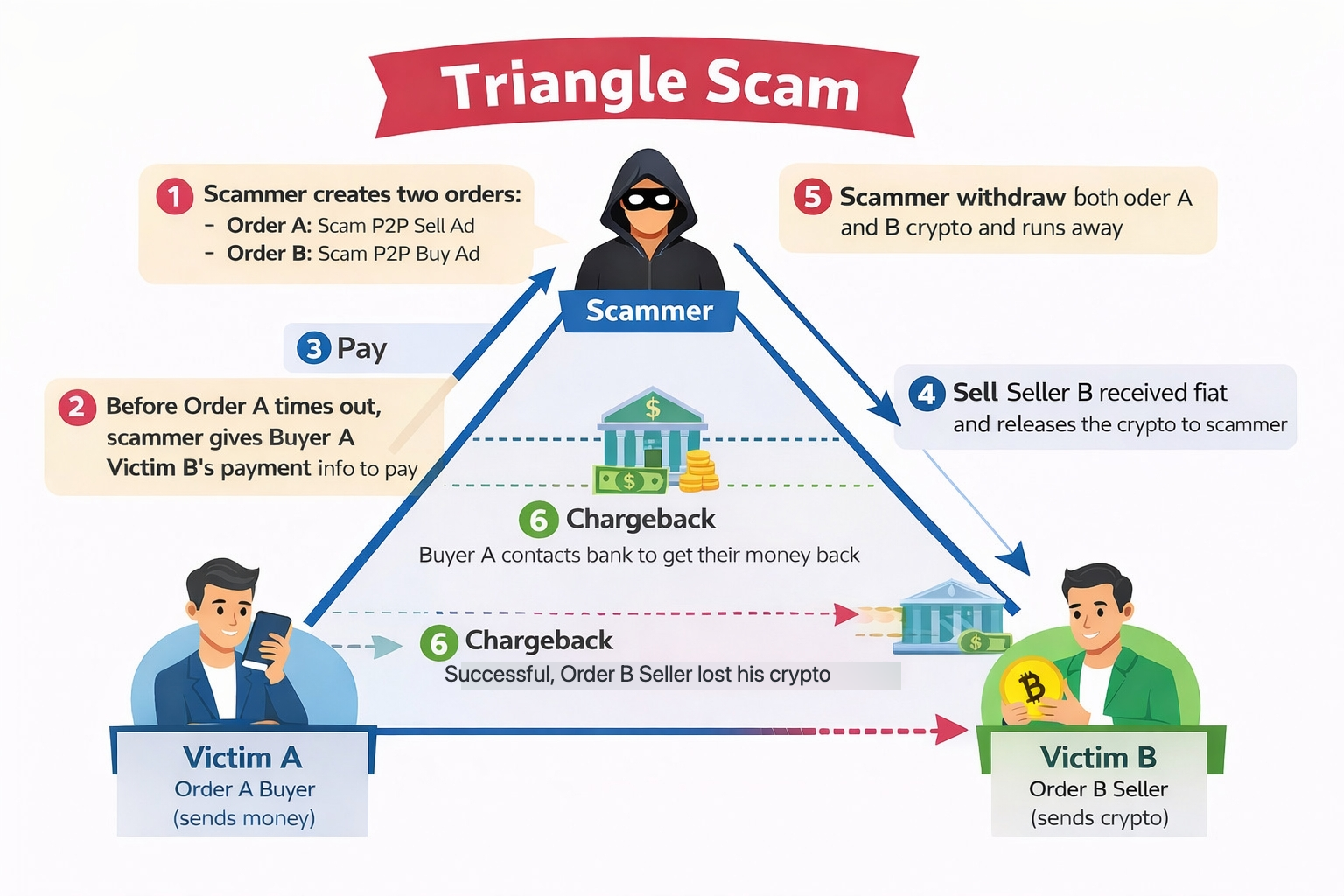


Timed-Out / Cancelled Scam
A buyer follows the payment instructions provided by the counterparty and sends funds. Later, the buyer is asked to cancel the original order or the order expires due to delayed instructions. By the time the issue is noticed, the scammer has already withdrawn the crypto from the completed order.
Coordinated Double-Order Scam
Two scammers target the same seller by placing identical orders for the same amount of crypto, usually simultaneously. The goal is to create confusion and make the seller believe both buyers are legitimate. However, only one payment is made between the two scammers. They work together, each pressuring the seller to release crypto without verifying the payment, hoping the seller will act too quickly.

Example:
A seller receives orders from two buyers who seem urgent and trustworthy. The scammers work together, each trying to pressure the seller to release crypto. The seller might receive a payment for one order and release the crypto for that transaction, without confirming the details of the sender. Afterward, the second buyer presents a legitimate receipt, forcing the seller to release the crypto for the second order, leaving the seller without crypto or payment for the second transaction.

3. How to Prevent


✔ Always ensure the payer/payee name matches the counterparty's verified name on the P2P order
✔ Only use the payment details shown in your own P2P order
✔ Make sure you have enough time to complete payment before the order expires
✔ MEXC Customer Service will never ask you to cancel a paid order
✔ If you're dealing with two buyers who seem overly eager or insistent, this should raise a red flag. Always request payment receipts from both buyers and ensure the sender's name matches their MEXC account.
✔ Verify each order separately, and if anything feels suspicious, trust your instincts. Never skip any verification steps, even if the buyers seem urgent.
✔ If anything looks suspicious, stop the transaction and submit an appeal immediately.

P2P Risk Awareness: Triangle Scams and How to Reduce Your Risk

1. What is Triangle Scam?


A triangle scam occurs when a scammer tricks a buyer into sending payment to a different merchant's order on the platform. The payment is intentionally redirected so that the scammer can receive crypto from another completed order without paying the original seller.

2. Common Triangle Scams Scenarios


Timed-Out / Cancelled Scam
A buyer follows the payment instructions provided by the counterparty and sends funds. Later, the buyer is asked to cancel the original order or the order expires due to delayed instructions. By the time the issue is noticed, the scammer has already withdrawn the crypto from the completed order.
Coordinated Double-Order Scam
Two scammers target the same seller by placing identical orders for the same amount of crypto, usually simultaneously. The goal is to create confusion and make the seller believe both buyers are legitimate. However, only one payment is made between the two scammers. They work together, each pressuring the seller to release crypto without verifying the payment, hoping the seller will act too quickly.

Example:
A seller receives orders from two buyers who seem urgent and trustworthy. The scammers work together, each trying to pressure the seller to release crypto. The seller might receive a payment for one order and release the crypto for that transaction, without confirming the details of the sender. Afterward, the second buyer presents a legitimate receipt, forcing the seller to release the crypto for the second order, leaving the seller without crypto or payment for the second transaction.

3. How to Prevent


✔ Always ensure the payer/payee name matches the counterparty's verified name on the P2P order
✔ Only use the payment details shown in your own P2P order
✔ Make sure you have enough time to complete payment before the order expires
✔ MEXC Customer Service will never ask you to cancel a paid order
✔ If you're dealing with two buyers who seem overly eager or insistent, this should raise a red flag. Always request payment receipts from both buyers and ensure the sender's name matches their MEXC account.
✔ Verify each order separately, and if anything feels suspicious, trust your instincts. Never skip any verification steps, even if the buyers seem urgent.
✔ If anything looks suspicious, stop the transaction and submit an appeal immediately.